By Skip Foster, Red Tape Florida
Homeowners across Florida are being punished for doing something the Florida Legislature actually wants them to do: hire licensed private-sector inspection and plans review professionals to keep construction moving.
A survey of local government policy and code documents, conducted by Red Tape Florida, shows a disturbing pattern of gaming state statutes and punishing businesses who use private providers.
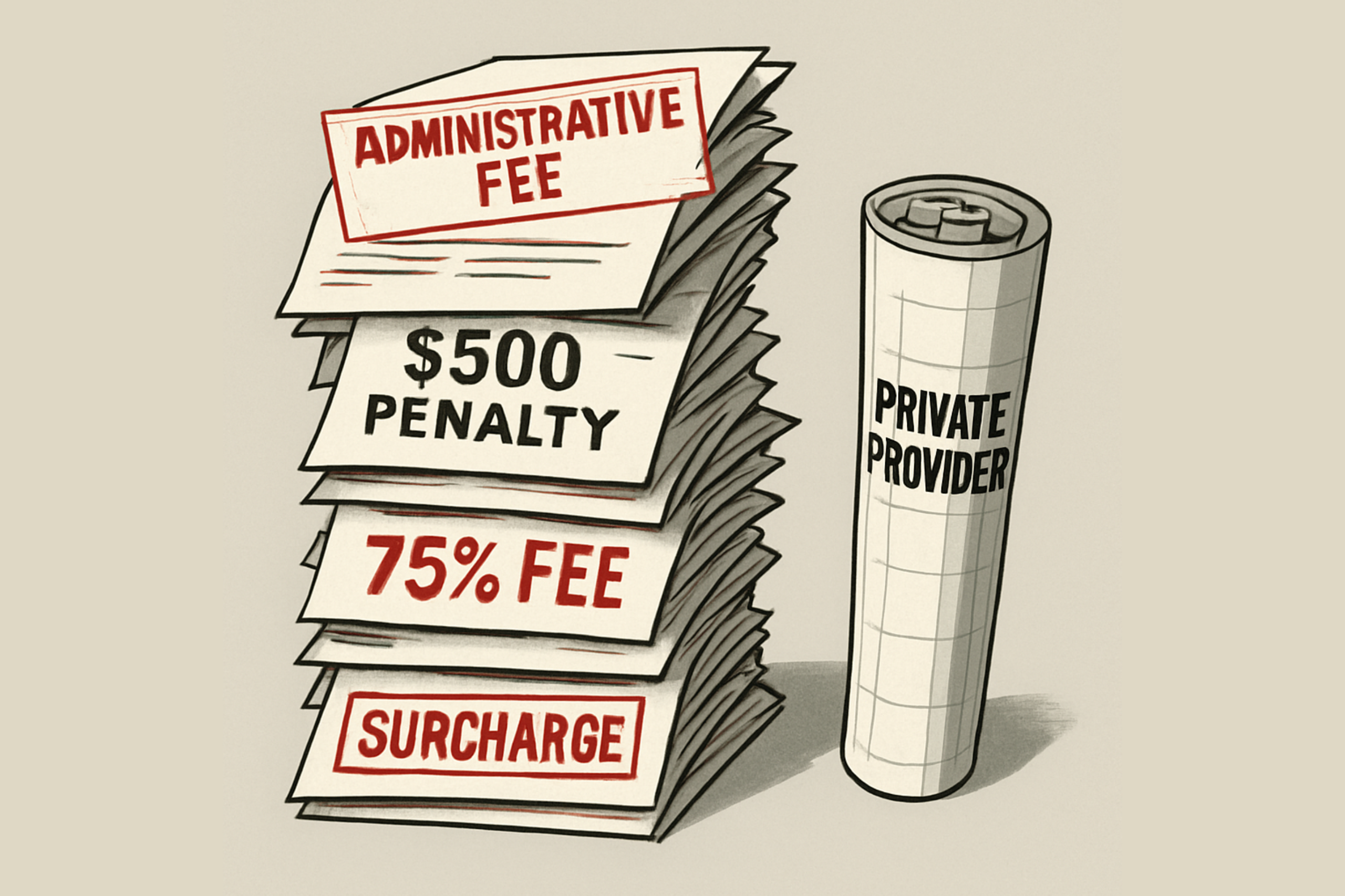
Instead of rewarding efficiency, far too many local governments are boldly slapping massive administrative penalties on homeowners who use private provider inspectors for plan reviews or inspections — penalties that have nothing to do with safety, nothing to do with oversight, and everything to do with protecting government revenue.
This is about bureaucracy fighting to keep its monopoly.
Florida Statute 553.791 gives homeowners the right to hire a private provider — a licensed engineer, architect, or building code professional with the same (or often higher) credentials as government inspectors, but with an actual motivation to move quickly and correctly.
Private providers exist for one reason: too many local building departments can’t keep up.
But instead of improving their performance and embracing private sector partners, some counties and cities have found a simpler strategy: punish the private sector for taking business away from them.
And the numbers prove it.
The local government list of shame
Here’s what Florida homeowners are facing when they choose a licensed private provider instead of using the local building department:
• Coral Gables: Keeps 70 to 85 percent of the permit fee even when the city performs zero plan review and zero inspections. The city refunds only 30 percent when both services are done by a private provider, and just 15 percent when inspections alone are outsourced.
• Plant City: Adds a flat $225 Private Provider Fee plus surcharges, even when the city does none of the work.
• Pinellas County: Charges a $200 base administrative fee plus 25 percent of the plan value on every private-provider permit — residential, commercial, and even inspections-only.
• Pasco County: Imposes a $600 Private Provider Administrative Fee on residential projects, clearly shown on county receipts.
• Hillsborough County: Uses a percentage-based penalty structure: 75 percent of the permit fee when plan review is done privately, 50 percent when only inspections are private, and 25 percent even when both are handled by the private provider. These charges apply even when the county performs none of the work.
• Gulf County: Adds a $500 private provider fee directly to the planning department, handwritten on the county’s plan review sheet.
FAC’s disingenuous claims
The Florida Association of Counties is now trying to spin this crisis into a story about “safety” and “fiscal impacts,” but its claims collapse under even the slightest scrutiny. In its policy document, FAC argues that private providers are “not in the best interest of public health and safety” and warns of “devastating financial impacts on Gulf County and its residents.”
None of that aligns with what is actually happening on the ground.
The financial burden in Gulf County isn’t coming from private providers — it’s coming from the county itself. Gulf County slapped a $500 private-provider fee onto the planning department base fees, directly raising construction costs for homeowners who are simply trying to move their projects forward. The same pattern exists statewide: when counties stack $500 fees, $600 surcharges, or 75-percent penalties onto private-provider work, the “devastating financial impacts” land squarely on homeowners because local governments chose to weaponize their fee schedules.
FAC’s “safety” argument collapses just as quickly. Private providers must hold the exact same state licenses as government building officials — architects, engineers, and certified code professionals — and they carry additional liability insurance. None of the opponents to private provider use have provided evidence of structures failing because of private-provider inspections. What there is, across county after county, is a pattern of chronic delays, backlogs, and bottlenecks in government inspection offices. Calling the private sector unsafe while ignoring those government failures is not consumer protection. It’s bureaucratic self-preservation.
Private sector always outperforms bureaucrats
The truth is simple: when private providers are used, projects move. When local governments fight them or bury homeowners in punitive “administrative” fees, projects stall and costs soar. FAC’s narrative tries to cast the private sector as the problem. In reality, the greatest risk — financial and otherwise — comes from counties more focused on protecting revenue than on helping citizens build safe, code-compliant homes on a reasonable timeline.
The FAC’s own justification gives the game away. Its adopted policy document admits that private providers were originally created because local governments “could not meet the demand” for plan reviews and inspections, especially during growth cycles or after hurricanes.
Unless the Legislature steps in, this war on the private sector will continue — quietly, expensively, and with real consequences for housing costs, construction timelines, and the basic fairness of Florida’s permitting system.
Time for Florida Legislature to step in
Florida doesn’t need new restrictions on private providers. It doesn’t need bureaucratic rhetoric disguised as safety. It doesn’t need to rubber-stamp FAC talking points. Florida needs lawmakers who are willing to say what counties won’t: that private-sector professionals should not be punished for doing work government offices can’t handle on time.
The good news – several legislators are doing just that. Rep. Jason Shoaf, whose district includes Gulf County, has called on local officials to explain their actions or he would determine in “further action is warranted.” Representative “Griff” Griffitts is sponsoring House Bill 405 that, among other reforms, requires building departments to discount a permit fee at least 50% when a private provider stands in the shoes of the government inspector. And at least two senators are questioning how a building department can charge a fee when an outside party performs the plans review and inspection.
The Legislature has already strengthened the private-provider system through recent reforms. Now it should finish the job.
- Reject the FAC narrative.
- Prohibit punitive fee structures including the “work around” administrative fee.
- Protect homeowners’ right to hire licensed private-sector professionals without being financially penalized for it.
Local governments have their chance to keep up. Many don’t. Florida homeowners shouldn’t be punished for choosing efficiency — and the private sector shouldn’t be the target.
The next move belongs to the Legislature. Florida’s citizens expect them to protect their choice, competition, and fairness in the permitting process.