
By Skip Foster, Red Tape Florida
A recent Wall Street Journal analysis offers a stark, real-world lesson in housing policy — one that Tallahassee and Leon County should be studying closely.
The Journal, reporting by Rebecca Picciotto, compared two cities separated by a river but united by the same regional economy: St. Paul and Minneapolis. Same labor market. Same population pressures. Radically different housing outcomes.
The difference wasn’t developers, Wall Street, or demographic change. It was policy.
In 2022, St. Paul enacted one of the nation’s strictest rent-control ordinances, capping annual increases at 3 percent — even on vacant units, with no inflation adjustment. Minneapolis chose a different path. It avoided rent control and focused almost entirely on allowing more housing to be built, rewriting zoning and land-use rules to permit more apartments and density.
The results were immediate and dramatic.
According to HUD data cited by the Journal, apartment-building permits in St. Paul fell 79 percent in early 2022 compared with the prior year. Investment activity froze. Developers halted projects. Lenders pulled back. Property values declined by at least 6 percent. St. Paul has since been forced to roll back parts of the ordinance, exempting newer construction and reconsidering the policy altogether.
Minneapolis experienced the opposite. Apartment permits surged nearly fourfold. Downtown neighborhoods rebounded faster. New supply came online. And despite ongoing affordability challenges, rent growth in Minneapolis lagged both St. Paul and the national average during the same period.
This wasn’t a theory. It was a side-by-side governance experiment — and it validated a warning economists have been making for decades – rent controls and growth-stifling measures hurt far more than they help.
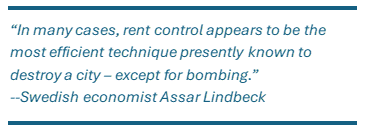
As Swedish economist Assar Lindbeck put it more than 50 years ago, “In many cases rent control appears to be the most efficient technique presently known to destroy a city — except for bombing.”
Why this matters in Tallahassee and Leon County
This matters because recent decisions in Tallahassee and Leon County point unmistakably toward the St. Paul model.
Just weeks ago, the Leon County Commission adopted changes to the comprehensive plan that further restricts where and how housing can be built. The vote was framed as smart growth and community protection. In practice, it adds friction, delay, and uncertainty — the very conditions that cause builders and lenders to pause or walk away.
Those early warning signs are already showing up locally. In a recent Tallahassee Real Estate Weekly market update, longtime Tallahassee broker and analyst Joe Manausa noted this key finding: “Homes in the lowest 25 percent climbed from roughly $147,000 in 2020 to about $210,000 in 2025. That is close to a 43 percent increase, and it represents the sharpest appreciation of any segment.”
Manausa added: “When the most affordable homes rise the fastest, tens of thousands of potential future buyers find themselves pushed farther from ownership”
At the city level, Tallahassee continues to talk about affordability while piling on layers of process, fees, discretionary review, and political veto points that make housing slower and more expensive to deliver. The language sounds pro-housing. The outcomes are not.
Good intentions don’t override incentives
One of the most revealing findings in the Journal’s reporting is how rent control altered landlord behavior. Because rent increases were capped annually and vacancy increases were banned, landlords began raising rents every year — even when they previously wouldn’t have — simply to avoid falling behind. Small owners sold. Maintenance was deferred. Investment left.
This is the part often missing from local housing debates: capital is mobile.
When government sends a signal that investment is risky, unpredictable, or politically constrained, capital doesn’t argue. It doesn’t negotiate. It goes elsewhere — often across the river.
Minneapolis understood that reality. St. Paul learned it the hard way.
Tallahassee and Leon County are now choosing which example to follow.
The choice ahead
The Wall Street Journal didn’t write about Tallahassee. But it could have.
The lesson from the Twin Cities isn’t that housing is easy, or markets are perfect. It’s that local governments can make housing crises worse — very quickly — by mistaking control for competence.
There is still time to choose a different path. One focused on supply, speed, and certainty rather than restriction and symbolism. One that acts like Minneapolis instead of St. Paul.
Because once projects stall and capital leaves, reversing course is far harder.
And by then, the damage is already done.