By Skip Foster, Red Tape Florida
If you only read the agenda item, this looks easy.
The Tallahassee Community Redevelopment Agency’s Greater Frenchtown/Southside Citizen’s Advisory Committee is being asked at its Jan. 12 meeting to approve a $750,000 grant for a modest redevelopment project at 115 West Harrison Street.
The proposal from a developer called WeWould REIT, LLC, sounds familiar, almost comforting: a newly constructed 6,143-square-foot building, two tenants, retail and food service, site work, jobs, improved aesthetics.
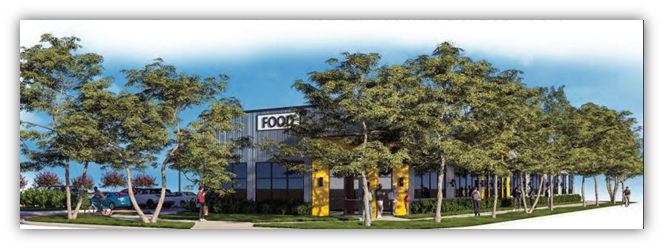
There’s even a friendly rendering. Trees. Pedestrians. A clean, modern building. A big sign on the front that reads, simply, “FOOD.”
Nothing to see here.
Except there is.
And you won’t find it in the agenda summary, the staff analysis, the fiscal impact, or the recommended action. To find it, you have to do what the agenda quietly hopes you won’t: keep reading.
What the agenda item tells you
The CRA agenda item is careful and polished. It explains the New Construction Assistance Program, notes that the $750,000 request falls just under the program’s 25 percent cap, and emphasizes consistency with redevelopment goals. It highlights minority business participation, job creation, and long-term economic benefits.
What it never does — not once — is tell commissioners or the public what the building is actually intended to be used for.
There is no mention of any controversial or sensitive use. No hint of anything beyond ordinary neighborhood retail. If you stopped here, you’d have no reason to ask questions.
The rendering helps reinforce that impression.
About that “FOOD” sign
Renderings aren’t neutral. They’re persuasion tools, designed to help decision-makers visualize what they’re being asked to approve.
This one leans hard into normalcy. The most prominent visual cue on the building isn’t a logo or a tenant name, but a generic, reassuring word: food.
That choice matters. If the project were truly just a speculative shell with no foreseeable end use, the rendering wouldn’t need to guide the viewer’s imagination so carefully. And if the CRA were comfortable openly subsidizing the actual intended use, there’d be no reason to dress it up as something else.
Still, none of this proves anything. Not yet.
For that, you have to turn a few more pages. Dozens of them, actually.
Turn to page 52
On page 52 of the application attachments — deep inside the technical appraisal materials — the first crack appears.
In a discussion of buyer intent and marketing history, the appraisal states that the buyers “intend to redevelop the property into a medical marijuana facility.”
That’s it. One sentence. One time. No emphasis. No explanation. Just a factual statement of purpose.
If you didn’t know to look for it, you’d miss it.
Turn to page 114
Keep going.
On page 114, the appraisal documents do it again. This time, even more plainly. The borrower plans to convert the property into a cannabis dispensary.
Again, one mention. One sentence. Buried in valuation paperwork few people read closely and no one summarizes for the board.
So, let’s pause here to say thank you — sincerely — to the appraiser. Appraisers don’t editorialize. They document reality. And in this case, reality made it into the record even when the City chose not to surface it.
What’s missing — and why that matters
The problem here isn’t legality. Medical marijuana is legal in Florida. Zoning questions are separate and ongoing.
The problem is disclosure.
The CRA agenda item does not merely fail to highlight the marijuana use — it actively constructs an alternative story. Retail. Food. Jobs. A pleasant building. A clean rendering. Meanwhile, the only honest descriptions of the project’s purpose live on page 52 and page 114 of a dense technical appendix.
That’s not transparency. That’s a head fake.
Especially when the developer isn’t shy elsewhere.
What the developer says when City Hall isn’t involved
Outside the CRA paperwork, WeWould is perfectly clear about what kind of company it is. Its website openly markets cannabis real estate, including cultivation centers and dispensary facilities.
The Tallahassee Frenchtown site is already listed in the company’s online portfolio — before the CRA has even voted — as an available asset.
So, the developer is transparent with investors and the market. The appraiser is transparent in the valuation documents. Only the City’s agenda item pretends this is something else.
Then there’s the money question
CRA staff will likely argue that this is just about the building, not the tenant. But that argument rings hollow when you look at who’s asking.
WeWould REIT describes itself as a private-equity cannabis real estate platform with a stated ambition of assembling a $250 million portfolio and exiting to the capital markets. It touts quarterly dividends and investor returns.
According to the NCAP application, the company has already invested roughly $1.6 million in the project and has secured a $1.1 million construction loan.
And yet, it’s asking the CRA to contribute $750,000 — nearly the maximum allowed — from taxpayer-backed redevelopment funds.
That raises a fair question the agenda item never asks: why is a well-capitalized, nationally oriented cannabis real estate firm seeking public subsidy to build a dispensary in one of Tallahassee’s most historically disadvantaged neighborhoods?
The reveal the CRA avoided
If the CRA believes subsidizing a marijuana dispensary is a wise redevelopment strategy for the Southside/Frenchtown district, it should say so plainly and defend that choice openly.
Instead, the truth was left to page 52 and page 114, hidden behind a “FOOD” sign and a carefully sanitized agenda summary.
That may get an item through a meeting.
It shouldn’t get a free pass from the public.