By Skip Foster, Red Tape Florida
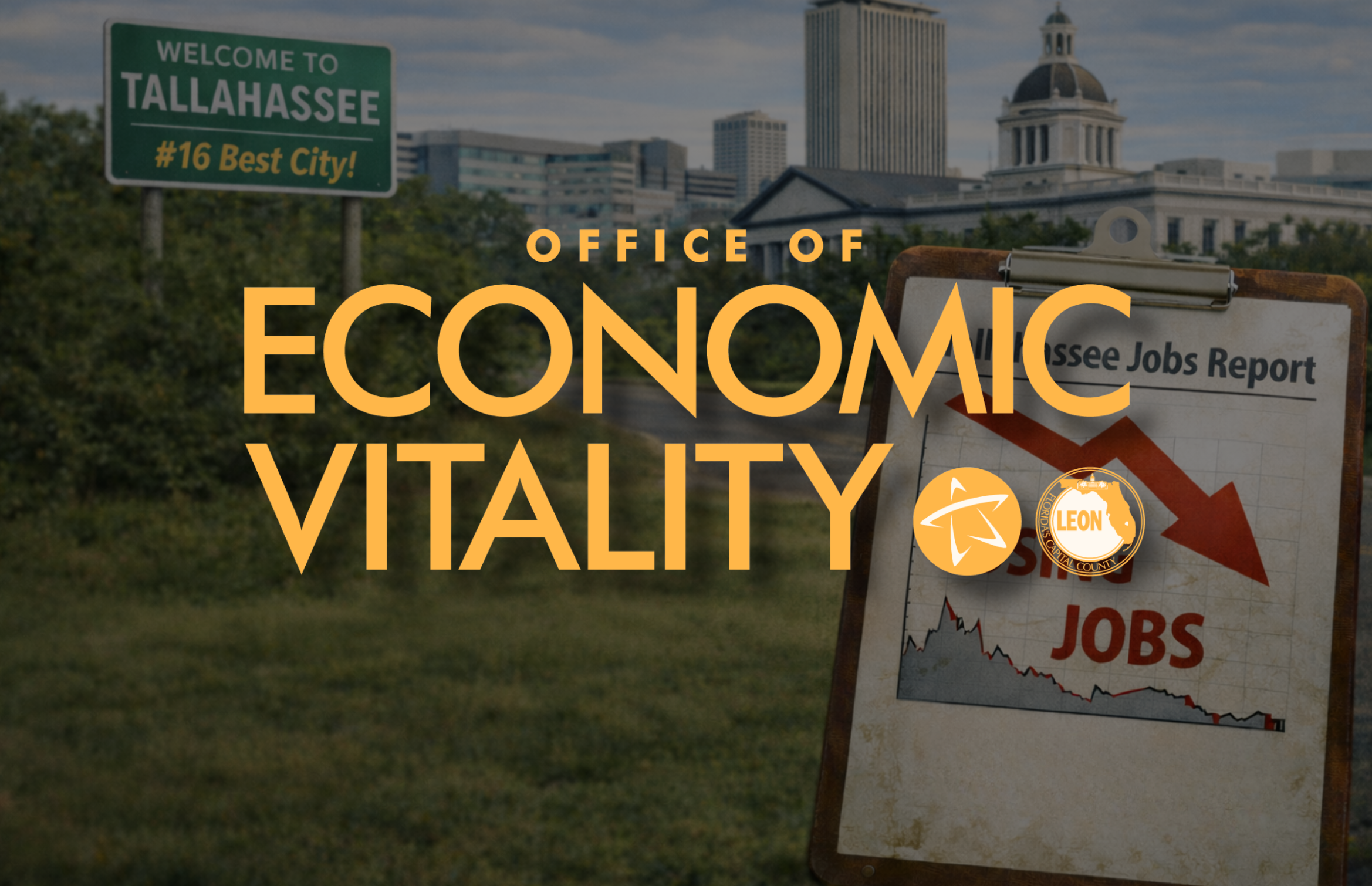
When governments are proud of their economic performance, they show residents jobs.
When they’re not, they show rankings.
That’s the only way to understand the City of Tallahassee Office of Economic Vitality’s Feb. 4 communiqué declaring that Tallahassee-Leon County’s economy is “building momentum” and that “the numbers show it.”
The OEV narrative that follows is not a serious economic analysis. It is a carefully assembled propaganda piece designed to distract from a stubborn and embarrassing reality: by OEV’s own data, Tallahassee is not growing — it is stagnating, and in some cases going backward.
Start with the rankings — because that’s where the deception begins.
OEV leads with a glowing national ranking from Area Development magazine, breathlessly announcing that Tallahassee-Leon County placed 16th overall among nearly 1,000metropolitan and micropolitan areas. That sounds impressive until you understand what this ranking actually rewards.
Area Development’s index is a blended soup of more than two dozen indicators, many of which favor government-heavy economies, long-term averages, and institutional stability. Tallahassee’s enormous state-government footprint, universities, and healthcare systems prop up these scores even when private-sector job creation is anemic.
In plain English: Tallahassee ranks well because it is stable — not because it is growing.
That distinction is not an accident. It is the entire point of using rankings instead of outcomes.
Next comes the “workforce strength” sleight of hand.
OEV touts a top-20 national ranking for “Prime Workforce” performance, citing wage growth, labor-force trends, and STEM employment shares. What the release never explains is where these jobs are actually coming from.
Much of Tallahassee’s wage growth mirrors national inflation and public-sector pay adjustments, not a competitive private market. Meanwhile, counting the share of STEM workers is meaningless when the region continues to struggle to attract the private employers who would hire them. A “strong workforce” that must leave town to thrive is not a strength — it’s a failure.
Then comes perhaps the most unintentionally revealing boast of all.
OEV proudly notes that roughly one-third of workers employed in Tallahassee-Leon County commute in from surrounding counties, framing this as evidence that Tallahassee is a powerful regional employment hub. In reality, this is not a flex. It’s a flashing warning light.
While growing a regional economy is a laudable goal, high inbound commuting often signals that the core city is failing to generate enough well-paid resident workers to support household formation and long-term wealth creation. Tallahassee captures labor during the day and exports wages, homeownership, and tax base at night.
The American Planning Association’s PAS Report on jobs–housing balance explains that when communities have a persistent mismatch between where jobs are and where workers can afford to live, the result is longer commutes and higher household transportation costs — and those costs can erase or outweigh wage gains, while also increasing regional congestion and infrastructure burdens
A thriving economy retains its workers. It doesn’t rent them.
But the most glaring omission in OEV’s entire release is the one statistic it absolutely refuses to confront: its own jobs data, as revealed in a recent Red Tape Florida story.
According to OEV’s own employment chart, Leon County had roughly 159,000 jobs in late 2022. By late 2025, that number had fallen to about 158,000. That is not momentum. That is net job loss — quietly buried beneath glossy language and national rankings.
To paper over this failure, OEV resorts to one of the oldest tricks in the economic-development spin book: anchoring job growth to April 2020, when pandemic shutdowns collapsed employment. Starting from the bottom of a once-in-a-century economic shutdown allows almost any community to claim dramatic “growth.”
Recovery is not success. Rebounding is not momentum. And Tallahassee’s post-pandemic performance remains weak even by that generous standard.
The Florida Chamber of Commerce, using the same federal data OEV selectively cites, reported that Leon County lost more than 4,000 jobs year-over-year — a fact OEV dismisses because it is inconvenient, not because it is wrong.
And here’s the most telling detail of all: in 2025, OEV did not announce a single new economic-development project that added jobs. Not one. No relocations. No expansions. No headline wins. Just rankings, rankings, rankings.
The release closes with optimism about real-estate “prospects,” citing a national perception survey showing improved sentiment among investors. Sentiment, however, does not build office space. Surveys do not sign paychecks. And optimism does not create private-sector jobs.
Perhaps Tallahassee-Leon’s job numbers would be better if OEV spent less time on self-congratulatory rankings report and more time on actually recruiting new business to our community.
Tallahassee residents do not live inside rankings.
They live inside paychecks. Inside housing costs. Inside career ceilings. Inside a local economy that has spent years confusing institutional stability with economic success.
Until the city is willing to show honest, current job numbers — without pandemic baselines, without composite rankings, and without propaganda — talk of “momentum” is not analysis.
It’s marketing. And it’s insulting.