By Skip Foster, Red Tape Florida
Temple Terrace recently provided a textbook example of how fragile local permitting systems become when basic backup plans exist only on paper — or worse, only in emails.
A homeowner needed a straightforward, safety-driven modification: converting a bathtub to a walk-in shower. The permit was submitted through a private provider, a process explicitly allowed under Florida law and intended to keep projects moving efficiently.
Even before the vacation delay, the private provider says the application faced resistance — including being told to deliver materials in person rather than electronically and to use city-specific forms not required by state law.
The application was submitted on May 25, 2025.
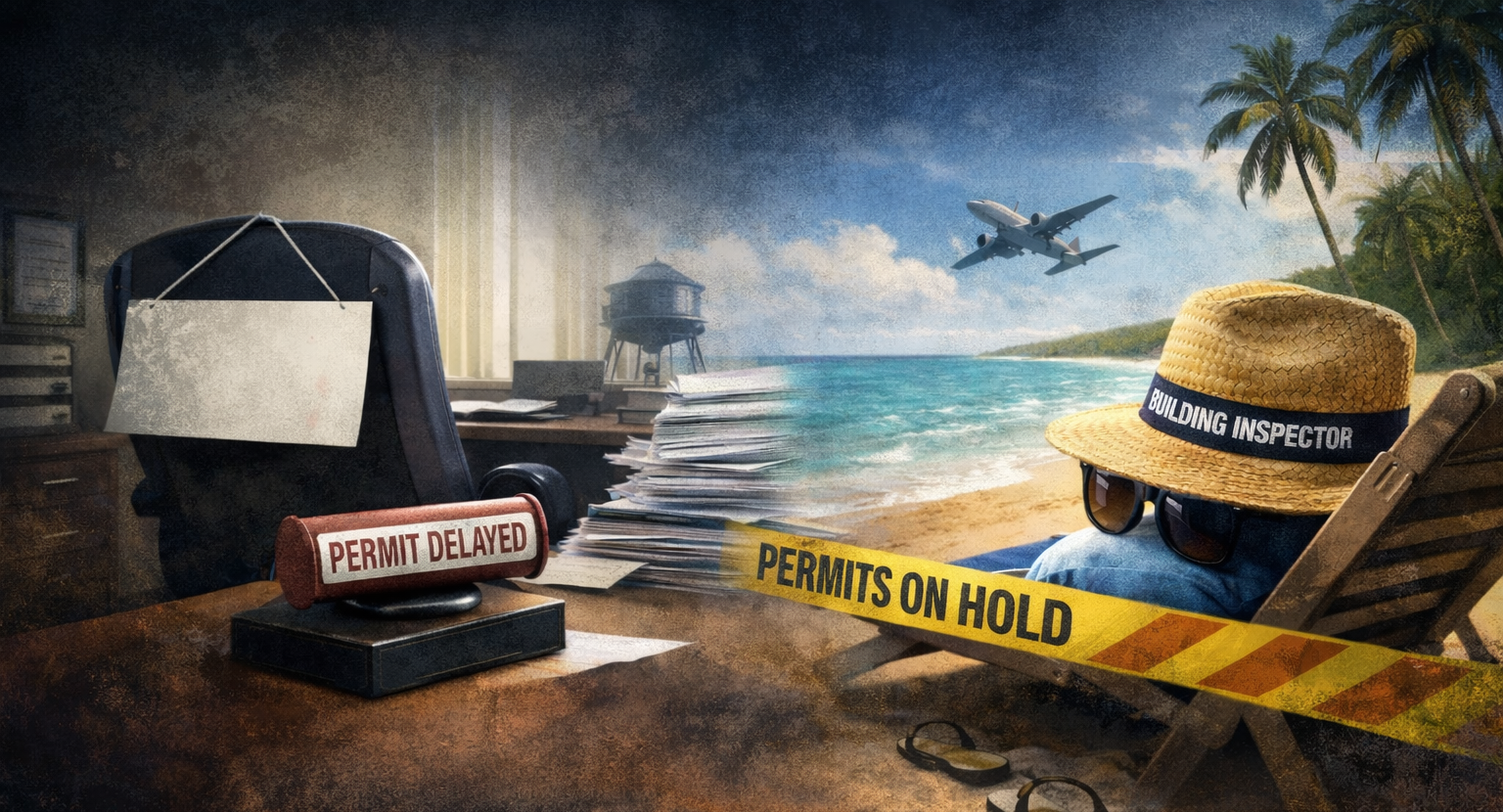
Then the City of Temple Terrace’s building official, Dallas Foss, went on vacation — and the permitting system effectively went with him.
What followed was not a minor delay or a paperwork hiccup, but a breakdown in authority that left contractors, residents, and even other government agencies trying to figure out who was actually in charge.
According to multiple emails from Temple Terrace’s permitting office, Hillsborough County was serving as the acting building official during Mr. Foss’s absence.
In one, Temple Terrace “permitting coordinator” Candace Willoughby, in an email obtained by Red Tape Florida, wrote to a building inspector on June 6 that “Mr. Foss is on vacation. We are using Hillsborough County BO.”
Contractors were told the county was “covering” and that work would continue.
There was only one problem.
Hillsborough County had no idea.
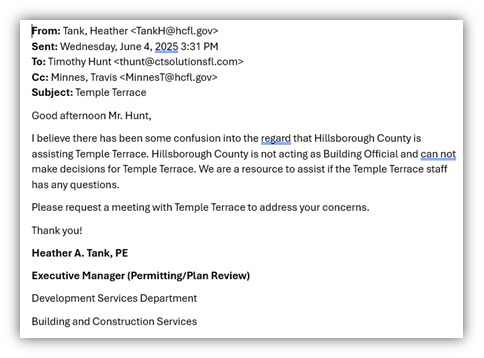
In a June 4 email, Hillsborough County Executive Manager Heather A. Tank, PE, put it plainly:
“I believe there has been some confusion into the regard that Hillsborough County is assisting Temple Terrace. Hillsborough County is not acting as Building Official and can not make decisions for Temple Terrace. We are a resource to assist if the Temple Terrace staff has any questions.”
That clarification came days after contractors had already been told otherwise by Temple Terrace staff.
Meanwhile, the permit remained untouched. From May 25 until mid-June, no action was taken, no alternative authority stepped in, and a routine safety project sat idle.
It was only after repeated emails on June 16, 2025 — following Mr. Foss’s return from vacation — that the permit was finally reviewed and issued.
The building official acknowledged the delay and apologized. City leadership later conceded that “we could have done better.”
But the episode raises a more uncomfortable question: what actually happened here?
Temple Terrace told applicants that Hillsborough County was “covering.” Hillsborough County says, in writing, that it was not. No formal backup agreement, interlocal arrangement, or delegated authority has been produced.
That leaves two possibilities. Either the city misunderstood its own coverage plan — or coverage was represented as existing when it did not.
The private provider also contends that Temple Terrace required procedures beyond what state law permits, including rejecting the standard state notice form and requiring inspections to be “scheduled” rather than simply noticed. Florida’s private-provider statute limits local governments from imposing requirements more stringent than those prescribed by state law. If accurate, that raises a separate compliance question.
This case surfaced only because the contractor pushed back and escalated. Most homeowners don’t. If one permit submitted on May 25 sat untouched until June 16 because a single official was out, it’s reasonable to ask how many others quietly stalled during the same period.
Florida’s permitting laws assume continuity. Permits are not supposed to pause because one person is on vacation. Yet in Temple Terrace, authority appears to have been so centralized — and so poorly documented — that a routine safety project effectively shut down.
That’s not just inefficient. It’s a governance failure.
When a city tells applicants that another government entity is providing coverage — and that entity later says it isn’t — trust erodes quickly. Mixed messages don’t just slow projects; they undermine confidence in the system itself.
This isn’t an argument against taking vacations. It’s an argument against pretending coverage exists when it doesn’t.
Temple Terrace says it is addressing the issue. That’s welcome. But the lesson applies far beyond one city.
When authority is unclear, delays aren’t accidents — they’re inevitable. And waiting weeks for a bureaucrat to return from vacation is not an acceptable outcome for residents trying to make their homes safer.