PART 3 in a series
(Click here for Parts 1 and 2)
Special Report by Skip Foster, Red Tape Florida
· · ·
When we last saw Sally Bradshaw, she had survived months of deviations, secret menus of unwritten City rules and a mandatory bench in a pollinator garden. But the City still had one more move to make. The $150,000 Sidewalk of Doom was waiting. And so was a deal nobody could believe.
· · ·
Independent bookstores aren’t exactly cash cows. Online giants cast a long shadow. The war is won with relationships and by creating an experience. Oh, and also by forming deep personal connections to community.
Midtown Reader’s “Let’s Read” program is a great example. While owner Sally is trying to turn a profit (while not even taking a salary for herself), she’s also seeking grants and pleading for contributions to hold book fairs in Leon County Title I schools, so that all children can experience the thrill of “shopping” for a shiny, colorful, brand-new book.

So far, Midtown Reader and its customers have donated over 5,000 books that have been gobbled up by children hungry to read.
The City had already put Bradshaw through months of deviations, unwritten rules and negotiated compromises. Now, even after Sally told the City the $150,000-plus sidewalk cost was a non-starter, the bureaucracy was less than empathetic.
City officials questioned the sidewalk bid provided to Bradshaw, believing it to be inflated. But building a sidewalk is not just pouring concrete. The city was requiring that Bradshaw incur the cost of relocating electrical and gas utilities, adding substantial cost to the project. Bradshaw’s estimate was on paper and real.
Still, the City was clear: No sidewalk improvements, no building permit.
Sally considered abandoning the renovation and told the City there was no way she could spend that type of money, having purchased the Waterworks building for over $850,000 and then planning to spend over $400,000 on a building addition plus parking. And that doesn’t include any additional book inventory, the entire purpose of the expansion.
Have we got a deal for you!
Then, the City came up with another path forward: Kill your parking lot and we will drop the sidewalk requirement.
It was, of course, both patently ridiculous and an offer Sally couldn’t refuse.
Just to put it in proper perspective, the options presented by the city were:
OPTION 1
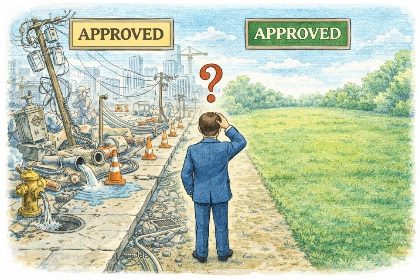
Add desperately needed parking (not just for Midtown Reader but other nearby businesses) but to earn that right, pay $150,000-plus for sidewalk and additional money for utility improvements – all to impact less than 3 percent of the total sidewalk on that stretch of Thomasville Road.
OPTION 2
Keep the sidewalk as is, but only be allowed to keep the same number of parking places as existed for Waterworks, prior to Bradshaw purchasing it.
Of course, the coup de grâce is that Waterworks went out of business, with a lack of parking a possible contributing factor.
So, Option 2 it was.
And what about the property that could have been used for parking? Well, we’ll save that for the end.
Meanwhile, let’s talk finances for a second.
When private property rights vanish
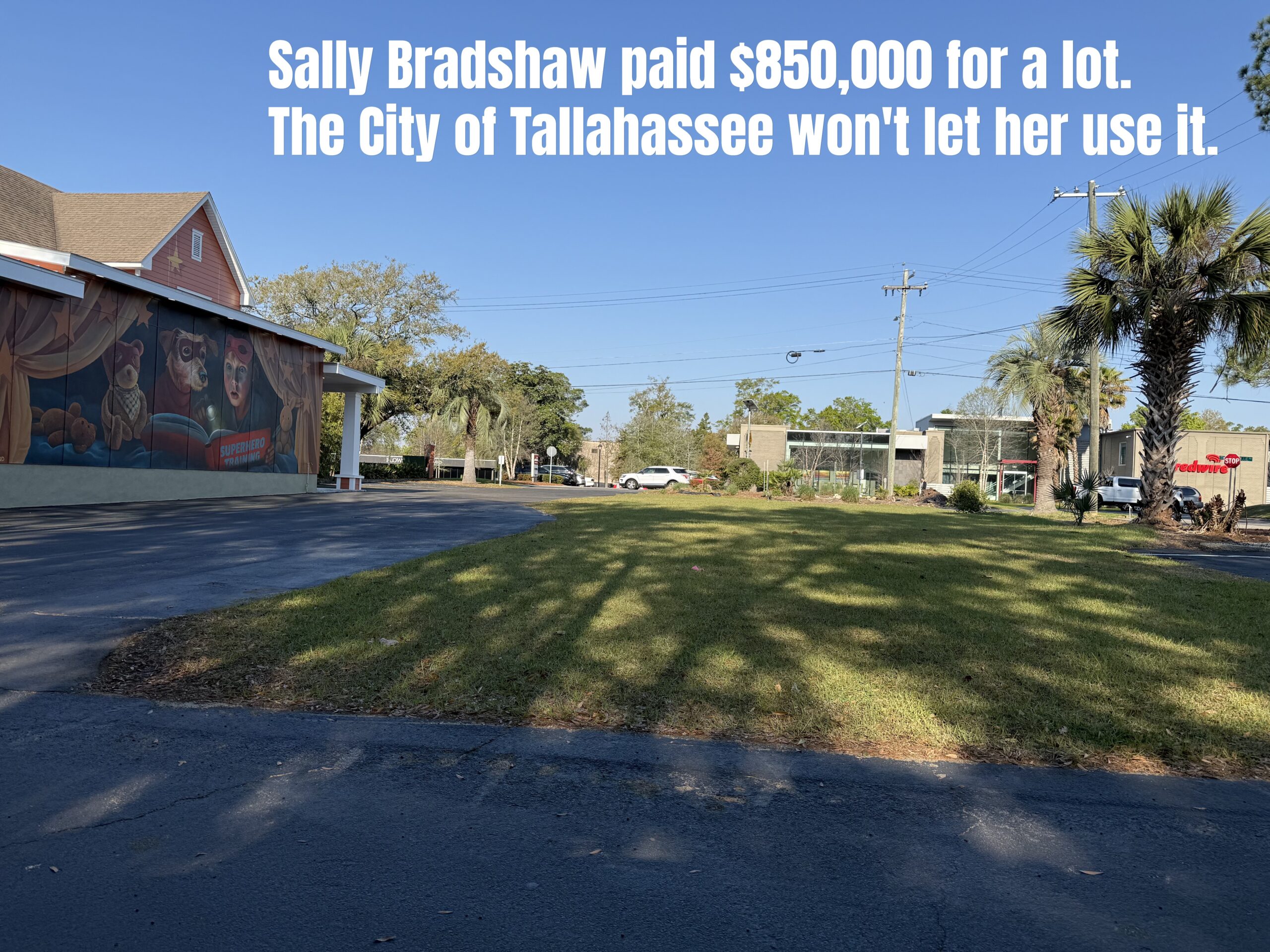
Bradshaw paid $850,000 for the Waterworks building and lot.
For that money, she gets a small expansion of Midtown Reader and … nothing else.
She can’t build on the rest of the lot.
She can’t add more parking than was already there.
She can’t do anything except … pay more property taxes!
That’s right sports fans, for some reason, Sally’s property taxes more than tripled, from $6,019 to $22,018. How could an empty, essentially unusable lot add $15,999 to a property tax bill? Nobody at the City has offered a satisfying answer.
So, let’s get out the adding machine.
The cost to ACTUALLY build the addition (new square footage added, shelves, paint, etc.) was $450,000.
Then there’s the architect and engineering fees.
Industry standards peg architectural and engineering fees for a renovation project at roughly 10 to 15 percent of construction costs. On a $450,000 project, that should be $45,000 to $67,500.
Midtown Reader’s architectural and engineering fees came to around $90,000.
The $400,000 in construction costs built the bookstore’s expansion. The additional $90,000 built nothing — no square footage, no jobs, no customers served. It was simply the price of permission..
Now, take a moment and think about all the other commercial and even residential projects that are ongoing at any one time in Tallahassee and then extrapolate that math.
And it’s not like Midtown Reader wasn’t willing to pay to improve the property — the mural on the Thomasville Road side of the building was paid for by Bradshaw, without requesting any local grant money to fund it.
What makes this even worse
As you think about this happening to hundreds of businesses across town, also consider this.
Sally knows how to get things done.
Think about all the small business owners who aren’t as well-connected. How could they possibly have prevailed against the might of the bureaucracy?
Then this: Midtown Reader added two employees, even with an expansion that lacks proper parking support and includes hundreds of thousands of dollars flowing to the government in regulatory fees and taxes. How many more jobs would our community have if the bureaucracy wasn’t so good at its job?
Finally, if Bradshaw hadn’t shipped that $90,000 to the bureaucracy, guess how many books it would have bought for Title 1 students?
18,000.
The final chapter
Illustrating this story, you see a picture of what has become of the vast majority of the old Waterworks lot. Instead of valuable parking that could have helped Midtown Reader grow and add even more jobs, it’s just a simple grass plot.
It’s there because that’s the way the City of Tallahassee wanted it.
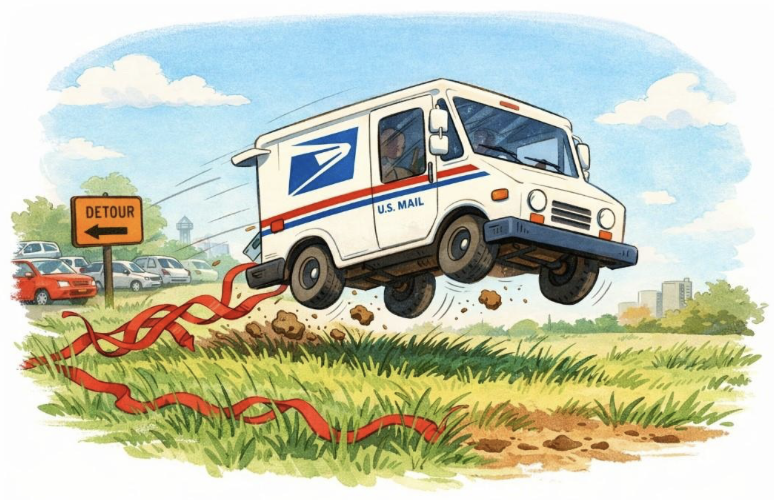
Sometimes people park on the grass anyway – that won’t work when it rains. Recently a USPS truck, hemmed in by traffic seeking a parking spot, just cut across the grass to escape.
That lot has become a symbol – a patch of grass where the entrepreneurial spirit has been buried under a thick mat of red tape.
Yet, at the same time, it’s a monument to the perseverance of a small businesswoman, determined to expand her business to create jobs, bring more books to customers and eager school children, provide a third space where a diverse group of Tallahassee residents can read and who did all that while finding a way to do it all while surviving a bureaucracy that seemed hellbent on killing her dream.
The End.
Coming Next: Red Tape Florida’s Skip Foster opines on the Sidewalk of Doom