By Skip Foster, Red Tape Florida
Let’s dispense with the fiction.
Tallahassee CRA officials, the day after Red Tape Florida reported on the issue, pulled a $750,000 grant request after acknowledging they could not support the project if the new building became a medical marijuana dispensary.
One problem: The applicant is a cannabis real estate company.
Not metaphorically. Not incidentally. Openly.
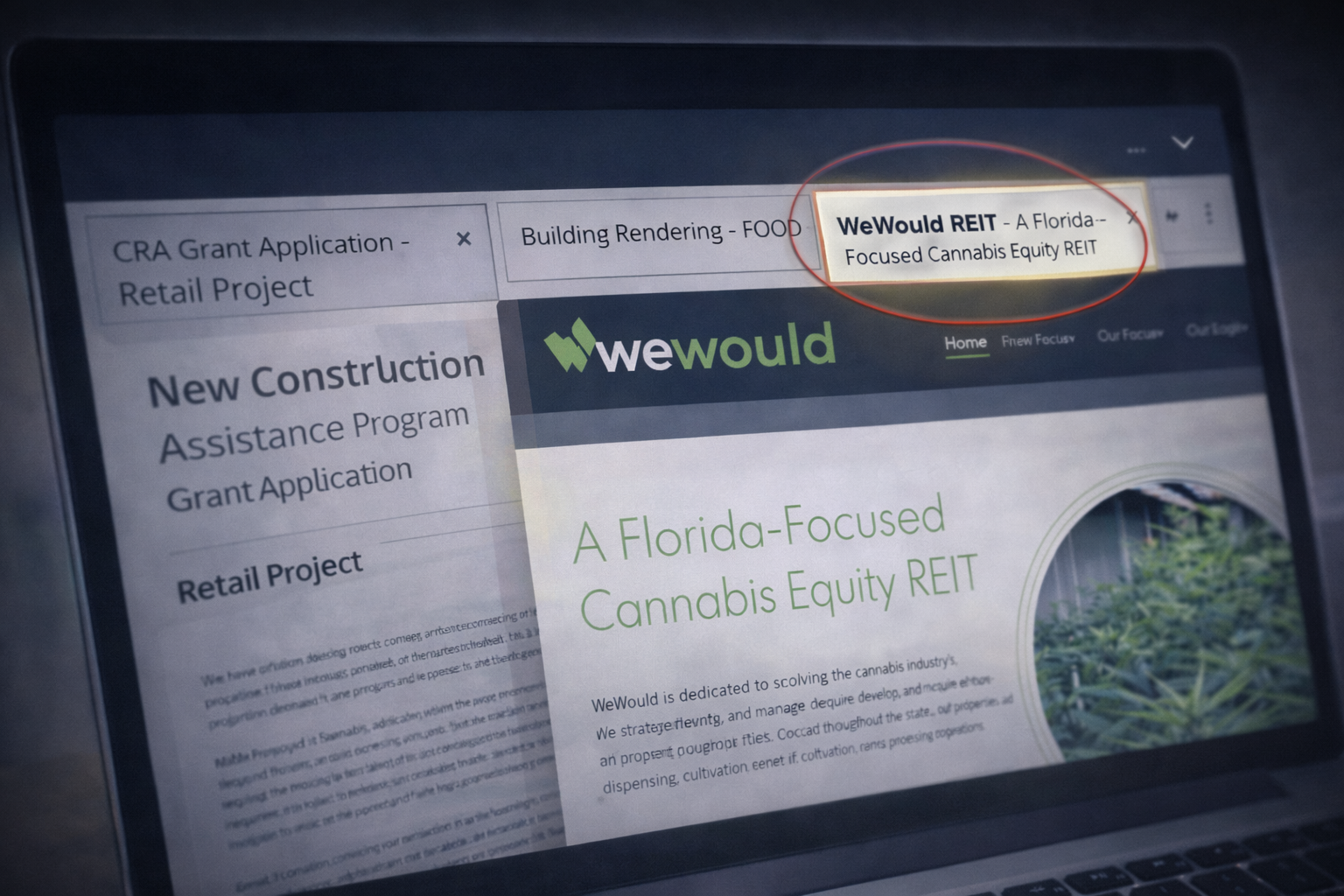
WeWould REIT describes itself on its homepage as a Florida-focused cannabis equity REIT, complete with a prominent image of a cannabis plant and multiple pages devoted to cannabis-specific investments.
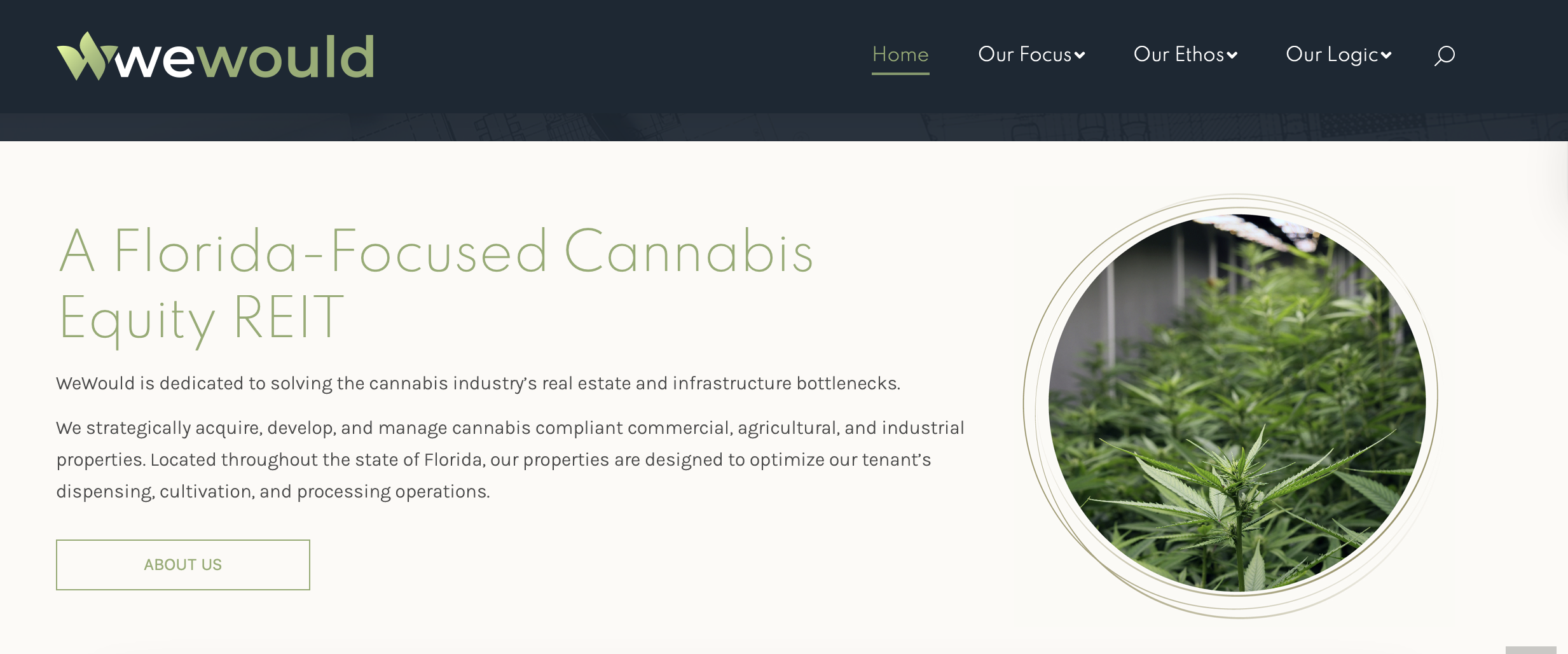
WeWould REIT describes itself on its homepage as a Florida-focused cannabis equity REIT, complete with a prominent image of a cannabis plant and multiple pages devoted to cannabis-specific investments.
Yet the proposal advanced through the CRA process as a generic retail project — complete with a colorful building rendering labeled “food.”
According to Stephen Cox, the CRA’s executive director, the item was pulled only after staff concluded they could not recommend approval if the developer intended to lease the space to a dispensary. “We had a conversation with the owner, and he couldn’t guarantee that a dispensary wasn’t on the table,” Cox told the Tallahassee Democrat.
That explanation raises a far more basic problem than zoning or community preference. Either CRA staff knew they were advancing a grant application from a cannabis-focused real estate company, or they advanced a $750,000 public subsidy without performing even minimal due diligence. There is no third option.
This is the bureaucratic equivalent of telling a police officer that your friend said the bag he handed you was just home-grown oregano.
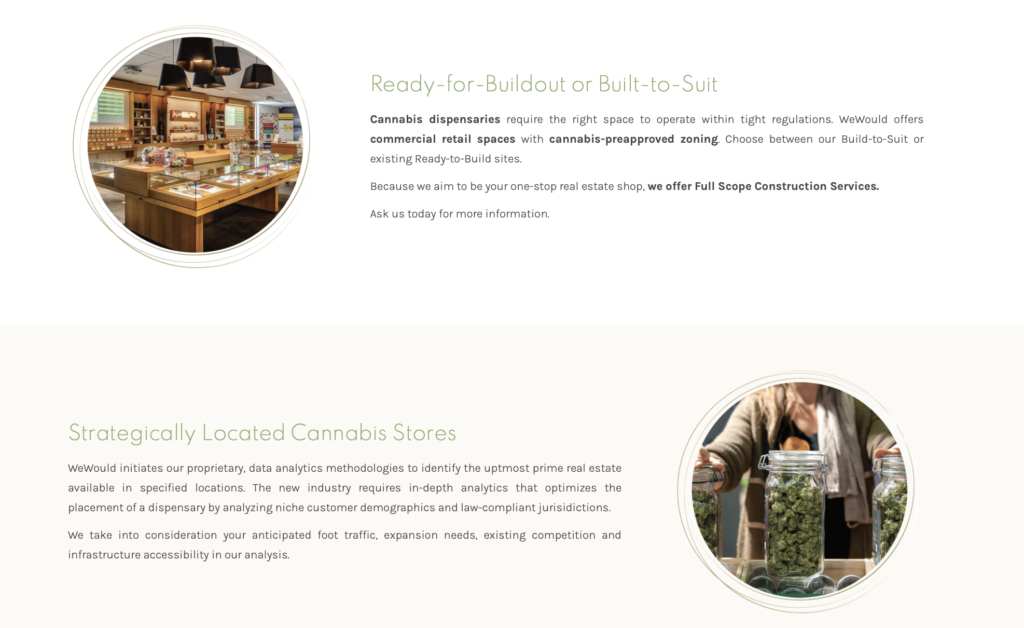
A quick tour of WeWould REIT’s own website makes the point unavoidable. Its homepage identifies the firm as a cannabis equity REIT. Its “Our Focus” page is devoted entirely to cannabis real estate. Its portfolio highlights properties acquired, developed, or leased for cannabis uses. Its “About Us” section frames the company’s mission around serving the cannabis industry and navigating its regulatory and capital challenges.
Cannabis is not a side possibility. Cannabis is the business.
This is the company CRA staff later said “couldn’t guarantee” a dispensary wouldn’t be part of the project.
Which raises a question that should concern every taxpayer in a CRA district.
What exactly is the threshold for due diligence?
Because this was not the product of in-depth investigative journalism. It did not require subpoenas, records requests, or forensic accounting. It required typing the applicant’s name into a browser.
Yet a 127-page grant application was assembled, packaged, placed on an agenda and nearly sent to a citizen advisory committee as a generic retail project, while the applicant’s core business model was treated as an afterthought.
Cox acknowledged that staff had previously discussed with the developer that a dispensary would “be looked negatively by the community” and that CRA staff “would not be able to give a recommendation for approval from the staff perspective” if that were the use.
In other words, CRA leadership understood that a marijuana dispensary was a live possibility — yet the proposal still moved forward without that issue being resolved or clearly disclosed.
CRA staff advanced a proposal framed as “retail,” showcased a rendering labeled “food,” and confined the only clear references to a medical marijuana dispensary to page 52 and page 114 of technical attachments.
Only after the Red Tape Florida story prompted resident calls did staff pull the item.
“We spoke with him and said, ‘Look, if you’re trying to do something like that, that’s definitely not going to fly,’” Cox said of the dispensary use. “You can still build it, but as far as assistance goes, that’s not going to be something that we would be in favor of.”
That may be true. But it is not reassuring.
If CRA staff did not know this was a cannabis real estate company, that is a failure of basic competence.
If they did know and chose to soft-pedal it in public materials, that is a failure of transparency.
Either way, the public deserves better than a shrug and a pulled agenda item.
That’s not redevelopment — just like it’s never oregano in the plastic bag.