Here are 7 solutions to the City’s 5 biggest bureaucratic problems
Opinion by Skip Foster, Red Tape Florida
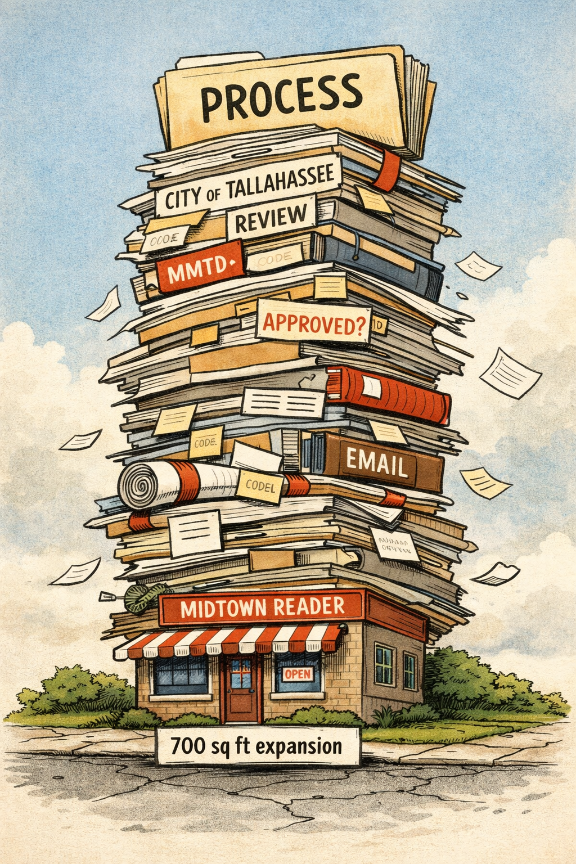
Sally Bradshaw just wanted to add 700 square feet to her bookstore. And she was willing to pay $850,000 to buy the lot next door to make it happen.
But what the City of Tallahassee put her through is a story that should make every business owner in this city angry — and every elected official ashamed.
This is what Red Tape Florida was created to cover.
The Midtown Reader expansion debacle is not just a series about one business. It is a case study in how Tallahassee’s development process actually operates — and why so many in the private sector quietly say it doesn’t.
Over the course of this series, we have documented the facts.
- A modest 700-square-foot expansion required more than a year to complete.
- It triggered 997 documented emails between the architect, engineers and city staff.
- It required about $90,000 in professional and permitting fees.
- It involved unwritten rules — including a critical exemption threshold that was not documented anywhere but materially affected the outcome of the project.
- It included requests for public-facing uses on private property — from food trucks to minute garden details like a “water feature” — that were not clearly grounded in written code or allowed under property rights theory.
- And it culminated in a requirement that a single 150-foot stretch of sidewalk be doubled in width — at a cost exceeding $150,000 — while the remaining 97 percent of the corridor remained unchanged.
These are not opinions. They are facts.
And when you step back from them, a pattern emerges. This is not a system optimized for outcomes. It is optimized for process and the whims of bureaucrats.
A system where compliance is expensive, time-consuming and uncertain. A system where critical rules are not always written down.
A system cloaked in secrecy, where communication often intentionally shifts off the record. And a system where the burden of navigating it all falls squarely on the private citizen.
The result: A small businesswoman paid $850,000 for property adjacent to her business to add on a modest 700 square feet to her bookstore.
And now, she can’t use the lot for anything else.
Five Huge Problems
If we take a step back, the permitting debacle experienced by Midtown Reader illuminates five major problems with Tallahassee’s approach to development:
- The building regulations are antiquated and wildly misaligned with reality. Much of Tallahassee’s regulatory framework is derived from planning principles established in the 1980s, a time when urban planners thought we all should live like European townspeople, riding our bicycles around the quaint plaza with fresh baguettes spilling out of our baskets. It’s why we see this absurd tilt toward wide sidewalks and expensive bike lockers when most of Tallahassee relies on cars for transportation.
- The permitting process itself is broken. The messages and mandates a builder receives are often conflicting between departments and individual inspectors, and one bureaucrat may demand a change after construction that directly conflicts with an earlier mandate from another bureaucrat. It’s a Kafkaesque nightmare of miscommunication and ineptitude, and one that hugely increases the cost of housing and stifles business growth.
- The culture within Tallahassee’s bureaucracy is toxic. Contractors will tell you that no local government bureaucracy – literally none— is more hostile than Tallahassee’s to development or more capricious in its demands. There is no sense of urgency, no urge to help, no nod toward private property rights, and no contrition when the goal posts constantly shift. The focus on meaningless detail is ridiculous; planners imposing their personal tastes rather than applying rational regulation.
- There is little private sector pushback. The Tallahassee Chamber is notable for its silence and reluctance to engage, and builders, architects, and engineers in the City are intimidated by the threat of quiet retribution from city staff. It is a conspiracy of silence that predictably results in a bureaucracy run amok with no real scrutiny or accountability.
- There is no leadership at the top of the city government addressing the problem. The never-ending food fight between our 3-2 vote split seems to consume all the available attention, and the very practical problem of running the permitting arm of city government seems to fall by default to the people in the cubicles. This last decade was an opportunity for Mayor John Dailey and City Manager Reese Goad to make meaningful progress in this area. Instead, they paid to win some awards.
But, there is hope. Here are seven solutions to all of these problems if leaders emerge who are interested in growing jobs and helping small businesses:
First, modernize the code
Tallahassee needs a full, line-by-line audit of its land development code, with one simple test: does this reflect how people actually live, build and move in this city today?
If the answer is no, it goes.
Sidewalk standards, bike infrastructure requirements, aesthetic mandates — all of them should be evaluated against actual usage and cost impact. If 95 percent of residents are driving, then forcing expensive pedestrian-oriented infrastructure onto every small project is not planning — it’sfantasy.
This is not a tweak. It is a reset.
And it should be led by the private sector as much as planners, not the other way around.
Second, create a true “single point of accountability” for permitting
Right now, applicants are navigating a maze of departments, each with the power to delay, contradict, or reinterpret.
That has to end.
Every project should have one designated project manager inside city government with actual authority — not just coordination responsibility — to resolve conflicts, enforce timelines, and provide binding answers.
If two departments disagree, the applicant should not be the one stuck in the middle.
The city should be.
Third, require everything to be written down — and enforce it
No more unwritten rules. No more “this is how we usually do it.” No more verbal only communications to avoid a public record trail of accountability.
If a requirement affects cost, design, or approval, it must exist in the written code or in a formally adopted policy.
If it’s not written down, it cannot be enforced. Period.
And if staff applies a requirement that is not in code, there should be a clear, fast appeal process with real consequences. Sunlight alone would eliminate half the problems described in this series.
Fourth, measure the system like a business — and publish the results
Right now, no one is being held accountable for outcomes. That’s fixable.
The city should publicly track:
- Average permitting time by project type
- Number of review cycles per project
- Number of post-approval changes required
- Total fees and compliance costs for representative projects
- How much time deviations are adding to projects.
On the last bullet, we learned from Midtown Reader that a fast permit doesn’t always mean anything – there are other ways a bureaucracy can throw sand into the gears.
All of those metrics should be published quarterly.
If it takes 12 months to approve a 700-square-foot expansion, that should not be anecdotal. It should be visible — and unacceptable. What gets measured gets fixed.
Fifth, create safe, structured private-sector feedback — and actually listen
Right now, contractors, architects, and business owners stay quiet for a reason. They fear retribution.
That has to change.
The city should establish a formal, anonymized feedback system for applicants and industry professionals, paired with quarterly roundtables where concerns can be raised without fear of retaliation.
Sixth, leadership needs to own this publicly
This is not a staff-level issue. It is a leadership failure.
The Mayor, City Manager, and Commission should set clear, public goals for permitting reform:
- Reduce approval times by a certain percent
- Eliminate conflicting directives
- Codify all requirements
And then report progress — or lack thereof — to the public.
If this is not a priority at the top, it will not change at the bottom.
Seventh, the Chamber needs to get in the game
As the business community’s leading advocate, the Chamber needs to ramp up accountability and find the right people to work on this issue. “Behind the scenes” efforts have not produced results. It’s time for strong, visible leadership. Political support should come with the expectation of progress on this (and other) issues. This will almost certainly require different Chamber voices being heard.
The bottom line
Is it so unreasonable to expect a local government, when approached about a small business expansion like Midtown Reader, to say: “Great! How can we help?”
Instead, the City creates some sort of American Ninja obstacle course.
Make no mistake, the Midtown Reader story isn’t about the system failing, it’s about the system operating exactly as it is designed – making it as hard as possible for a business to succeed.
It’s unacceptable and Red Tape Florida won’t stop until it’s fixed.