Special Report by Skip Foster, Red Tape Florida
This is a three-part story about a bookstore, a city, and a process that few people ever see until they are in it. It includes hundreds of emails, unwritten rules, unexpected requirements, and a $150,000 sidewalk that raises larger questions about how decisions get made.
PART ONE
This is a story about 997 emails, a $150,000 sidewalk, an 8-eye-bolt bike rack and a parking lot that never got built.
The story includes specific instructions on a pollinator “water feature,” an order to build bookshelves into windows and a very, very expensive patch of grass.
But ultimately, it’s a story about what happens when a city government mistakes a beloved small business for a regulatory obstacle course.
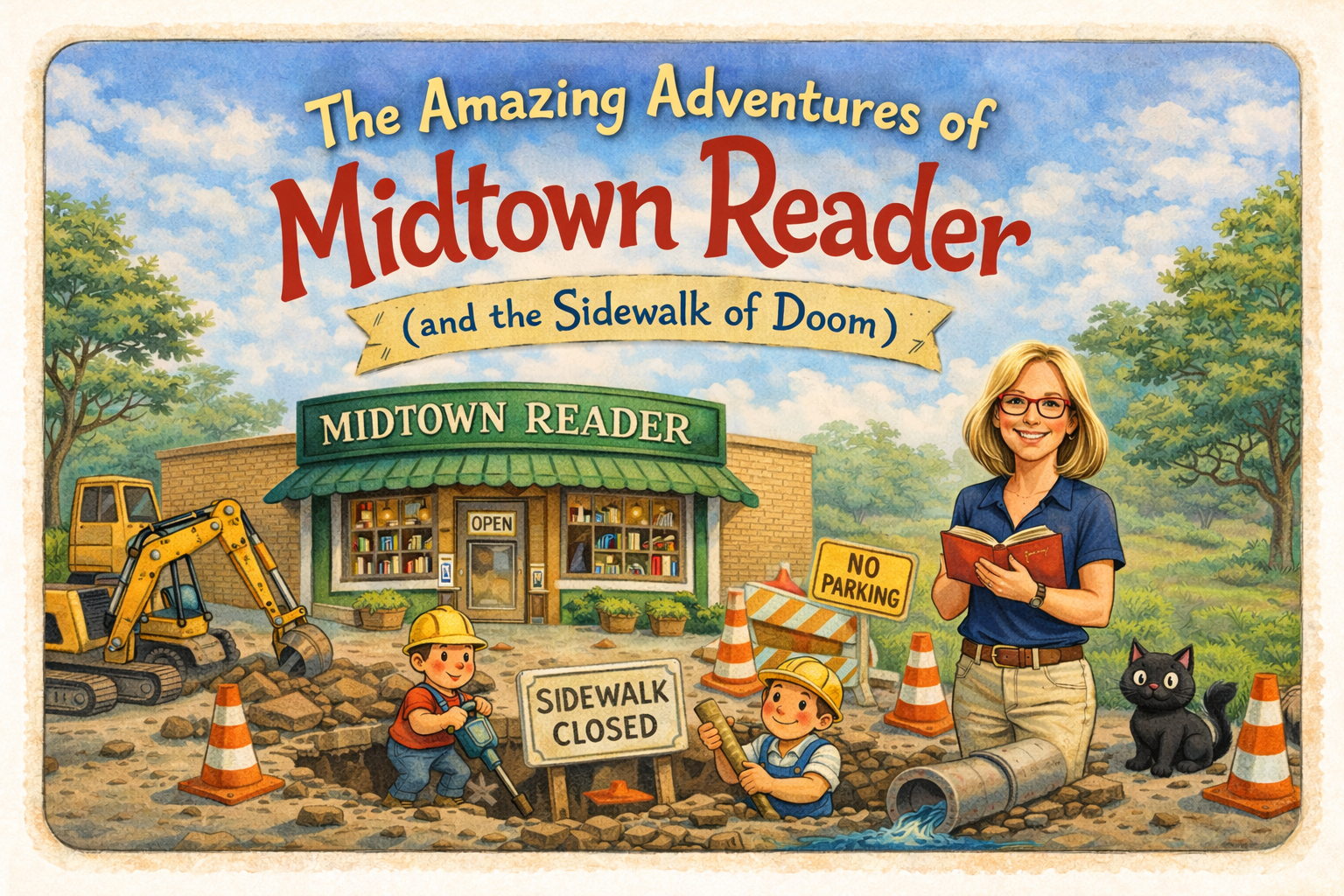
This is The Amazing Adventure of Midtown Reader (and the Sidewalk of Doom).
· · ·
The City of Tallahassee almost broke Sally Bradshaw. Almost.
The founder and owner of Tallahassee bookstore Midtown Reader has turned it into a beloved Tallahassee institution.
But as the store bustled, it also busted at the seams. She needed additional inventory space and parking — the latter a chronic issue for Midtown merchants.
So, after Don Quarello decided to close the adjacent Waterworks after a long and iconic run and after no successor emerged to run the bar, she purchased the property
By August of 2024, Waterworks had been demolished and Sally was ready to go.
Then, the real adventure began. It was time to deal with the City of Tallahassee.
It took more than a year before the small expansion opened.
And the cost? Well, read on …
The city had some ideas
There were two main phases to the attempt to get the renovation complete.
As it turned out, the building permit was the easy part. It was the process of getting approval for what are called “deviations” that turned a modest 700-foot expansion into a novel more at home in the sci fi section of the bookstore than home improvement.
A deviation is a formal city approval allowing a property owner to deviate from a specific development standard — a waiver, essentially, from what the code requires.
There are plenty of rules in the City’s voluminous book of codes. But it was the ones NOT listed that city officials started dropping on Midtown Reader. At one point, city officials suggested the bookstore set aside space on its private property for food trucks.

Food trucks. For a bookstore.
Now, a pause.
One thing Red Tape Florida has discovered in its first year is that local government planning departments are all quite familiar with the state’s public records laws. It’s for that reason that most “suggestions” are delivered, you guessed it, verbally.
While email traffic can still be voluminous (more on that later) there are other things local government officials wouldn’t be caught dead putting in a public record.
Red Tape Florida has found that builders and contractors will often send an email with a question, but the reply will come by phone. Emails asking to confirm what was discussed go unanswered.
With that backdrop, let’s return to Midtown Reader.
The biggest city demand wasn’t about food trucks. It was about a sidewalk.
Remember the left turn lane controversy?
To understand this story, one has to remember what was happening in the news in Tallahassee. In early 2025, as the Midtown Reader project was gaining steam, opposition began to form over proposed changes to Thomasville Road in Midtown.
A Blueprint 2000 “placemaking” project would result in the road becoming one way for at least 2 years while the left turn lane was eliminated and utilities were upgraded. Among many Midtown merchants, Sally Bradshaw spoke publicly against the plan and its devastating impact on her business.
Oh, and one more change was a part of the Blueprint plan: The Thomasville Road sidewalks would be expanded from 5 feet wide to 6 feet wide on the east side of the street and 7 feet on the west side.
When sidewalks go sideways
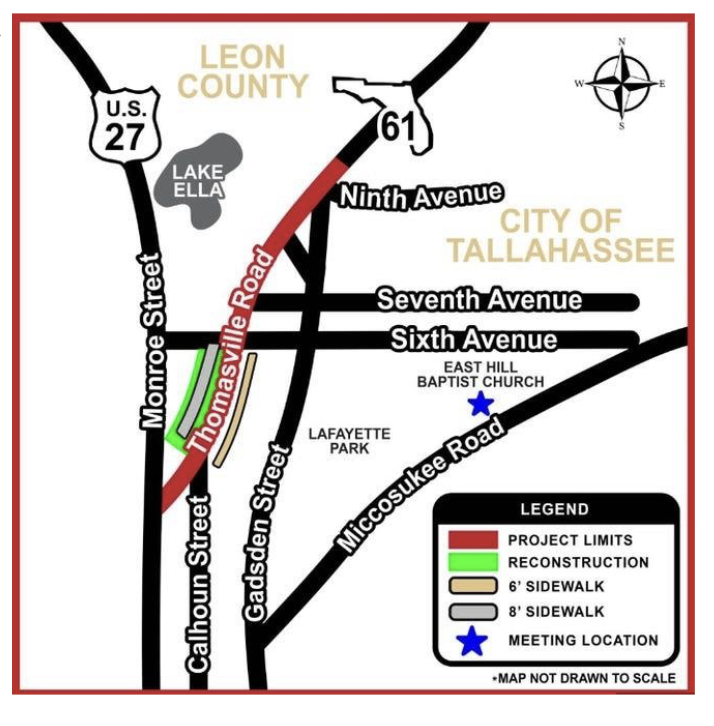
In Midtown, about 3,000 feet of sidewalk line Thomasville Road on each side, from the intersection of 7th Avenue, south to Monroe Street. The 5-foot-wide stretch of sidewalk in front of Midtown Reader and the old Waterworks lot is only 150 feet long.
But for the City of Tallahassee to issue a building permit to Midtown Reader, it had some demands.
Namely this: Midtown Reader would be required to double the width of the sidewalks in front of its half block — from 5 feet to 10 feet wide.
AND it would be required to do all the accompanying utility work – gas and electric.
The result would be a 150-foot stretch of 10-foot-wide sidewalk, while the other 97 percent of the sidewalk on either side of Thomasville Road in Midtown remained 5 feet wide.
Oh, you might be thinking … how much does that cost?
The initial estimate obtained by Bradshaw was a whopping $150,000-plus and included grading, earthwork, curbing, demolition and much more. And that was before any utility work.
But things get even stranger.
You might be asking, where did 10 feet come from?
Good question. The ill-fated Midtown Placemaking project — eventually scuttled by FDOT after concerns about the devastating impact on affected businesses — only called for sidewalks to be widened to 6 feet on the east side of Thomasville Road (the Midtown Reader side) and 8 feet on the west side.
Why was 6 feet good enough for Blueprint, FDOT and the City of Tallahassee but now 10 feet was the new rule for Midtown Reader?
Bradshaw never got a clear answer to that question.
For Sally, the sidewalk demand was a non-starter given the cost, and the fact that walking traffic in midtown is extremely low — most customers come from other areas of the city, they drive, they need parking.
But the City had a counteroffer.
The sidewalk was the final indignity. But it wasn’t the first.
PART TWO
· · ·
When we left our story in Part 1, it was late 2024 and the City of Tallahassee had just dropped a $150,000-plus sidewalk demand on a bookstore owner who just wanted to add 700 square feet. But that wasn’t where the adventure began. To understand the Sidewalk of Doom, we need to go back to the beginning.
· · ·
Before the Sidewalk of Doom, there was the deviations gauntlet.
A deviation, as noted in Part 1, is a formal city approval allowing a property owner to depart from a specific development standard. Think of it as asking permission to not follow a rule.
What Sally Bradshaw discovered is that some of the most consequential rules aren’t written down anywhere.
The accidental discovery
When Bradshaw first planned the expansion, she envisioned developing the full Waterworks lot. That meant full compliance with something called the MMTD — a layer of design requirements that governs everything from sidewalk widths to window placement to where you can put your parking.
Full MMTD compliance is expensive, time-consuming and, as it turns out, sometimes unnecessary.
It turns out City Hall has a secret menu. You just have to know to ask.
Here’s how Bradshaw found out.
The project’s civil engineer was simultaneously working on a small addition for a church on Pasco Street. The engineer had done everything right: she went through the full MMTD compliance process, dotting every “i.”Then, after all that work, the City informed her that a project adding less than 33 percent of new building area to an existing structure didn’t have to comply with the strict MMTD standards.
Nobody had written this policy down. It lived, apparently, in the institutional memory of city planning staff. It is not known how many times it has been applied to those who discovered it – or not applied to those who were unaware.
The engineer on the church job applied that hard-won knowledge to Midtown Reader. She made sure their plans kept the new addition under the 33 percent threshold — ending up at 29.88 percent — and suddenly a significant portion of the regulatory burden evaporated.
The unwritten rule had saved Bradshaw. But the fact that it was unwritten had nearly cost her the entire project.
Food trucks, gardens and eye bolts
Even with the 33 percent workaround, the deviations process ground on.
City planning officials informed Bradshaw she needed to provide what staff called an “active use” area — a minimum 1,200-square-foot paved space, open to the public, on her private property. Part 1 referred to a food truck, which was a non-starter.
Bradshaw proposed a pollinator garden instead. The City agreed — then proceeded to weigh in on the exact configuration of the sidewalks running through it, the precise design of the garden itself, the requirement of a water feature, and the mandatory placement of a bench. All of it open to public access, on private property.
It was, as one participant in the process later described it, the “least-worst” solution.
Then there was the bike rack.
All properties within the MMTD overlay are required to provide secure bicycle parking. The City’s preferred solution has historically been large, box-style bike lockers. Bradshaw pushed back because the large bike area was inconsistent with the building’s design and was far too large for a modest expansion. After negotiation, the requirement was whittled down to its code minimum: a covered structure with hardware sufficient to lock a bicycle.
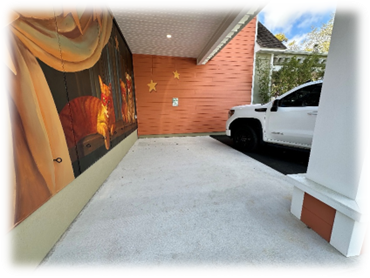
The final result was a shed roof and 8 eye bolts for bike spaces.
Of note, since the grand opening, the bike rack has held either one or zero bikes every time Sally has seen it. And she recently discovered that the one bike that has been using the rack is from someone who walks across the street to do work at another business.
The window that wasn’t
City planning staff informed Bradshaw she was required to install an 8-by-8-foot window on the west wall of the addition for what the MMTD calls transparency — the idea that buildings should have visible, active frontages.
The problem: it’s a bookstore. The west wall needed to hold bookshelves.
Bradshaw’s team argued the point. The City rejected the reasoning. So, the architect did the math — calculating all existing glazing on the building and determining, by what one participant described as “the smallest ofmargins,” that the existing windows already met the MMTD transparency standard.
The 8-by-8 window requirement disappeared. But not after weeks of back and forth.
The cost of time … and email.
Consider what it took just to communicate with the City.

The project’s architect logged 997 emails on the Midtown Reader project alone — to the owner, the engineers, and a cast of city staff spanning multiple departments. Many of those emails required hours of research.
And this for a modest 700-square-foot bookstore expansion.
Bradshaw was fortunate enough to know how to persevere in a war of attrition.
But most small businesspeople never find out the unwritten rules and pay even more.
Or just give up.
PART THREE
· · ·
When we last saw Sally Bradshaw, she had survived months of deviations, secret menus of unwritten City rules and a mandatory bench in a pollinator garden. But the City still had one more move to make. The $150,000 Sidewalk of Doom was waiting. And so was a deal nobody could believe.
· · ·
Independent bookstores aren’t exactly cash cows. Online giants cast a long shadow. The war is won with relationships and by creating an experience. Oh, and also by forming deep personal connections to community.
Midtown Reader’s “Let’s Read” program is a great example. While owner Sally is trying to turn a profit (while not even taking a salary for herself), she’s also seeking grants and pleading for contributions to hold book fairs in Leon County Title I schools, so that all children can experience the thrill of “shopping” for a shiny, colorful, brand-new book.

So far, Midtown Reader and its customers have donated over 5,000 books that have been gobbled up by children hungry to read.
The City had already put Bradshaw through months of deviations, unwritten rules and negotiated compromises. Now, even after Sally told the City the $150,000-plus sidewalk cost was a non-starter, the bureaucracy was less than empathetic.
City officials questioned the sidewalk bid provided to Bradshaw, believing it to be inflated. But building a sidewalk is not just pouring concrete. The city was requiring that Bradshaw incur the cost of relocating electrical and gas utilities, adding substantial cost to the project. Bradshaw’s estimate was on paper and real.
Still, the City was clear: No sidewalk improvements, no building permit.
Sally considered abandoning the renovation and told the City there was no way she could spend that type of money, having purchased the Waterworks building for over $850,000 and then planning to spend over $400,000 on a building addition plus parking. And that doesn’t include any additional book inventory, the entire purpose of the expansion.
Have we got a deal for you!
Then, the City came up with another path forward: Kill your parking lot and we will drop the sidewalk requirement.
It was, of course, both patently ridiculous and an offer Sally couldn’t refuse.
Just to put it in proper perspective, the options presented by the city were:
OPTION 1
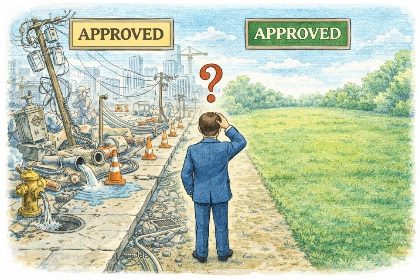
Add desperately needed parking (not just for Midtown Reader but other nearby businesses) but to earn that right, pay $150,000-plus for sidewalk and additional money for utility improvements – all to impact less than 3 percent of the total sidewalk on that stretch of Thomasville Road.
OPTION 2
Keep the sidewalk as is, but only be allowed to keep the same number of parking places as existed for Waterworks, prior to Bradshaw purchasing it.
Of course, the coup de grâce is that Waterworks went out of business, with a lack of parking a possible contributing factor.
So, Option 2 it was.
And what about the property that could have been used for parking? Well, we’ll save that for the end.
Meanwhile, let’s talk finances for a second.
When private property rights vanish
Bradshaw paid $850,000 for the Waterworks building and lot.
For that money, she gets a small expansion of Midtown Reader and … nothing else.
She can’t build on the rest of the lot.
She can’t add more parking than was already there.
She can’t do anything except … pay more property taxes!
That’s right sports fans, for some reason, Sally’s property taxes more than tripled, from $6,019 to $22,018. How could an empty, essentially unusable lot add $15,999 to a property tax bill? Nobody at the City has offered a satisfying answer.
So, let’s get out the adding machine.
The cost to ACTUALLY build the addition (new square footage added, shelves, paint, etc.) was $450,000.
Then there’s the architect and engineering fees.
Industry standards peg architectural and engineering fees for a renovation project at roughly 10 to 15 percent of construction costs. On a $450,000 project, that should be $45,000 to $67,500.
Midtown Reader’s architectural and engineering fees came to around $90,000.
The $400,000 in construction costs built the bookstore’s expansion. The additional $90,000 built nothing — no square footage, no jobs, no customers served. It was simply the price of permission..
Now, take a moment and think about all the other commercial and even residential projects that are ongoing at any one time in Tallahassee and then extrapolate that math.
And it’s not like Midtown Reader wasn’t willing to pay to improve the property — the mural on the Thomasville Road side of the building was paid for by Bradshaw, without requesting any local grant money to fund it.
What makes this even worse
As you think about this happening to hundreds of businesses across town, also consider this.
Sally knows how to get things done.
Think about all the small business owners who aren’t as well-connected. How could they possibly have prevailed against the might of the bureaucracy?
Then this: Midtown Reader added two employees, even with an expansion that lacks proper parking support and includes hundreds of thousands of dollars flowing to the government in regulatory fees and taxes. How many more jobs would our community have if the bureaucracy wasn’t so good at its job?
Finally, if Bradshaw hadn’t shipped that $90,000 to the bureaucracy, guess how many books it would have bought for Title 1 students?
18,000.
The final chapter
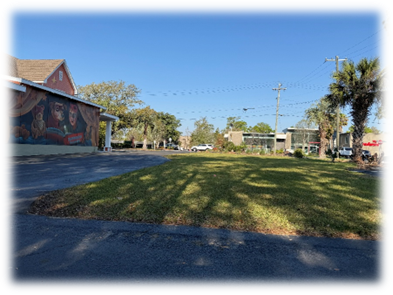
Illustrating this story, you see a picture of what has become of the vast majority of the old Waterworks lot. Instead of valuable parking that could have helped Midtown Reader grow and add even more jobs, it’s just a simple grass plot.
It’s there because that’s the way the City of Tallahassee wanted it.
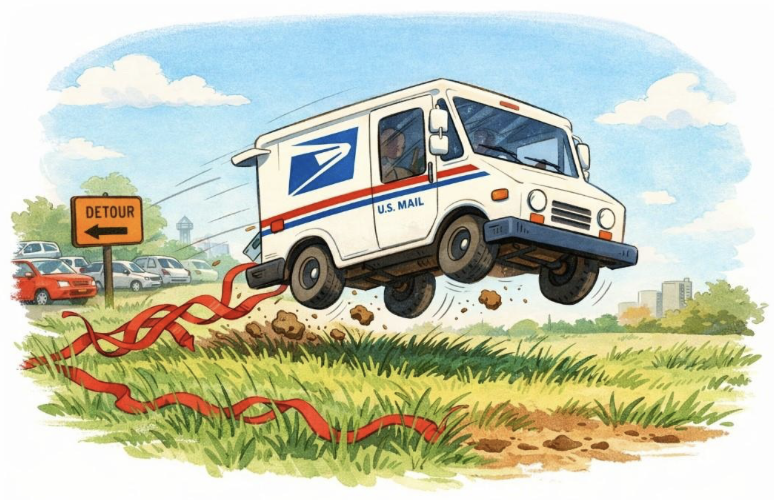
Sometimes people park on the grass anyway – that won’t work when it rains. Recently a USPS truck, hemmed in by traffic seeking a parking spot, just cut across the grass to escape.
That lot has become a symbol – a patch of grass where the entrepreneurial spirit has been buried under a thick mat of red tape.
Yet, at the same time, it’s a monument to the perseverance of a small businesswoman, determined to expand her business to create jobs, bring more books to customers and eager school children, provide a third space where a diverse group of Tallahassee residents can read and who did all that while finding a way to do it all while surviving a bureaucracy that seemed hellbent on killing her dream.
The End.