So, how many OEV employees actually recruit new business?
A year ago, Ricardo Schneider — then president of Danfoss Turbocor, one of the few Tallahassee companies expanding at real scale — set a deadline: if the region didn’t land at least two new business commitments within 12 months, it would be a “community failure.” That deadline has now passed. No new businesses have been secured, and Schneider isn’t backing off.
[…]
By Skip Foster, Red Tape Florida
So, how many OEV employees actually recruit new business?
Share this
Share
+1
Tweet
Share
Share
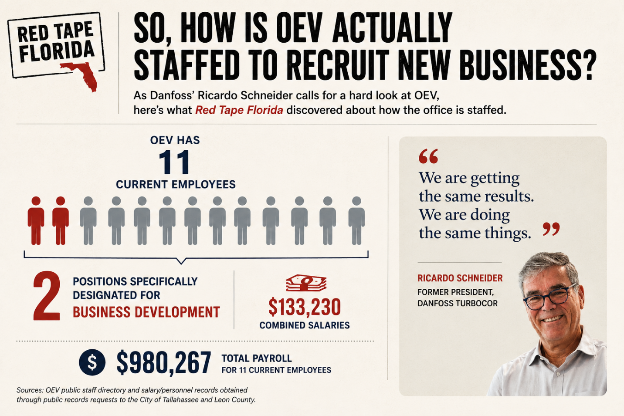
As Danfoss’ Ricardo Schneider calls for a hard look at OEV, here’s what Red Tape Florida discovered about how the office is staffed.
By Skip Foster, Red Tape Florida
A year ago, Ricardo Schneider — then president of Danfoss Turbocor, one of the few Tallahassee companies expanding at real scale — set a deadline: if the region didn’t land at least two new business commitments within 12 months, it would be a “community failure.” That deadline has now passed. No new businesses have been secured, and Schneider isn’t backing off.
“I’m very disappointed with where we are today,” he told the Tallahassee Democrat in a Thursday story, adding it’s time for “a discussion about the future of OEV after the election.”
“We are getting the same results,” he said. “We are doing the same things.”
That’s a pointed call for scrutiny from someone who isn’t a political opponent of OEV — he’s the former head of the company local leaders have repeatedly held up as proof the strategy works.
So Red Tape Florida reviewed OEV’s current public employee directory together with salary and personnel records obtained through public records requests to the City of Tallahassee and Leon County, to see exactly how the office charged with attracting new employers and investment is staffed.
The staffing breakdown looks like this: of OEV’s 11 current employees, two hold positions specifically designated for business development — a Business Development Manager and a Business Development Intern. Four positions are specifically assigned to the Minority, Women and Small Business Enterprise program. Three are categorized under leadership and administration, and two under research, marketing and special projects.
OEV Staff, Titles and Salaries
Listed alphabetically by last name. Based on OEV’s public staff directory (titles) and salary and personnel records obtained via public records requests (annual salary).
| Name | Title | Category | Annual Salary |
| Keith Bowers | Director, Office of Economic Vitality | Leadership & Administration | $148,195.84 |
| Jessica Grant | Administrative Specialist II | Leadership & Administration | $60,371.76 |
| Darryl Jones | Deputy Director, Minority Women & Small Business Enterprise | MWSBE | $111,402.27 |
| Sean Lewis | Special Projects Coordinator | Research, Marketing & Special Projects | $96,719.92 |
| Dan Lucas | Business Intelligence Manager | Leadership & Administration | $102,827.11 |
| Kadin Musco | Business Development Intern | Business Recruitment | $32,448.00 |
| Dineta O’Hara | Business Development Manager | Business Recruitment | $100,782.15 |
| LaTanya Raffington | Senior Manager, Minority Women & Small Business Enterprise | MWSBE | $90,941.71 |
| Wilnick SaintCharles | Senior Coordinator, Minority Women & Small Business Enterprise | MWSBE | $78,000.00 |
| Shanea Wilks | Senior Manager, Minority Women & Small Business Enterprise | MWSBE | $94,578.46 |
| Maegen Wynn | Business Outreach & Marketing Coordinator | Research, Marketing & Special Projects | $63,999.94 |
| Total (11 current employees) | $980,267.17 | ||
Note: A twelfth employee, Violeta Wall, appears in payroll records as a Blueprint Right-of-Way Assistant earning $64,786.42 annually. That position does not appear on OEV’s current public staff directory and is not included in the table above. Combined with the 11 current employees, total salaries across all 12 payroll records reach approximately $1,045,053.59.
OEV employs one Business Development Manager and one Business Development Intern. Together, those two positions account for approximately $133,230 in annual salaries.
By comparison, four employees work in the Minority, Women and Small Business Enterprise program. Their combined annual salaries total approximately $374,922, representing about 38 percent of the office’s current payroll.
The remaining staff includes OEV Director Keith Bowers, Business Intelligence Manager Dan Lucas, Business Outreach and Marketing Coordinator Maegen Wynn, Special Projects Coordinator Sean Lewis and Administrative Specialist Jessica Grant.
To be fair, Bowers surely spends a considerable amount of his time on recruitment, in addition to managing the entire OEV operation. But if Tallahassee-Leon taxpayers were under the impression that most of OEV’s staff positions are specifically dedicated to recruiting new industry to the region, the office’s own staff directory tells a different story.
The MWSBE program certifies and assists minority-, women-, and small-business-owned firms seeking to compete for public contracts. That work is distinct from recruiting companies to relocate or expand into Tallahassee-Leon County.
OEV’s staffing structure comes as the region faces real economic headwinds by the office’s own numbers. Resident employment has fallen from 163,592 in October 2024 to 154,743 as of the most recent reporting — a decline of 8,849, or 5.4 percent — and the unemployment rate stood at 5.0 percent in May 2026, up from the mid-3-percent range a year earlier. Population growth, initially reported by the U.S. Census as a decline in 2024, has since been revised to a bare 0.13 percent gain — essentially flat.
Red Tape Florida has written extensively on these matters:
- OEV’s 2025 scorecard: A goose egg
- Skip Foster’s speech to Tiger Bay on the county’s economic distress and the reasons behind it.
The purpose of this analysis is not to suggest that one function is important and others aren’t. OEV has responsibilities beyond recruiting new industry, including administration of the MWSBE program. But attracting new employers and investment is central to the agency’s economic development mission.
The staffing records do, however, answer one factual question: of OEV’s 11 current employees, two hold positions specifically designated for business development, in a community where economic development wins are practically non-existent.
Schneider, for his part, isn’t blaming any one person. He credited OEV Director Keith Bowers by name, saying Bowers is “pushing very hard.” But his larger criticism is unmistakable: “We are getting the same results. We are doing the same things.”
OEV performs a number of functions assigned by the City and County. But staffing reflects priorities. Other OEV employees may participate in recruitment efforts as part of their broader responsibilities, but their listed positions are not specifically designated as business development — and of the two that are, one is an intern. Whether that’s the right allocation is ultimately a policy decision — one Schneider is now asking the community to have out loud.
Taxpayers deserve to know how their economic development office is actually organized going into that conversation.
August 13, 2026By Skip Foster, Red Tape Florida

On the brink of a win against Florida red tape
Florida does not need another speech about housing affordability. It needs fewer obstacles to building housing.
That is what HB 803 addresses.[…]
April 28, 2026By Skip Foster, Red Tape Florida
On the brink of a win against Florida red tape
Governor DeSantis should sign HB 803 – and we believe he will
By Skip Foster, Red Tape Florida
Florida does not need another speech about housing affordability. It needs fewer obstacles to building housing.
That is what HB 803 addresses.
The bill, now awaiting the governor’s signature, goes directly at the layer of local permitting that quietly drives up costs — duplicative reviews, inflated fees, shifting requirements, and timelines that stretch for reasons that have little to do with safety or code compliance.
This is not abstract. Red Tape Florida has documented it.
In Gulf County, the county imposed a $500 “planning review fee” on applicants who used a private provider — the very tool state law created to speed up permitting. Builders were effectively told: use the private-sector fast lane and pay a toll for the privilege. In some cases, they were also routed through additional internal steps before permits could move forward.
HB 803 shuts that down.
The bill requires local governments to reduce permit fees when private providers are used — at least 25 percent in some cases, and at least 50 percent when private providers handle both plan review and inspections. It also prohibits additional administrative or inspection fees tied to the use of a private provider.
That is a straightforward fix. If government is doing less work, it should not charge the same — and it certainly should not charge more.
Alachua County offers another example of how the system has drifted.
RTF reported that the county created a “Private Provider Inspection Confirmation” process that does not exist in state law. Contractors described county inspectors redoing inspections already completed by private providers, issuing correction notices without coordinating with them, and requiring additional approvals before work could proceed.
The county also required scheduling through a portal that limited flexibility, rejected documentation for technical reasons, and added layers of process that had the effect of slowing projects even after private-provider approval.
That is not oversight. That is duplication.
HB 803 addresses that by limiting how far local governments can go once a qualified private provider is engaged. It restricts local review largely to true local issues — site conditions, floodplain management, administrative completeness — rather than allowing a second round of building-code review under a different name.
It also requires local governments to maintain registration systems for private providers and bars them from charging administrative fees just to participate in the process.
The point is simple: if the state authorizes private providers, local governments cannot quietly recreate the same process and call it something else.
Tallahassee provides a third, more familiar example.
RTF reported on a property owner attempting to renovate a small maintenance shed at an apartment complex. What should have been routine turned into a multi-year process involving dozens of plan-review comments, additional surveys, stormwater requirements, tree-mitigation calculations despite no tree removal, structural questions about decades-old footers, and even a dispute over a roof overhang extending a few inches beyond a setback line.
At a certain point, it became cheaper and faster to demolish the structure than to satisfy the process.
That is the system Florida says it wants to fix.
HB 803 does not solve every one of those problems, but it targets the mechanics behind them.
It requires more uniform building permit applications statewide, reducing the need to relearn the process from one jurisdiction to another. It creates a five-business-day decision window for certain smaller residential permits once an application is complete. It prevents inspection fees from being based on total project cost rather than the actual cost of the inspection.
And it addresses a quieter constraint on supply by requiring that offsite-constructed housing — including modular and manufactured homes — be treated the same as site-built homes. Local governments can no longer impose more restrictive rules simply because of how a home is constructed.
Taken together, these changes do something important: they reduce uncertainty.
And uncertainty is expensive.
Every additional review, every extra requirement, every week a project sits waiting for a decision adds cost — financing, carrying, and risk. Those costs do not disappear. They are built into the final price of housing.
If Florida is serious about affordability, it cannot ignore that reality.
HB 803 does not rely on subsidies or new programs. It removes friction. It aligns fees with actual work. It reinforces the role of private providers. And it sets clearer expectations for how permitting should function.
It also reflects a consistent direction in state policy. Florida has spent the past several years pushing to reduce barriers to development and increase predictability. This bill fits squarely within that approach.
The Legislature’s support reflects that. HB 803 passed with overwhelming, bipartisan margins.
There is nothing controversial about requiring government fees to match government work.
There is nothing controversial about preventing duplicate inspections.
There is nothing controversial about treating different types of housing fairly.
What is controversial is the status quo — where local processes add cost without adding value, and where builders and property owners face a system that too often feels designed to slow them down rather than help them move forward.
Governor DeSantis has made cutting red tape a central theme of his administration. HB 803 is exactly that.
It reduces unnecessary costs. It limits duplication. It makes it easier to build.
Florida does not need another conversation about housing.
It needs fewer barriers to building it.
This bill removes some of them.
It should be signed and we believe it will be.
April 28, 2026By Skip Foster, Red Tape Florida