
Part 2 of a series (read Part 1 here)
Special Report by Skip Foster, Red Tape Florida
· · ·
When we left our story in Part 1, it was late 2024 and the City of Tallahassee had just dropped a $150,000-plus sidewalk demand on a bookstore owner who just wanted to add 700 square feet. But that wasn’t where the adventure began. To understand the Sidewalk of Doom, we need to go back to the beginning.
· · ·
Before the Sidewalk of Doom, there was the deviations gauntlet.
A deviation, as noted in Part 1, is a formal city approval allowing a property owner to depart from a specific development standard. Think of it as asking permission to not follow a rule.
What Sally Bradshaw discovered is that some of the most consequential rules aren’t written down anywhere.
The accidental discovery
When Bradshaw first planned the expansion, she envisioned developing the full Waterworks lot. That meant full compliance with something called the MMTD — a layer of design requirements that governs everything from sidewalk widths to window placement to where you can put your parking.
Full MMTD compliance is expensive, time-consuming and, as it turns out, sometimes unnecessary.
It turns out City Hall has a secret menu. You just have to know to ask.
Here’s how Bradshaw found out.
The project’s civil engineer was simultaneously working on a small addition for a church on Pasco Street. The engineer had done everything right: she went through the full MMTD compliance process, dotting every “i.”Then, after all that work, the City informed her that a project adding less than 33 percent of new building area to an existing structure didn’t have to comply with the strict MMTD standards.
Nobody had written this policy down. It lived, apparently, in the institutional memory of city planning staff. It is not known how many times it has been applied to those who discovered it – or not applied to those who were unaware.
The engineer on the church job applied that hard-won knowledge to Midtown Reader. She made sure their plans kept the new addition under the 33 percent threshold — ending up at 29.88 percent — and suddenly a significant portion of the regulatory burden evaporated.
The unwritten rule had saved Bradshaw. But the fact that it was unwritten had nearly cost her the entire project.
Food trucks, gardens and eye bolts
Even with the 33 percent workaround, the deviations process ground on.
City planning officials informed Bradshaw she needed to provide what staff called an “active use” area — a minimum 1,200-square-foot paved space, open to the public, on her private property. Part 1 referred to a food truck, which was a non-starter.
Bradshaw proposed a pollinator garden instead. The City agreed — then proceeded to weigh in on the exact configuration of the sidewalks running through it, the precise design of the garden itself, the requirement of a water feature, and the mandatory placement of a bench. All of it open to public access, on private property.
It was, as one participant in the process later described it, the “least-worst” solution.
Then there was the bike rack.
All properties within the MMTD overlay are required to provide secure bicycle parking. The City’s preferred solution has historically been large, box-style bike lockers. Bradshaw pushed back because the large bike area was inconsistent with the building’s design and was far too large for a modest expansion. After negotiation, the requirement was whittled down to its code minimum: a covered structure with hardware sufficient to lock a bicycle.
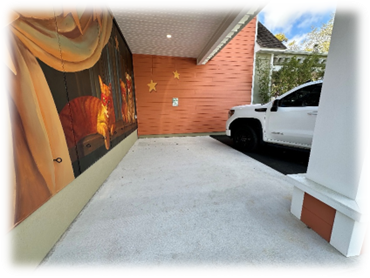
The final result was a shed roof and 8 eye bolts for bike spaces.
Of note, since the grand opening, the bike rack has held either one or zero bikes every time Sally has seen it. And she recently discovered that the one bike that has been using the rack is from someone who walks across the street to do work at another business.
The window that wasn’t
City planning staff informed Bradshaw she was required to install an 8-by-8-foot window on the west wall of the addition for what the MMTD calls transparency — the idea that buildings should have visible, active frontages.
The problem: it’s a bookstore. The west wall needed to hold bookshelves.
Bradshaw’s team argued the point. The City rejected the reasoning. So, the architect did the math — calculating all existing glazing on the building and determining, by what one participant described as “the smallest ofmargins,” that the existing windows already met the MMTD transparency standard.
The 8-by-8 window requirement disappeared. But not after weeks of back and forth.
The cost of time … and email.
Consider what it took just to communicate with the City.

The project’s architect logged 997 emails on the Midtown Reader project alone — to the owner, the engineers, and a cast of city staff spanning multiple departments. Many of those emails required hours of research.
And this for a modest 700-square-foot bookstore expansion.
Bradshaw was fortunate enough to know how to persevere in a war of attrition.
But most small businesspeople never find out the unwritten rules and pay even more.
Or just give up.
COMING NEXT: PART 3
What will the City accept in place of the Sidewalk of Doom? The city makes an offer Midtown Reader can’t believe … or refuse