By Skip Foster
In 2021, Mayor John Dailey embraced Chamber-style scorecards as proof that Tallahassee was “making strong progress.” Five years later, with the numbers no longer flattering, local leaders are defending something else entirely: an economic narrative that only works if you start counting at the depths of the COVID shutdown and ignore what local government’s own data shows now.
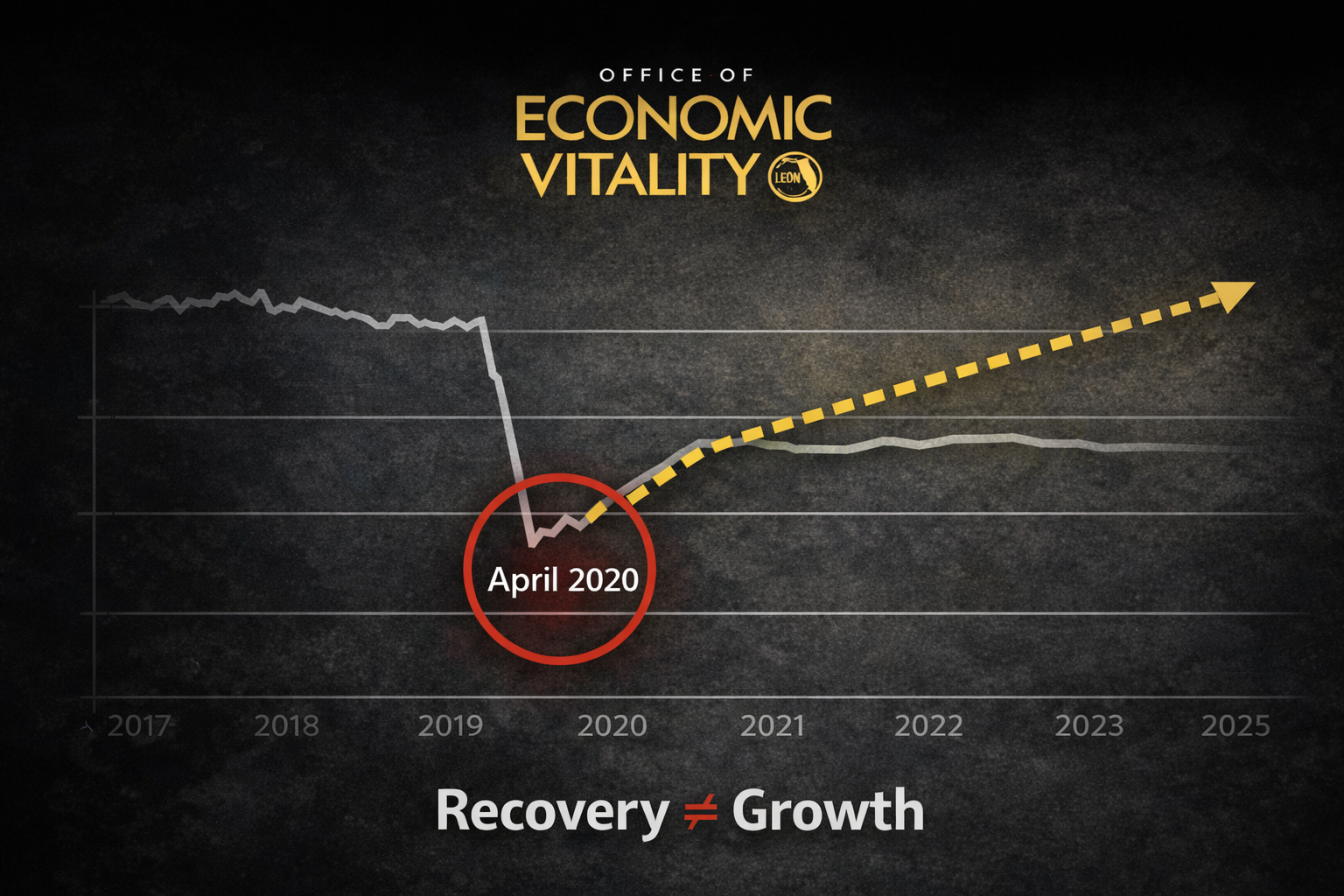
That distinction matters. Because the city-and county-run Office of Economic Vitality isn’t simply offering a different interpretation of Leon County’s economy. It is claiming “job growth” by anchoring its story to the pandemic-driven employment collapse of spring 2020 — while simultaneously glossing over its own more recent jobs data showing that both the Tallahassee metro area and Leon County have fewer jobs today than they did just a few years ago.
With the Florida Chamber of Commerce reporting that Leon County lost more than 4,000 jobs year over year, local officials insist the data is misleading. But the more misleading move is how OEV is choosing its baselines and time windows — and how consistently that choice makes stagnation look like progress.
Lies, damn lies and … OEV statistics
For nearly a year, Red Tape Florida has focused on what actually constitutes economic development: new private-sector employers, new headquarters, and new payrolls that did not already exist here. Not projections. Not reclassifications. Not job churn inside government, hospitals, or universities. Not pie-in-the-sky economic impact projections.
By that standard, Leon County’s record has been abysmal. In 2025, the Office of Economic Vitality failed to announce a single new economic development project adding jobs. Zero. That fact alone should have prompted a serious reckoning.
Instead, OEV doubled down on narrative, claiming that the Florida Chamber stats were misleading. As it turns out, OEV was the one practicing subterfuge.
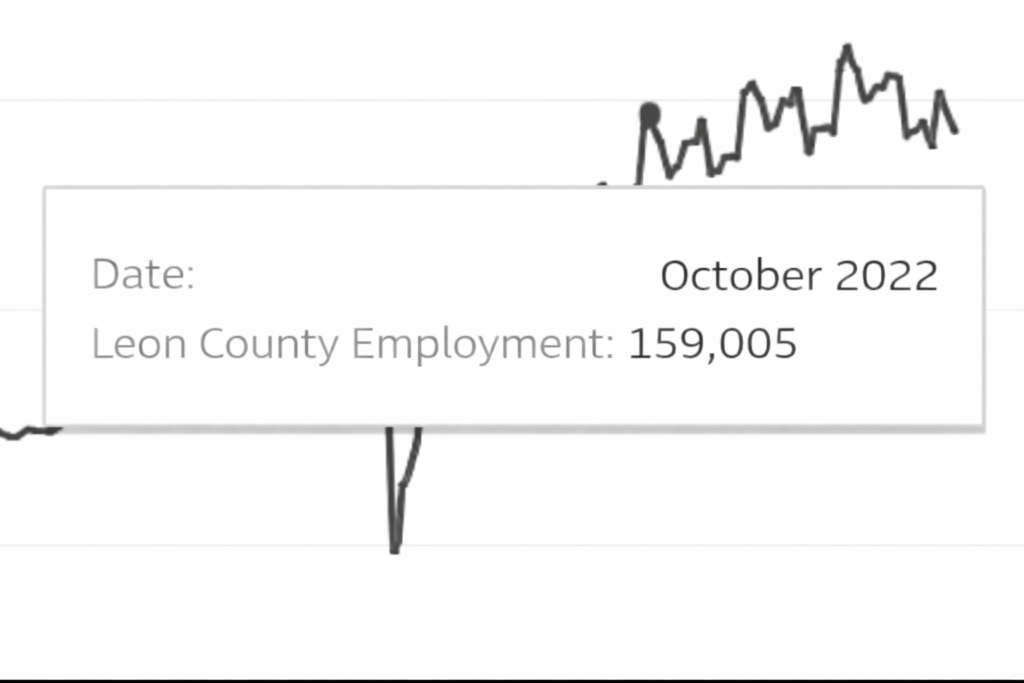
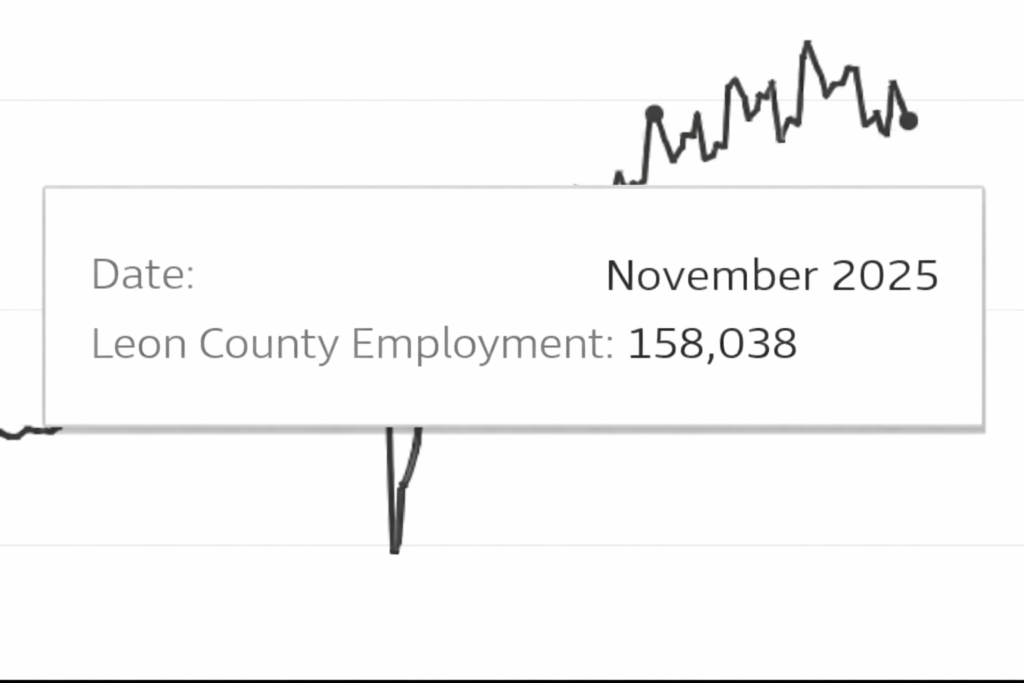
Look at OEV’s own Leon County–only employment chart. In October 2022, Leon County employment stood at roughly 159,000 jobs. By November 2025, employment had fallen to approximately 158,000. Yes, that‘s fewer jobs after three years.
That is not a disagreement over methodology. It is decline.
And then there’s the baseline trick which was the basis for OEV director Keith Bowers claiming a 25,000-job increase since 2020.
That “growth” appears only when OEV measures from April 2020, when employment collapsed during the COVID shutdown. Leon County employment plunged to roughly 127,800 jobs that month, as you can see from the plunge on OEV’s own graph. The Tallahassee MSA shows a similarly sharp trough. Measuring “growth” from that moment is not economic development or job growth. It is recovery from a once-in-a-century emergency.
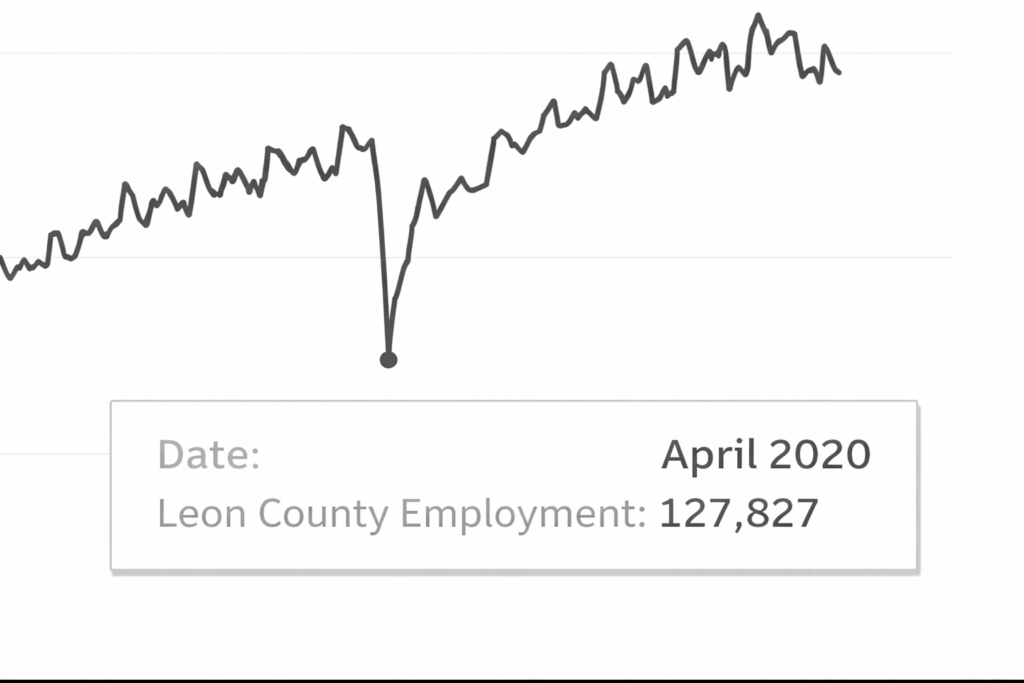
Every community in Florida looks like a success story if you start counting at the bottom of the pandemic crater. Serious analysts do not treat April 2020 as a neutral baseline without heavy caveats. OEV does it anyway — and then quietly ignores the fact that job counts have been anemic in the years since.
Put plainly, OEV is doing two things at once: using the COVID collapse to inflate long-term “growth” claims, while ignoring its own short- and medium-term data showing job losses. That is not optimism. It is selective storytelling.
Even in the best case, job growth lags
Strip away the cherry-picking, and the broader picture becomes unavoidable. Even under OEV’s preferred data, Leon County is underperforming the state. Florida has added jobs, population, and private-sector investment at a pace Tallahassee is not matching. Peer counties are moving forward. Leon County is treading water — and now drifting backward.
Right BEFORE the pandemic, Leon County reported having 152,456 jobs, which means the county has added an anemic 5,500 jobs in more than 5 years, less than 1 percent-per-year growth.
That’s simply an embarrassing record and a monument to weak local government leadership over the past 10 years – and longer.
The population numbers reinforce the same conclusion. Over the past decade, Leon County’s population has grown by just 4.4 percent, while Florida as a whole has surged ahead. At the same time, local government staffing has expanded dramatically. That is not the profile of a dynamic regional economy. It is the profile of a place where the public sector grows faster than the private one.
This is why the sudden impulse to discredit the Florida Chamber’s Scorecard rings hollow. It was the brainchild of widely respected Florida Chamber CEO Mark Wilson who, of course, has no reason to paint one county’s number is anything other than what they actually are.
The Scorecard itself isn’t new or unfamiliar. In fact, local leaders once treated Florida Chamber-style dashboards as a gold standard — so much so that the Tallahassee Chamber built its own Community Scorecard modeled after that framework. When those dashboards showed progress, City Hall was happy to cite them. Now that both state-level data and OEV’s own charts point in the wrong direction, the instinct is to litigate definitions instead of confronting outcomes.
Obfuscation and distraction: A pattern developing?
OEV’s response fits neatly into that pattern. Rather than acknowledging structural underperformance, OEV leans on technical explanations about commuting patterns, seasonal swings, and timing. None of that answers the question residents actually care about: where are the new jobs?
Hospitals hiring nurses is not economic development. Universities adjusting staffing is not economic development. Seasonal rebounds are not economic development. Economic development is additive. It shows up when new companies choose Tallahassee over somewhere else. On that score, the record is thin — and getting thinner.
As an aside, we would also point out that this is the second time in just a few days where local government has been caught being – to put it quite charitably – less than forthright about its actions. The recent CRA debacle, where the identity of a cannabis retailer was concealed, has the same foul aroma.
Massive leadership opportunity
The Tallahassee Chamber of Commerce, now under new leadership, has been notably cautious. “We’re aware of all the numbers,” Chamber officials say. Awareness is fine. Leadership requires clarity. When the Florida Chamber sets a target of more than 14,000 new jobs for Leon County by 2030, and the local pipeline bears no resemblance to that ambition, someone needs to say so plainly.
There is no shame in admitting that Leon County’s economic development strategy is not working. Regions stall. Models age. What matters is whether leaders are willing to confront reality and change course.
At this point, local elected officials — starting with former scorecard cheerleader Mayor Dailey, but including all city and county leaders — have a responsibility to reevaluate the structure, priorities, and accountability of the Office of Economic Vitality. Not as a personal critique of staff, but as a basic governance obligation. When even your own charts contradict your public talking points, the issue is no longer interpretation.
It’s credibility.
This story isn’t about which spreadsheet wins an argument.
It’s about whether Tallahassee is serious about growth.
And right now, denial is louder than the results.