FAC falling for Gulf County’s schtick on the use of private provider inspections
Here we go again: county bureaucrats who don’t like a state law are circling the wagons, slow-walking compliance, and now trying to rewrite reality to make it sound like private providers are bad for residents and business. The Florida Association of Counties’ Community & Urban Affairs Committee is pushing an agenda item dressed up as “citizen protection,” but its own packet undercuts the scare story it’s selling. […]
October 17, 2025FAC falling for Gulf County’s schtick on the use of private provider inspections
Share this
Share
+1
Tweet
Share
Share
TALLAHASSEE — Here we go again: county bureaucrats who don’t like a state law are circling the wagons, slow-walking compliance, and now trying to rewrite reality to make it sound like private providers are bad for residents and business. The Florida Association of Counties’ Community & Urban Affairs Committee is pushing an agenda item dressed up as “citizen protection,” but its own packet undercuts the scare story it’s selling.
The packet’s central claim is “secrecy” — that a contractor can use a private provider without the homeowner’s knowledge. So what? Homeowners hire licensed professionals precisely to make hundreds of technical decisions they don’t micromanage — which inspector to schedule is no different from which truss detail to spec.
The use of private providers, with or without homeowner signoff, is specifically permitted in Florida statutes. Private providers are licensed, certified, and insured to the same state standards as their public-sector counterparts. We all know that the private sector almost always moves more quickly and efficiently than the government. If a homeowner wants to be notified, that’s a contract choice between owner and contractor — not a pretext for counties to kneecap a lawful option.
We’re told private providers were “designed for bigger cities” or post-hurricane spikes, as if rural counties were never in the picture. But the packet also reminds readers the Florida Building Code is meant to apply uniformly across jurisdictions and that private providers have been in statute since 2002 – that’s 23 years! Translation: this isn’t a Miami carve-out — it’s statewide policy that counties have had decades to implement.
On oversight, the sales pitch is “lack of control.” The FAC agenda item tries to bury reality in the fine print, which lists the controls: sworn plan certifications; phase-by-phase inspections; 10-business-day permit timelines after affidavit; sworn certification of code compliance upon completion; and since 2024, mandatory, published audit procedures with results posted for the public.

If “no oversight” is your talking point while you quote the oversight, maybe the talking point needs an audit.
The fiscal bogeyman is even thinner. The packet declares “devastating financial impacts” on Gulf County and its residents, offers no numbers, and then quietly notes that when an owner elects to use a private provider, the permit fee must be reduced to reflect the county’s actual cost savings — with only a reasonable administrative fee allowed. If the math is so devastating, show it. Otherwise, this reads like counties protecting fee revenue, not homeowners.
And, of course, what we know is that it’s the private sector that is taking it in the teeth on this. Gulf County is charging businesses $500 for the use of private providers – and doing absolutely nothing in return.
The legislative rundown is similar sleight of hand. The “loss of local control” language is pinned to a bill that died. The one that passed in 2025 tweaked single-trade inspections and allowed limited post-start use of providers — hardly a system meltdown. Panic without provenance is politics, not policy.
And take a look at who submitted the item: Gulf County — via Brad Bailey. Readers of Red Tape Florida will remember Bailey from our reporting on Gulf’s flat $500 “review” fee when owners chose private providers. Bailey is not a licensed plans examiner nor does he have a building code administrator license, which makes him an odd face for an anti–private provider push built on technical authority. The through-line isn’t safety — it’s bureaucracy protecting its turf.
Bottom line: Florida’s private-provider law gives owners a legal, licensed, insured alternative to the use of local building departments – who often can’t or won’t deliver timely reviews and inspections. The packet trying to kneecap that option reads like a brief for preserving status quo revenue and control — not for protecting consumers. If counties want new tools, say what and why. But stop flouting the law, stop inventing problems, and stop pretending homeowners and small builders are the threat.
FAC shouldn’t embarrass itself further by advancing this item — a straw house, built on sand by an unlicensed builder.
Here’s a better idea – tell Gulf County start following the law.
October 17, 2025
Fees are taxes in sheep’s clothing
Property-tax scrutiny is pushing cities and counties toward a quieter revenue source: fees. In theory, fees are better than taxes because they connect what you pay to what you use. In practice, many of today’s “fees” are compulsory, appear on the property-tax bill, and climb steeply — functioning like taxes by another name.[…]
October 14, 2025Red Tape Florida
Fees are taxes in sheep’s clothing
If you don’t have a choice to pay it, it’s not really a fee
Property-tax scrutiny is pushing cities and counties toward a quieter revenue source: fees. In theory, fees are better than taxes because they connect what you pay to what you use. In practice, many of today’s “fees” are compulsory, appear on the property-tax bill, and climb steeply — functioning like taxes by another name.
Start with public safety. Kissimmee just created a $150 annual fire assessment to fund a shift to a 42-hour work week and new hires; commissioners framed it as the only realistic way to cover rising costs without jacking up the millage. Nearby Ocoee doubled its fire fee from $69.50 to $139.23 per “fire protection unit,” explicitly to avoid a property-tax increase.
The Tallahassee–Leon fire-services fight hinges on the City’s push for a massive fee hike: in June, commissioners backed a roughly 22–25% increase set to take effect in September; after the County voted 5–2 to reject it, the City floated a pared-back 9.98% “Plan B,” then on Sept. 17 voted to sever the interlocal fire-services agreement.
Stormwater is on the same path. Last year Orlando approved a multiyear schedule that lifts the typical residential stormwater bill toward about $21 a month by 2028; city staff said the jump was overdue after years without increases. Oviedo adopted annual stormwater hikes through 2033 that will push typical monthly charges well over $40 to finance a backlog of projects.
If these were simply user fees, you’d pay at the counter and opt out by not using the service. That’s not how they work. Florida’s “non-ad valorem assessments” are levied by local governments, posted on the same bill as your property taxes, and collected by the tax collector. Courts have long noted that special assessments aren’t ad valorem taxes, but they can still be imposed broadly when there’s a defined “special benefit” to property. That’s why fire and stormwater assessments can reach properties that otherwise pay little or no property tax. Orlando even spells it out plainly: stormwater is billed as a non-ad valorem charge on the annual tax bill.
Meanwhile, state leaders are floating big property-tax changes for homesteads, which only increases the incentive for locals to lean on assessments and fees instead. Whether or not those Tallahassee debates go anywhere, the local shift is already happening.
Here’s the rub: calling something a “fee” doesn’t make it feel any different to the family writing the check. A doubled fire assessment and a steep stormwater hike reduce disposable income just like a millage increase would. The main difference is political optics — fees face less backlash and are easier to target, so they’ve become the preferred tool to backfill public-safety payrolls and rebuild aging pipes.
None of this argues for starving core services. Fire protection and stormwater systems are essential, and costs are rising. But honesty demands we treat compulsory assessments like what they are: tax-like charges that deserve the same transparency and accountability as any millage increase.
Three fixes would help. First, add a single “all-in burden” line on local dashboards that shows the combined annual impact of millage, assessments, and utility charges for a typical home. Second, require a true pay-for-performance link—publish the service improvements tied to each increase (response times, staffing levels, flooded-street reductions) and report against them quarterly. Third, sunset schedules automatically unless councils re-vote after a public check-in.
If local government needs more money, make the case and show the results. But let’s retire the fiction that calling it a fee makes it anything less than a tax in sheep’s clothing.
October 14, 2025Red Tape Florida
The Opportunity Still Exists — If We Want It
It’s easy to feel discouraged when examining what hasn’t materialized around the MagLab. There are no recognized clusters of private-sector R&D, no noticeable proliferation of startups, and no regional plan in place to activate this scientific powerhouse as an economic engine for North Florida. […]
September 19, 2025Red Tape Florida
The Opportunity Still Exists — If We Want It
Final part of a series
It’s easy to feel discouraged when examining what hasn’t materialized around the MagLab. There are no recognized clusters of private-sector R&D, no noticeable proliferation of startups, and no regional plan in place to activate this scientific powerhouse as an economic engine for North Florida.
But that reality is not set in stone.
The MagLab’s scientific output is elite. Its researchers are top-tier, and the facility’s presence in Tallahassee—backed by substantial NSF and state investment—is a rare asset.
And there are signs of life.
The Motor Drive Systems and Magnetics (MDSM) annual conference was held in Tallahassee for the first time this year and is returning in 2026.
Companies such as Biofront (disease testing kits) and Piersica (new battery technologies) have a toehold in Tallahassee.
What’s missing is a comprehensive strategy: a bold, shared vision among FSU, FAMU, TSC, the city, the county, state government and the business community. One that moves beyond resting on the lab’s reputation – and empty slogans like “Magnetics Capital of the World” — and actually delivers tangible results.
That means:
- FSU must open the gates — removing barriers to private-sector partnerships.
- The city must prioritize infrastructure, particularly power and site readiness for innovation-driven firms.
- The Chamber and economic development agencies must treat the MagLab as a keystone and persist when it comes to getting alignment among all the stakeholders listed above.
- And speaking of economic development, a collaboration between local government and the private sector must dramatically rework how OEV interacts with prospects to create a much higher level of agility and creativity.
- Leadership must emerge – that can convene stakeholders and tackle the issues that have led to 30 years of stagnation.
In the short term, here are 5 more quick wins that could be achieved in the next 24 months.
- Launch the MagLab Commercialization Challenge
An annual, high-visibility competition offering seed funding, lab access, and expert mentoring to startups or companies that can develop market-ready products from MagLab research. Winners commit to establishing or expanding operations in Tallahassee, turning lab breakthroughs into local jobs.
- Launch an “Innovation Sites” Map
Publish an online, publicly accessible map showing shovel-ready industrial parcels, with details on power capacity, broadband speed, and zoning — the same intel site selectors demand on day one.
- Secure a Signature Industry Partner
Land one high-visibility corporate tenant in advanced materials, clean energy, or biotech that actively uses MagLab capabilities, and announce it prominently.
- Host a National Tech + Science Summit in Tallahassee
Use the MagLab as the anchor venue for a multi-day, industry-heavy event — following the MDSM model but broadened to attract venture capital, suppliers, and manufacturing prospects.
- Set a Goal – and Achieve it
Commit to recruiting at least five MagLab-related companies and creating 250 new private-sector R&D/manufacturing jobs by the end of year two — and publish progress quarterly.
Conclusion
There is no way around it – Tallahassee’s inability to build an economy around the MagLab is a massive underachievement.
But it’s not too late to turn things around.
It starts with acknowledging how little has been done so far … and recognizing just how much is still possible through collaboration, humility, creativeness and energy.
September 19, 2025Red Tape Florida

Profit-sharing at a nonprofit? Fair’s bonus payouts, $25k signing bonus raise red flags
After Red Tape Florida first reported about the now-infamous $28,000 retirement watch, fallout was swift, with local and state officials demanding an investigation. Now, a new revelation: The incoming executive director of the Fair — who has defended the board’s decision to buy the luxury watch for her predecessor — herself received a $25,000 cash signing bonus upon being hired.[…]
September 17, 2025Red Tape Florida
Profit-sharing at a nonprofit? Fair’s bonus payouts, $25k signing bonus raise red flags
“Profit sharing” at a nonprofit.
A $25,000 signing bonus.
A salary higher than the 20-year veteran a new director replaced.
Internal documents and interviews obtained by Red Tape Florida reveal how the North Florida Fair is rewarding its leaders — and why officials are demanding answers.
After Red Tape Florida first reported about the now-infamous $28,000 retirement watch, fallout was swift, with local and state officials demanding an investigation.
Now, a new revelation: The incoming executive director of the Fair — who has defended the board’s decision to buy the luxury watch for her predecessor — herself received a $25,000 cash signing bonus upon being hired.
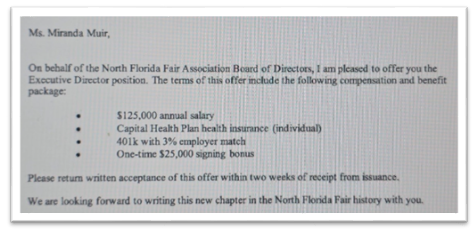
In a Dec. 5, 2024, offer letter from then-board Chair Rachel S. Pienta – who resigned in protest after the watch controversy — new fair manager Miranda Muir was offered a contract that included:
- $125,00 annual salary
- Health insurance
- 401k with 3 percent employer match
- A one-time $25,000 signing bonus
Minutes from the September 12, 2024, meeting reveal a discussion about the offer to Muir, who had been attending meetings since 2023 as the heir apparent to the director’s job and seemed a lock for the position.
While Harvey had not yet set a retirement date, the board moved toward making an offer to Muir. Initially, a base salary of $100,000 was discussed – below the long-time outgoing manager Harvey’s salary of $112,000. But board member Marcus Boston said he “went on the internet” and found a higher range
A committee was formed and there was also a mention of one-time moving expenses, but no mention of any sort of bonus. In the end, Muir received a base salary more than 10 percent higher than Harvey — and the $25,000 bonus.
Board member Steve Hurm, contacted this week by Red Tape Florida, said the board never discussed a signing bonus. “That information was never brought to me and if it had been I would have objected,” said Hurm.
Pienta declined to comment on the Muir offer saying in a statement: “I want to reiterate that it has been an honor and a privilege to serve on the North Florida Fair board over the years, including as Board President/Chair since 2024. I have stepped down from that position and will continue to focus on and strengthen our local 4-H programming and participation in the Fair moving forward.”
“Profit sharing”
Meanwhile, the bonus money has been flowing at the fair for years and has been referred to at meetings and in minutes as “profit-sharing.”
When Hurm first heard that term he was alarmed.
“When a board member mentioned ‘profit-sharing,’ Hurm recalled, “I interrupted and said it was a nonsensical term – we’re a non-profit.”
By law, nonprofits don’t have “profits” to share. The IRS flatly prohibits it: no part of a charity’s earnings may inure to the benefit of insiders. Reasonable salaries? Sure. Profit sharing? That’s the language of Wall Street, not a 501(c)(3).
Watchdog groups warn boards constantly about even appearing to funnel surpluses to executives. Florida law is equally clear: compensation must be reasonable, but distributing income to officers is off-limits. And yet, here is a nonprofit agricultural fair association putting “profit sharing” in black and white — not whispered in a back room, but recorded as if it were standard practice.
It’s not just sloppy language. It’s a governance red flag that makes the organization look less like a community charity and more like a for-profit corporation cosplaying as one.
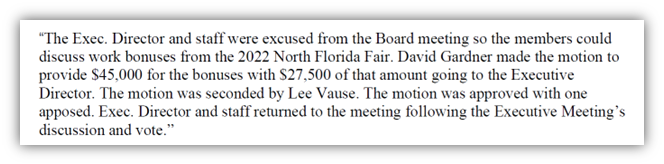
In 2023, Harvey received $27,500 in bonus money for strong performance of the annual fair. Minutes for 2024 aren’t available, but the 2025 proposed budget shows that total staff bonuses in 2024 were $74,000.
It is not clear if Harvey received a bonus this year for 2024 fair performance, but the 2025 total budget for bonuses rose to $100,000.
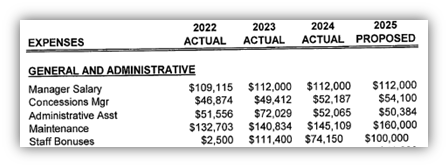
In the North Florida Fair’s most recent publicly available form 990 – from fiscal year 2023 – Harvey had a reported $178,000 in total compensation. Of that, according to schedule J on the form, $103,715 was base salary, $63,500 was bonuses, $7,619 was “other compensation” and $3,726 was retirement and deferred compensation.
Also that year, two board members of the non-profit were paid — $2,809 to George Kolias and $571 to Carole Abbott. The watch controversy drew withering criticism from Leon County Commissioners Bill Proctor, Christian Caban and Brian Welch at Wednesday’s meeting, while Commissioner Nick Maddox did not appear as concerned. Hanging over the issue is $30 million in proposed Blueprint funding to enhance the fairgrounds. That funding was frozen at a recent Blueprint meeting by a 9-3 vote with Tallahassee Mayor John Dailey, City Commissioner Dianne Williams-Cox and Maddox voting against.
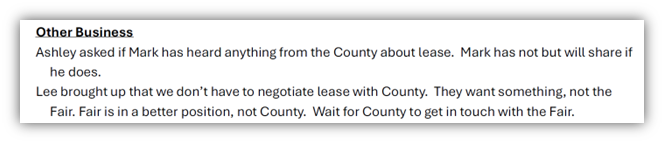
Also a factor is Leon County’s lease with the Fair.
But before the retirement watch controversy broke, it was fair board members who thought they had the upper hand in negotiations with Leon County over the fair’s $1 lease.
Board member Lee Vause Jr., who remains on the board after supporting the retirement gift, was quoted in the minutes responding to a conversation about the Fair’s lease with Leon County by saying: “We don’t have to negotiate lease with County. They want something, not the Fair. Fair is in better position, not County. Wait for County to get in touch with the Fair.”
September 17, 2025Red Tape Florida
Building a MagLab ecosystem: Is it FSU’s job or a wide array of stakeholders?
Florida State University secured the bid and has drawn world-class researchers to the MagLab. It has kept the MagLab operational, but without the lavish upgrades seen elsewhere on campus (Doak Campbell Stadium, student union, etc.). The successes at the MagLab have primarily been the product of the scientists and researchers doing the actual work. […]
September 15, 2025Red Tape Florida
Building a MagLab ecosystem: Is it FSU’s job or a wide array of stakeholders?
Part 4 of a series
Florida State University secured the bid and has drawn world-class researchers to the MagLab. It has kept the MagLab operational, but without the lavish upgrades seen elsewhere on campus (Doak Campbell Stadium, student union, etc.). The successes at the MagLab have primarily been the product of the scientists and researchers doing the actual work.
And when it comes to translating that scientific prestige into broader economic benefits for Tallahassee, FSU’s role becomes more complex and, at times, restrictive.
1. The self-evaluation problem
FSU regularly publishes economic impact reports estimating the MagLab’s local annual output. However, these reports are produced by FSU’s own research center (CEFA) and rely heavily on FSU-generated spending data, rather than independently audited outcomes or private-sector-led growth.
This raises concerns about potential bias and the absence of independent validation.
2. A culture of insularity
While many universities collaborate with local stakeholders, FSU appears to operate with limited outward engagement. Although Innovation Park – over which the university now has much more control — hosts some private sector entities, it remains predominantly academic and research-focused, rather than a thriving hub of public-private innovation. And there is no way around the fact that the park’s location – save for its proximity to the airport – is not desirable.
3. Gatekeeping vs. partnering
Some business leaders feel FSU treats the MagLab as its own asset—rather than a community resource. Further, FSU does not give the MagLab its own voice to be a community resource because all the business-related deals must go through FSU-sponsored research.
These perceptions may ultimately undermine trust and deter entrepreneurial or investment opportunities.
4. No clear economic vision
FSU lacks a visible, comprehensive plan to translate the MagLab’s scientific strengths into a citywide economic strategy. Unlike institutions that launch innovation districts, venture funds, or commercialization pipelines, no comparable effort is evident here.
What Could Change
This isn’t a critique of FSU’s scientific excellence but a call for strategic recalibration. FSU should:
- Invite independent review of its economic impact claims.
- Formulate a public-private economic growth strategy centered around the MagLab.
On this point, there are numerous examples of institutions that have taken the lead. North Carolina State University’s Centennial Campus in Raleigh is a 1,300-acre, university-planned public-private research community that intentionally recruited more than 75 corporate, government, and nonprofit partners to co-locate with academic departments and research centers — creating thousands of private-sector jobs and driving Raleigh’s transformation into a tech hub. Similarly, Arizona State University’s SkySong Innovation Center redeveloped a shuttered mall into a thriving mixed-use campus housing over 80 companies, blending academic research with industry to generate sustained regional investment and employment. These projects weren’t incidental spinoffs — they were university-designed strategies to harness institutional assets for local economic growth. - Expand partnerships with private-sector firms, accelerators, and developers.
- Reposition itself not only as a scientific steward, but as a partner in regional prosperity.
If the MagLab is truly a national asset, its benefits should reach beyond campus boundaries.
And then the burden shifts to other stakeholders:
Local government: The lack of a community economic development vision is apparent to anyone paying attention. That has to change. Further, businesses that visit our market lament the bulky, clumsy structure of the Office of Economic Vitality with its unclear lines of decision-making and lack of dexterity. That has to change, too.
State government: Understandably, Tallahassee is viewed as a business-unfriendly, anti-growth, hyper-political town. But the potential of a MagLab-driven economy is too great to let those realities overcome it.
Private sector: The Chamber has simply not been effective in convening the public sector stakeholders to solve this problem. Perhaps a different group of strong business leaders is up to the challenge.
Coming next: Is it too late? (Spoiler alert: No)
September 15, 2025Red Tape Florida

What could have been built around the MagLab (and what still could be)
In August 1990, the National Science Foundation awarded the National High Magnetic Field Laboratory to FSU — a decision that surprised many, including MIT, which had operated the Francis Bitter National Magnet Laboratory for 30 years. The original promise was vivid: a world-class scientific facility anchoring Florida’s capital city in the emerging area of magnetics. […]
September 11, 2025Red Tape Florida
What could have been built around the MagLab (and what still could be)
Part 3 of a series
In August 1990, the National Science Foundation awarded the National High Magnetic Field Laboratory to FSU — a decision that surprised many, including MIT, which had operated the Francis Bitter National Magnet Laboratory for 30 years. The original promise was vivid: a world-class scientific facility anchoring Florida’s capital city in the emerging area of magnetics.
Three decades after FSU won the competition to host the National High Magnetic Field Laboratory, the scientific mission of the MagLab is undeniably successful — the lab holds multiple world records and attracts top researchers from around the globe. But in terms of local economic impact, the results have fallen short of the original vision.
So, what would success have looked like? Here are four areas where Tallahassee has not kept pace with other national lab communities — and where it still has an opportunity to improve:
1. A research park that catalyzes private-sector growth
In thriving innovation districts, anchor institutions spark the development of adjacent private-sector firms. At Los Alamos and Oak Ridge, for example, national labs are surrounded by ecosystems of federal contractors, startups, and applied research firms.
Tallahassee’s, by contrast, is dominated by public and academic entities. It mainly consists of empty lots and aging buildings, except those built by FSU which have no connection to the MagLab. As detailed in part 2, the commercialization pipeline remains underdeveloped.
2. A tech corridor with venture capital and startup activity
Florida ranks among the top ten states for total venture capital investment — but virtually none of that flows through Tallahassee. From 2012 to 2021, the state attracted over $85 billion in VC and private equity, with nearly all of it concentrated in Miami, Tampa, and Orlando.
In Tallahassee, tech-based entrepreneurship remains rare, and there are very few examples of biomedical spinoffs or next-generation materials companies directly tied to MagLab research.
3. Strategic alignment between lab, government, and infrastructure
Cities like Los Alamos and Oak Ridge benefit from coordinated local and state investment in infrastructure, workforce development, and commercialization strategies to support lab spillover.
Tallahassee lacks such alignment. Its electric grid and zoning regulations have not been meaningfully modernized to attract energy-intensive firms. And the MagLab has also failed to embrace current energy solution technologies, instead choosing to stay the course from the early 1990s on how energy is managed – which is wasteful given what is available today.
4. Brand equity and national recognition
The MagLab is recognized in the scientific community for its world-record magnets — but its national profile is surprisingly low outside of research circles.
Unlike Oak Ridge or Los Alamos, which are synonymous with scientific innovation, Tallahassee rarely markets the MagLab as a signature asset. That’s not a failure of the science — it’s a missed opportunity in branding and communications.
5. More and better energy capacity and usage
If Tallahassee ever hopes to build an innovation economy around the MagLab, a basic question must be asked: Is the city even equipped to support one?
The answer is: maybe, maybe not.
Start with electricity. The MagLab is a power-hungry facility — among the largest single energy consumers in the region. In summer 2024, reports circulated that Florida State University had been asked by the City of Tallahassee to shut down MagLab power operations for an hour due to load concerns. This raises a fundamental red flag about whether our city-owned utility can support the demands of energy-intensive research or industrial-scale commercial spinoffs.
One issue is that the MagLab is still using 1990s-era magnets that are high-energy consumers. Existing technology would make these magnets operate more efficiently and lower power consumption when it comes to cooling and powering the magnets.
The MagLab’s most powerful magnets can draw between 18 and 33 megawatts. At the upper end, that’s enough power to supply roughly 20,000 U.S. homes. Tallahassee apparently has no surplus generating capacity – where would the power come from if a new data center, battery plant, or high-wage advanced manufacturer was eyeing Tallahassee?
6. Site readiness
Beyond electricity, there’s also site readiness. Tallahassee lacks shovel-ready parcels that are truly equipped for tech-sector investment. In communities like Oak Ridge and Los Alamos, federal labs are surrounded by pre-zoned, utility-ready development pads supported by regional industrial recruitment efforts. Not so here.
Bottom line: Even if the MagLab did produce a wave of commercialization, it’s unclear whether Tallahassee could physically support the growth. Our infrastructure isn’t ready, our energy grid is strained, and our land inventory is weak.
The Good News
It’s not too late. The MagLab remains among the world’s top facilities in its field. Realizing its broader potential will require:
- A serious commercialization strategy
- Infrastructure enhancements to attract private investment
- Deliberate partnerships across academia, government, and industry
- Independent economic metrics and bold regional targets
A world-class lab deserves a world-class regional strategy. Tallahassee has a second chance — if its leaders seize it.
Coming next: Is this an FSU problem or an all-the-other-stakeholders problem?
September 11, 2025Red Tape Florida
“Completely inappropriate”: Local, state leaders outraged over luxury watch gift
Leon County Commission Chair Brian Welch blasted actions by the North Florida Fair board on Friday as “completely inappropriate and utterly confounding,” adding he will seek a review by both Leon County Government and the Blueprint Intergovernmental Agency to determine “what level of oversight we have in the management of the fairgrounds.” […]
September 9, 2025Red Tape Florida
“Completely inappropriate”: Local, state leaders outraged over luxury watch gift
Leon County Commission Chair Brian Welch blasted actions by the North Florida Fair board on Monday as “completely inappropriate and utterly confounding,” adding he will seek a review by both Leon County Government and the Blueprint Intergovernmental Agency to determine “what level of oversight we have in the management of the fairgrounds.”
“I cannot believe that a non-profit board that oversees the administration of a public asset would act in such an irresponsible way,” Welch wrote. “I intend to ensure that both Leon County Government and the Blueprint Intergovernmental Agency investigate this situation as soon as possible.”
Tallahassee City Commissioner Jeremy Matlow also weighed in on Red Tape Florida publisher Skip Foster’s Facebook page saying the gift was “incredibly out of touch.”
Florida State Rep. Allison Tant also registered her outrage: “If this watch was paid with anything supported by tax dollars, it should be returned and refunded,” Rep. Tant said. “And the fairground authority should be audited. This is not what public or not-for-profit funds should be used for.”
Welch’s post landed as social media comments were unanimously outraged and featured calls for accountability. A sampling:
Anger over spending and priorities
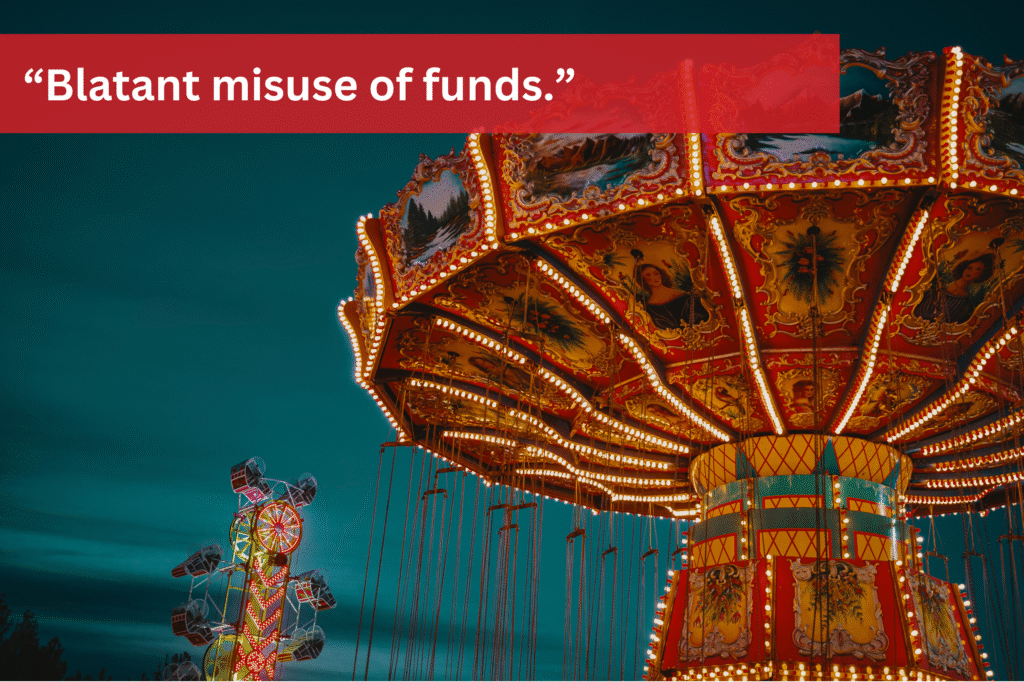
- “Blatant misuse of funds.” — Allison Flynn
- “Personally, I don’t think anyone should have a $35,000 watch when children are homeless and/or going hungry!” — Liz Jameson
- “$200 watches work just as well.” — Colleen Castille
Credit for dissent and calls to return money
- “Proud of Rachel Sutz Pienta and the others who resigned. Now, how about the director refuse to take it and return the $? That’s what should happen next.” — Carrie Boyd
- “What incredible audacity! … Bravo to Rachel Sutz Pienta and the other board members who refused to go along with this…” — Rick Oppenheim
Governance and oversight concerns
- “Truly outrageous. I wonder if an audit would reveal other reckless expenditures.” — Bill Berlow
- “The fairgrounds board has had a cloak of protection… They answer to no one. This can only change with leadership addressing it.” — Henree D. Martin
- “This is the ‘rest of the story’ I’ve been waiting for.” — Pam Jordan Anderson
Bigger-picture ideas
- “The fairgrounds need to relocate to Gadsden County. Become truly regional.” — Ed Murray Jr.
Why it matters
The North Florida Fair is run by a private not-for-profit association but operates a community asset and regional venue. That public–private mix is fueling questions about who sets the rules, how directors are chosen, and what public oversight exists.
What’s next
- Welch says he’ll press for County/Blueprint inquiries into oversight levers (leases, grants, interlocal agreements).
- Commenters are calling for the Fair Association to publish its bylaws, explain how board seats are filled, and return any inappropriate purchases.
- Several readers urged a full audit and a public workshop before any board changes move forward.
RTF has requested the association’s governing documents and any county/Blueprint agreements related to the fairgrounds. If you have records or perspectives to add, email info@redtapeflorida.com.
September 9, 2025Red Tape Florida

$35,000 retirement watch for North Florida Fair manager prompts board resignations
The non-profit North Florida Fair Association board has voted to spend roughly $25,000 on a luxury retirement watch for longtime fair manager Mark Harvey, based on public records obtained by Red Tape Florida. […]
September 8, 2025Red Tape Florida
$35,000 retirement watch for North Florida Fair manager prompts board resignations
The non-profit North Florida Fair Association board has voted to spend roughly $25,000 on a luxury retirement watch for longtime fair manager Mark Harvey, based on public records obtained by Red Tape Florida.
That number bears repeating: twenty-five thousand dollars. On a watch. For a man already paid over $174,000 a year in salary, bonus, and benefits from a nonprofit that exists only because of public trust and taxpayer-owned land. Combined with a $10,000 donation from a fair vendor, it adds up to a $35,000 retirement gift.
The razor thin 5-4 vote led to multiple resignations from the board, including by its president and secretary.
How We Got Here

The idea began innocently enough. Some board members floated the notion of a nice retirement gift for Harvey, who, by all accounts, has had a long and successful run as the fair manager.
But it quickly spiraled. Pressed by a board member to choose a gift, Harvey identified an Audemars Piguet Code 11.59, a high-end timepiece more likely seen on Wall Street than at a county fair. At one point, a $42,000 Rolex was even under discussion.
To defray the cost, a vendor pledged $10,000. The rest — about $25,000 — will come directly from fair funds.
The Dissenters
Not everyone was willing to sign on. In his resignation letter immediately after the meeting, board secretary Steve Hurm cited Florida Statute 616.07(2), which makes clear that fair association property is public property to be held in trust for the “legitimate purpose of the association.” He argued that spending tens of thousands on a luxury watch flouted that responsibility.
Board president Rachel Pienta echoed the concerns in her resignation email, warning she could not defend the board’s action. Their point was straightforward: nonprofits benefiting from public assets cannot treat themselves like private clubs or corporations. Also submitting resignations: board members Ashley Edwards and David Gardner.
How the Vote Went Down
If the substance was troubling, the process was worse. After a June meeting lost its quorum, the board initially conducted an email “survey” vote, even though one board member had warned that such votes are improper and have no standing under Robert’s Rules.
That vote was deemed invalid and at the board’s specially called July 7 meeting, the $25,0000 expenditure was approved by a 5-4 vote.
The Optics
The fairgrounds sit in a neighborhood where the median household income is around $25,000 — less than the cost of this watch. The board’s decision effectively told those families: we think a departing executive’s wrist deserves more than what you live on for a year.
This is, at best, colossally bad judgment.
The new fair manager, Miranda Muir, denied a Red Tape Florida public records request stating that the association is “not subject to the State of Florida Sunshine Laws.” Hurm, an attorney, disagrees. He warned the board in a May 7 email that “this is not something we can discuss or vote on without violating the Sunshine law.”
Red Tape Florida was able to obtain the documents despite Muir’s stonewalling.
Why It Matters — and the RTF Connection
The North Florida Fair Association is not a private outfit. It is a nonprofit that exists because of public trust, tax-exempt status, and free use of Leon County land, including taxpayer-funded improvements. To wit, it has recently been in the news because more than $30 million of taxpayer dollars have been allocated via Blueprint 2020 to improve the fairgrounds’ facilities.
With these public dollars come an obligation to act as stewards, not spendthrifts.
Instead, the board demonstrated the classic symptoms of bureaucracy-creep that Red Tape Florida was built to expose. Quasi-public bodies, cushioned by tax breaks and government assets, start operating as if the rules don’t apply to them. Transparency slips, accountability erodes, and insiders reward themselves at the public’s expense.
The fair itself remains a cherished community institution. But its board just sent a message that stewardship takes a back seat to self-indulgence. We salute the board members who resigned in protest – this action was indefensible and wrong.
A watch may tell time, but this one tells a deeper story — of poor judgment, of blurred lines between public and private, and of how easily trust can be squandered. Unless new board leadership steps in, the North Florida Fair Association may find that credibility, once lost, is far harder to buy back than any luxury timepiece.
September 8, 2025Red Tape Florida

The missing middle — Why Tallahassee’s magnetics ecosystem never formed
A research facility doesn’t create economic value by itself. It needs an ecosystem — private-sector firms, infrastructure, and capital — to translate science into jobs. Tallahassee has failed to build that.[…]
September 4, 2025Red Tape Florida
The missing middle — Why Tallahassee’s magnetics ecosystem never formed
Part 2 in a series
A research facility doesn’t create economic value by itself. It needs an ecosystem — private-sector firms, infrastructure, and capital — to translate science into jobs. Tallahassee has failed to build that.
The reasons are structural:
- Limited commercialization pipeline.
Florida State University has not established a robust tech-transfer process to consistently spin out companies from MagLab research. In fiscal year 2023, FSU generated just $251,000 in licensing and royalty revenue, a modest figure compared to top-performing research universities.
- Lack of a corporate cluster.
Unlike national labs such as Oak Ridge and Los Alamos, the MagLab is not surrounded by a dense network of R&D firms or advanced manufacturers. Even within Innovation Park, there is little evidence of a thriving private-sector ecosystem linked to the lab’s research.
- Inadequate infrastructure.
Tallahassee’s electric grid, industrial land supply, and air travel connectivity are frequently cited by site selectors and business leaders as barriers to growth. The MagLab itself accounts for 7–8% of the city’s total electricity use — and reports suggest it has been asked to reduce load during capacity constraints.
- No targeted incentives.
Unlike Oak Ridge, TN — where city and county officials have deployed tailored incentive packages to attract lab-adjacent companies — Tallahassee and Leon County have no specific economic development tools tied to the MagLab’s potential spinoffs or commercialization opportunities.
- Insufficient marketing.
There is no dedicated marketing campaign to promote the MagLab to corporate site selectors, research parks, or innovation investors. Though the MagLab is featured in some general OEV (Office of Economic Vitality) materials, there is no sustained marketing outreach effort positioning it as a business development asset.
- Community culture unfriendly to business
Tallahassee’s reputation precedes – it is widely known in business circles that the city is not easy to work with when it comes to permitting and economic development. OEV’s clunky structure prevents even talented leaders from succeeding.
Despite the reality on the ground, FSU often touts the MagLab’s economic development impact on the community. But things aren’t as rosy as the picture that is painted.
Economic ‘impact’
At first glance, the economic impact figures associated with the MagLab sound impressive. Florida State University and its supporters often cite large numbers — including a $325 million annual statewide impact. But these estimates rely heavily on internal modeling, and a closer look at the components raises questions about what kind of impact is really being measured.
Let’s break it down.
1. Who created the impact estimates?
The most commonly cited impact numbers trace back to FSU-affiliated analysts (CEFA) and FSU publications, not an independent third party — e.g., $325M statewide (FSU BOT materials) and $221M Tallahassee / $325M Florida (MagLab “Economic Impact” PDF sourced to CEFA 2019). To date, there is no publicly available economic impact report on the MagLab conducted by an unaffiliated national consulting firm or neutral economic research organization.
2. What’s actually included in the “impact”?
The $325 million impact figure includes:
- Salaries and benefits paid to lab and university staff;
- Federal and state funding allocated to the lab;
- Construction, equipment, and operational spending;
- Indirect and induced effects estimated from lab visitors, vendor spending, and employee consumption.
These are typical components of input-output modeling — they reflect the flow of public funds through the regional economy. In other words, much of the “impact” represents economic activity, not necessarily private-sector growth or wealth creation. There is little in the estimate to suggest substantial returns in the form of new tax revenue, private investment, business formation or job creation.
Unfortunately, these numbers are usually lapped up or parroted by business advocates and the media.
3. What’s missing from the equation?
In economic development terms, the presence of a high-profile research facility like the MagLab would ideally spark spinoff companies, attract venture capital, support industry partnerships, and expand the local tax base. However, publicly available reports and presentations from the MagLab do not document a pattern of commercialization successes, private-sector relocations, or large-scale job creation beyond the lab itself.
One exception is Danfoss Turbocor, a private manufacturer that has cited the MagLab as a factor in its decision to grow in Tallahassee — a point noted in an FSU Board of Trustees presentation.
4. How does MagLab compare to national peers?
Consider Oak Ridge National Laboratory (ORNL) in Tennessee, which has built a significant economic ecosystem around federal research. DOE’s Oak Ridge Reservation — which includes ORNL — generated $7.2 billion in economic impact and supported ~43,000 jobs in Tennessee in FY2020 (ETEC/Baker Center study). ORNL’s role is amplified by robust technology transfer and manufacturing partnerships.
Now, again, to be fair, ultra-high field magnets (the Mag Lab’s primary focus) have limited manufacturing purpose right now. But that didn’t stop Danfoss from seeing the potential of an ecosystem forming and of the proximity to research.
Even accounting for scale differences, the gap in economic reach and private-sector spillover is substantial. Despite being a world-class scientific asset, the MagLab has not yet catalyzed a broader innovation or manufacturing cluster in Tallahassee.
Bottom line
The MagLab’s economic impact claims are based on modeling of public spending and its local ripple effects — not on independent analysis of long-term economic transformation. While the lab clearly delivers scientific value and supports high-wage public-sector employment, the evidence for substantial private-sector growth around it is limited. An independent economic assessment could help clarify the lab’s true role in regional development — and what might be done to enhance it.
Coming next: What could have been and could still be
September 4, 2025Red Tape Florida
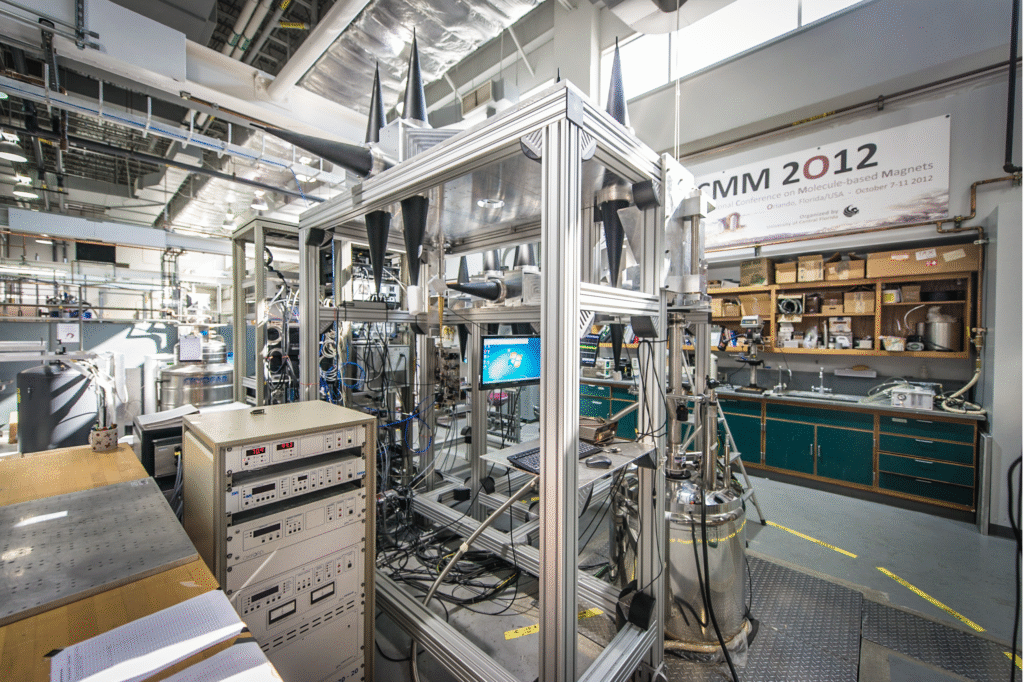
SPECIAL REPORT: How Tallahassee failed to build an economy around the Mag Lab
In the early 1990s, Tallahassee won what looked like a jackpot: the National High Magnetic Field Laboratory. With more than a billion dollars in federal investment, a dedication ceremony featuring Vice President Al Gore, and Gov. Bob Graham hailing it as a “lynchpin of economic development,” the MagLab was sold as Tallahassee’s ticket to a high-tech future. […]
September 2, 2025Red Tape Florida
SPECIAL REPORT: How Tallahassee failed to build an economy around the Mag Lab
Introduction
In the early 1990s, Tallahassee won what looked like a jackpot: the National High Magnetic Field Laboratory. With more than a billion dollars in federal investment, a dedication ceremony featuring Vice President Al Gore, and Gov. Bob Graham hailing it as a “lynchpin of economic development,” the MagLab was sold as Tallahassee’s ticket to a high-tech future.
The promise was classic government pitch: build a world-class research facility and the private sector will follow. Startups will sprout, high-wage jobs will cluster, and a sleepy capital city will become a science and innovation hub.
Three decades later, the private-sector return can be counted on one finger. Aside from oft-cited Danfoss Turbocor, there’s no visible cluster of spinoffs or manufacturing base tied to MagLab expertise. The only impact figures in circulation are FSU-affiliated: an earlier CEFA study estimated about $90 million a year in economic output for the Tallahassee MSA; newer FSU/CEFA materials scale that to ~$221 million in Tallahassee and ~$325 million statewide, numbers subsequently echoed in Board of Trustees decks and congressional letters. These are input-output accounting results built largely on university payroll and procurement, not independent evidence of new enterprise formation.
This disconnect between the hype and the reality is exactly why Red Tape Florida exists. Too often, bureaucrats and institutions oversell projects, pocket the accolades, and move on — while taxpayers and communities are left wondering where the promised growth went. If the MagLab had landed in Austin, Raleigh, or Nashville, would it have been wasted potential or a genuine catalyst? Tallahassee’s record speaks for itself.
The MagLab is an incredible scientific asset. And there are hopeful signs, including strong research performance and the return in 2026 of an important magnetics conference to Tallahassee.
But as an economic engine, it’s a cautionary tale of bureaucratic inefficiency and missed opportunity. Over the next several installments, Red Tape Florida will dig into how this happened, what lessons can be learned, and what it will take to finally turn an expensive, underperforming government project into the spark of private-sector growth it was supposed to be.
Part 1: Los Alamos vs. Tallahassee — A Tale of Two Lab Towns
To understand what’s missing in Tallahassee, consider Los Alamos, New Mexico — home to another National Science Foundation-supported lab: Los Alamos National Laboratory (LANL). The contrast is striking.
LANL has been a magnet for defense tech firms, manufacturing contractors, and federally funded spinoffs. More than 600 companies are part of the regional contractor network. The lab directly or indirectly supports over 25,000 jobs in the state — many in the private sector.
Meanwhile in Tallahassee, the MagLab supports fewer than 500 jobs — most of them public university employees. There is no comparable cluster of firms, no surge of startups, no downstream manufacturing ecosystem.
Why the difference?
First, to be fair, Los Alamos and Tallahassee are not perfect analogs. LANL is a massive national security lab with a multibillion-dollar budget and a mission tied directly to federal defense contracting. The MagLab is smaller, academically focused, and funded by the National Science Foundation.
But that doesn’t excuse the failure to build any real ecosystem around a world-class research facility. Other communities have done far more with less.
Take for example the Sandia Science & Technology Park in Albuquerque — 44 companies/organizations, 2,018 on-site employees (July 2025), nearly $500M cumulative public+private investment and 25-year impacts include $7.7B in wages and 6,500+ jobs tied to park companies
LANL’s operator, Triad National Security LLC, actively recruits corporate partnerships and administers grants to private companies. In contrast, the MagLab is operated by a public university and has focused primarily on academic research — not economic development. The new regime in Wescott has promised more results in this area. So far, evidence is hard to find.
In Los Alamos, the lab is an anchor for a private-sector ecosystem. In Tallahassee, it’s a silo.
Basically, it boils down to leadership and collaboration.
Coming next: The missing middle – why Tallahassee’s ecosystem never formed.
September 2, 2025Red Tape Florida