
From contradictory records to weak results, new documents reveal a strategy that isn’t competing
By Skip Foster, Red Tape Florida
If you want to understand Tallahassee’s economic development problem, start here:
The Office of Economic Vitality was asked by Red Tape Florida to produce the last three years of marketing and promotional spending — broadly defined to include advertising, sponsorships, memberships, events, and payments to third parties.
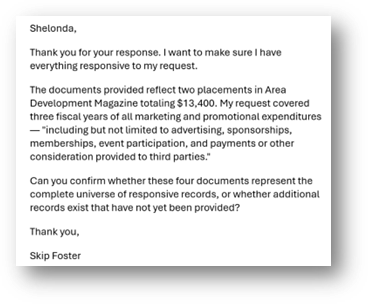
OEV’s initial response produced just two print ads totaling roughly $13,400.
After a follow-up request from Red Tape Florida, expressing skepticism that the response was complete, OEV produced a second batch of records showing approximately $132,700 in additional spending, bringing the total to about $146,000.
But even that was not the full picture. Separate internal materials reviewed by Red Tape Florida identify additional marketing channels that do not appear in either records production.

This doesn’t just raise questions about transparency.
It helps explain a broader pattern — one that shows up in limited out-of-market reach, heavy in-state image-building, inconsistent data, and a continued failure to turn Tallahassee’s most unique asset into a driver of economic growth.
And that pattern becomes clearer the deeper you go.
A trend of in-state spending
Start with where the money is actually going.

Of the roughly $146,000 in documented spending, a significant share is tied to Florida Trend — a publication with strong visibility inside Florida, but limited reach among national site selectors or companies making location decisions outside the state.
There is nothing inherently wrong with advertising in Florida Trend.
But it is not, by itself, an out-of-market recruitment strategy.
Economic development is not about being known in Florida. It is about competing outside of it.
And on that front, the numbers are striking.
Over the same three-year period, just $13,400 — less than ten percent of total documented spending — went to Area Development Magazine, one of the core national outlets used to reach site selectors and corporate decision-makers.
Those dollars bought a total of two print ads. In three years.
That imbalance is not incidental. It reflects a strategy that is far more focused on in-state visibility than on national competition.
And that’s before we consider what OEV – funded with $20 million in tax dollars over 10 years — didn’t include in either of its public records responses.
Missing marketing
A slide from an August 2025 OEV presentation to a local advisory board, obtained by Red Tape Florida, lists “Recent & Scheduled Advertising” placements that include Tallahassee Reports, Capital Outlook, airport advertising, Business in Focus, LIVE in Tallahassee, and unspecified digital buys.
If these placements are part of OEV’s marketing activity, why do they not appear in either response to a public records request that explicitly asked for all marketing and promotional expenditures? How much was spent in each area? What were the results?
Beyond the lack of transparency, who is this strategy designed to reach?
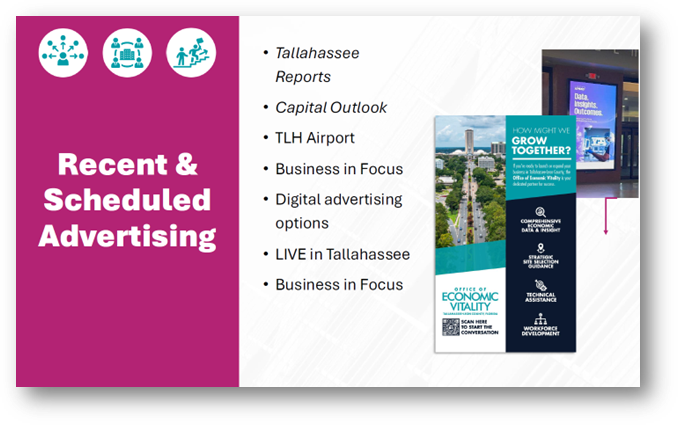
Several of these outlets are local or niche platforms with limited exposure beyond Tallahassee or North Florida. Others are general business features that do not specifically target site selectors or corporate decision-makers.
And, of course, as Red Tape Florida readers know, Tallahassee Reports dramatically changed its coverage of the City once taxpayer dollars started flowing its way. OEV fits the pattern – Red Tape Florida could not find a single story critical of OEV since 2020.
Back to marketing focus, it matters because it’s not just about visibility — it’s about visibility in the right places.
And there is little in this list that suggests a sustained effort to reach the audiences that actually drive location decisions.
But the issue is not just incomplete records or reaching the right audience. The performance data in the same presentation raises an equally important concern.
Across multiple slides, OEV reports digital and marketing engagement that can be most charitably described as modest. Limited reach, low interaction, and little evidence of sustained audience growth.
Communities that are serious about competing for visitors or investment typically measure engagement in the hundreds of thousands — or millions — of impressions across campaigns. By contrast, the activity reflected in OEV’s own materials is at a much smaller scale, with limited reach and minimal interaction. Just 89 clicks on the OEV web site in Q2 of 2025?
Not good.
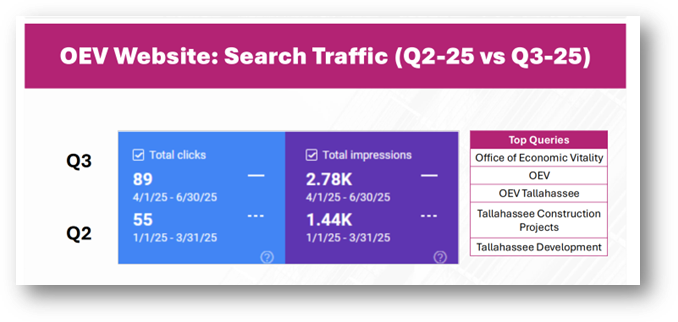
Even if the strategy were locally focused, the results would still need to justify the approach.
Instead, the data suggests a marketing effort that is not only narrowly targeted but also underperforming within that narrow scope.
The same pattern shows up in how Tallahassee treats its most distinctive economic asset.
Marketing magnetism
The National High Magnetic Field Laboratory is, by any measure, a world-class institution. It is also one of the few truly unique differentiators the community has in a competitive economic development landscape. Yet, Tallahassee’s underperformance at growing economic activity around this asset has been well-documented.
A notable and positive exception and recent big win for OEV — in collaboration with FSU — has been securing an important magnetics conference for two straight years. It’s surely a source of lead generation that is important for Tallahassee to retain.
Further, OEV has, at times, attempted to build a brand around the Mag Lab. Internal messaging refers to Tallahassee as the “Magnetic Capital of the World.” A 2023 video promotes the lab as “Florida’s Most Powerful Attraction,” highlighting its potential impact on energy, transportation, and healthcare. (Full disclosure: The video, which was nominated for a Suncoast Emmy award, was produced by Hammerhead Communications, in partnership with The Zachary Group).
But there is little evidence of a sustained effort to turn that concept into an actual recruitment strategy. Which is a fancy way of saying – that message is not being spread.
The video itself has drawn minimal viewership – 308 views on YouTube at last check. There is no visible campaign built around it. No consistent targeting of industries that would logically cluster around magnetics research, advanced materials, or high-field applications.
In other words, Tallahassee has a compelling story to tell. It just isn’t telling it where it matters.
Now, all of this could be overlooked if OEV was top notch at blocking and tackling. If the scoreboard was lighting up with wins. If the area was known for its business-friendliness and responsiveness.
But Red Tape Florida readers know that’s not the case.
From CEOs who wanted to come to Tallahassee, but eventually gave up, to the reality that there is only one out-of-market win for OEV in 10 years to the sad reality of our area’s poor job numbers, to the 0-for-2025 performance … the lack of marketing matches the results.
The bottom line
Put all of this together, and the pattern is difficult to ignore.
- An organization that struggles to produce a complete accounting of its own marketing activity.
- A spending profile that favors in-state visibility over out-of-market competition.
- A marketing footprint that is local, scattered, and not clearly aligned with decision-makers.
- Performance data that shows limited traction even within that footprint.
- And a world-class asset that remains under-leveraged as an economic driver.
These are not separate issues. They reinforce each other. And they lead to a simple conclusion:
Tallahassee’s economic development challenge is not just about the results. It is about whether the system is designed to produce them.
Of course, OEV is simply a part of a community-wide public sector pattern. Red Tape Florida has documented a similar mentality with the City of Tallahassee – ignoring non-performance and mediocrity while simultaneously pumping out feel good stories and touting obscure rankings.
Meanwhile, the economic development and business world passes Tallahassee by because companies don’t wait for follow-ups. They make decisions based on who shows up, who makes a clear case, and who competes.
Right now, Tallahassee isn’t doing enough of that.
And the records — incomplete as they may be — make that clearer than ever.