By Skip Foster, Red Tape Florida
Florida’s political leadership has been clear: the state needs more housing, and it needs it faster.
Over the past two years, lawmakers have passed a series of increasingly aggressive reforms aimed at making that happen. The Live Local Act opened the door to higher-density residential development in commercial and mixed-use areas. Follow-on legislation strengthened those provisions — clarifying height allowances, tightening approval standards, and giving developers more tools to challenge local denials.
Taken together, the direction of state policy is unmistakable.
Florida is trying to make it easier to build.
But the fact that lawmakers have had to revisit and refine the law — first through SB 328 in 2024, and later through SB 1730 in 2025 — raises a natural question:
If the policy is working cleanly, why does it keep needing to be strengthened?
One answer, reflected in legal and industry analysis, is that the original law created confusion and, in some cases, disputes between developers and local governments over how it should be interpreted and applied.
In other words, the problem was not just what the law said.
It was how it worked in practice.
That tension is now playing out most visibly in South Florida.
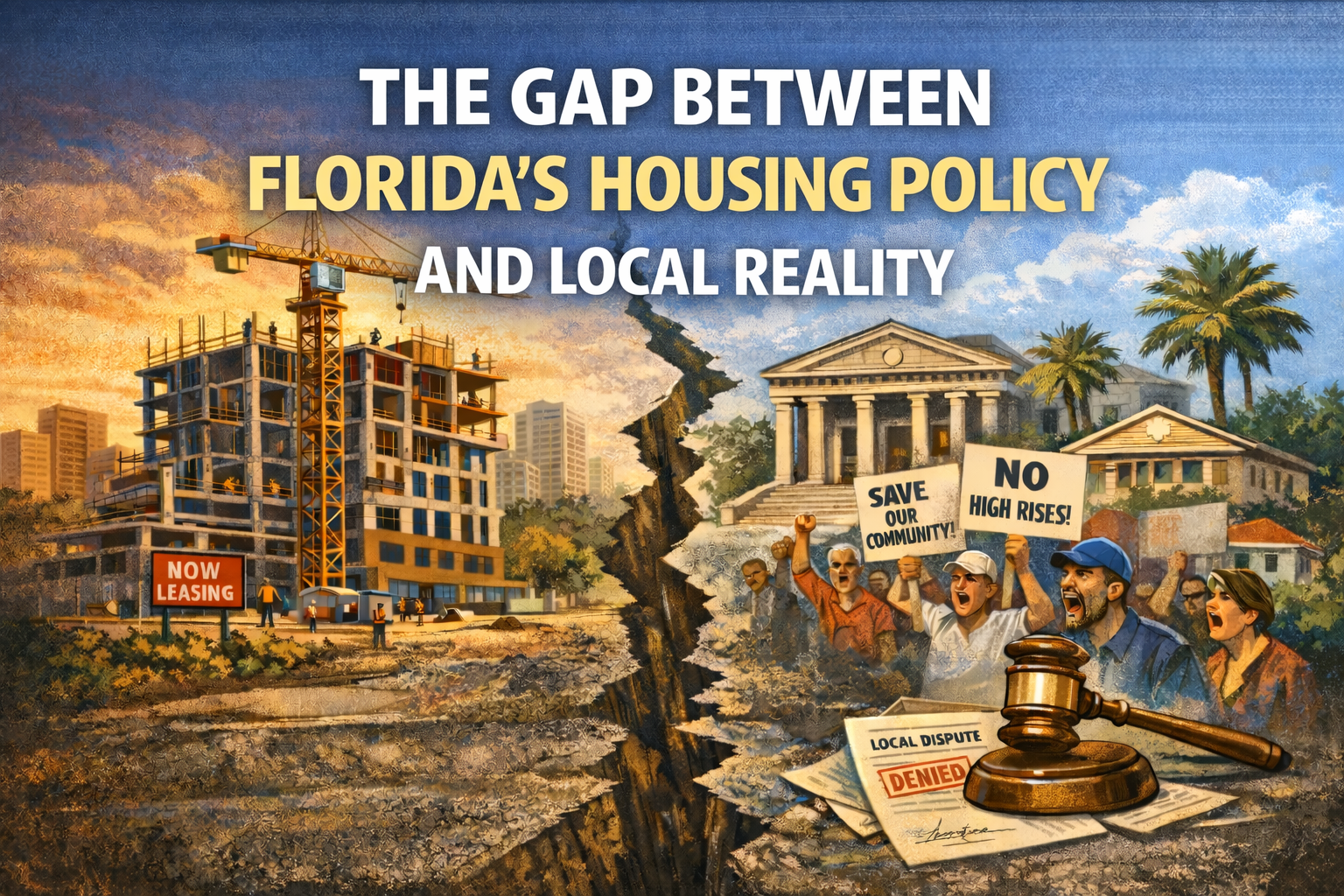
In Surfside, a proposed 11-story Live Local development — in a town where height is otherwise capped at four stories — triggered immediate and intense backlash from residents and local officials. The project was legally grounded in the statute, but politically controversial from the start. The result was not a clean approval process, but a high-profile local fight over what the law actually allows and how far it should go.
In Hollywood, the conflict moved even further. A Broward County judge sided with the city in a dispute over a proposed Live Local tower, prompting the developer to challenge what it described as a misinterpretation of the law. That case illustrates a different phase of the same issue: disagreements over Live Local are no longer just playing out in public meetings — they are moving into the courts.
And these are not isolated examples.
Industry reporting and legal commentary indicate that multiple South Florida communities have pushed back on Live Local projects, either through litigation, policy adjustments, or political pressure. In some cases, local governments are testing the limits of the law. In others, they are attempting to shape outcomes within it.
That helps explain why lawmakers have continued to act.
Recent legislation, including HB 399, goes even further in limiting local discretion — requiring more objective standards and narrowing the ability of local governments to deny qualifying projects. The message from the state is consistent: reduce friction, increase predictability, and move projects forward.
But the emergence of these conflicts suggests something important.
The gap between policy and execution has not closed.
It has simply shifted.
The Live Local Act largely governs what happens at the point of formal approval. But development projects are shaped long before they reach a hearing.
They move through pre-application discussions, staff review cycles, design revisions, and informal feedback processes that are not always visible to the public.
It is in those stages — before a vote is ever taken — that timelines expand, costs increase, and projects are quietly reshaped.
Local governments cite real pressures — infrastructure constraints, staffing limitations, community concerns about density. Those pressures are legitimate. But they do not change the math on Florida’s housing shortage, and they do not excuse a pattern of delay, litigation, and resistance that leaves working families without affordable options.
But the result is a system where state-level intent and local-level execution are not always aligned.
For developers, that creates a new reality.
The challenge is no longer simply understanding what the law allows. It is navigating how that law is interpreted, applied, and, in some cases, contested — both politically and legally.
And for policymakers, the implication is just as significant.
Passing legislation is only the first step.
Ensuring that it translates into actual housing production depends on what happens after the law is passed — in staff reviews, in administrative processes, and increasingly, in courtrooms.
Florida has made it clear that it wants to build more housing.
The question now is whether the system that delivers that housing can move at the same speed as the policy designed to enable it.
That is where the next phase of this story will be decided.