By Skip Foster, Red Tape Florida
The Office of Economic Vitality wants you to know that Tallahassee outpaced Florida and the nation in GDP growth last year.
That’s true.
The Tallahassee metro grew 4.3 percent in real, inflation-adjusted terms in 2024.
“GDP is one of the clearest indicators of overall economic activity,” OEV Director Keith Bowers said in yet another pro-OEV email sent via the City of Tallahassee’s email list.
But here’s the harder question:
If GDP rises and jobs don’t, which is actually the clearer indicator?
Because when you open the data — not the press release — the story looks less like “momentum” and more like something very Tallahassee.
Leon County accounts for nearly 88 percent of metro GDP. Leon alone grew 4.7 percent in 2024.
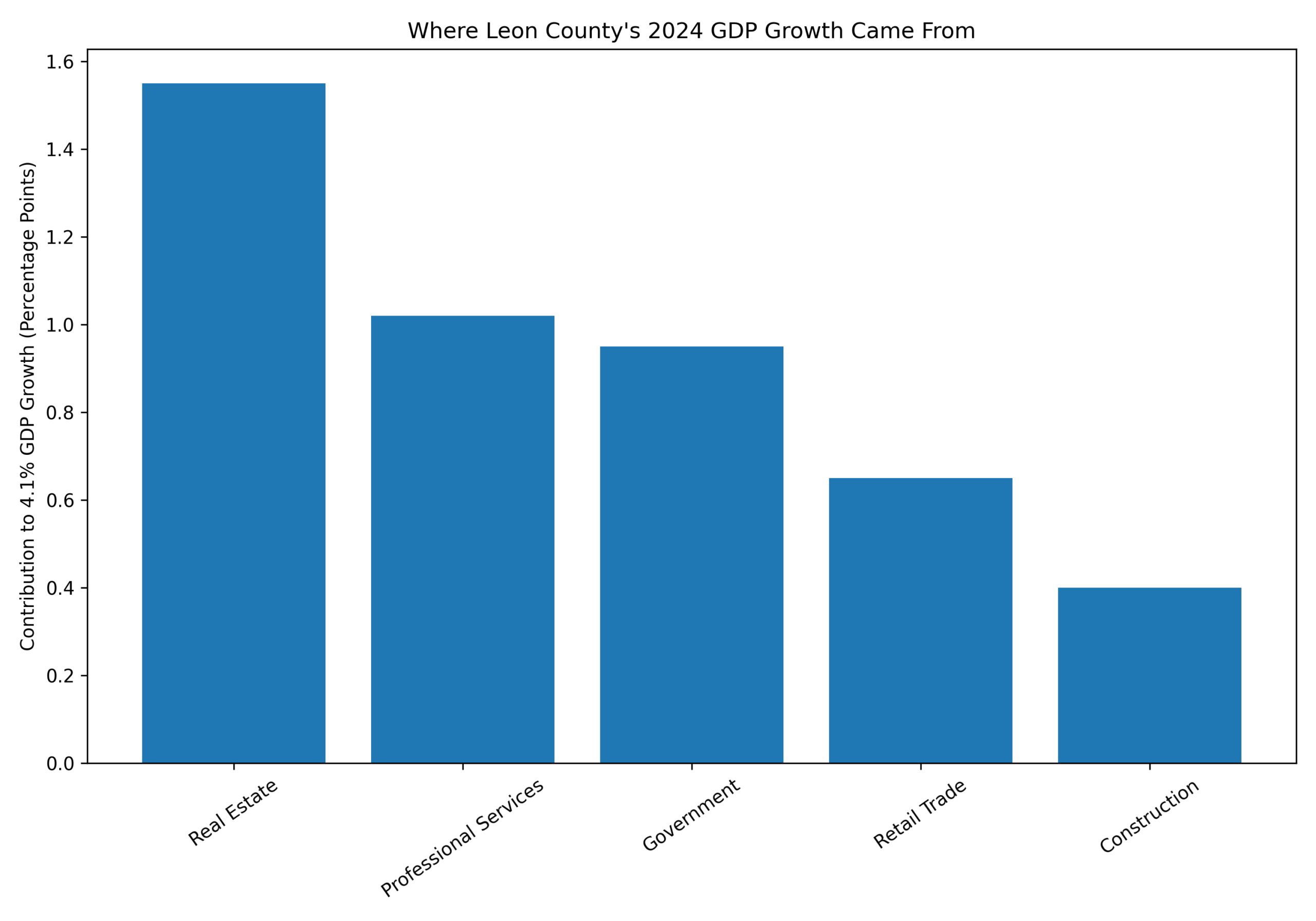
And when you break that 4.7 percent apart, three sectors drove most of it:
- Real estate and rental and leasing
- Professional, scientific, and technical services
- Government
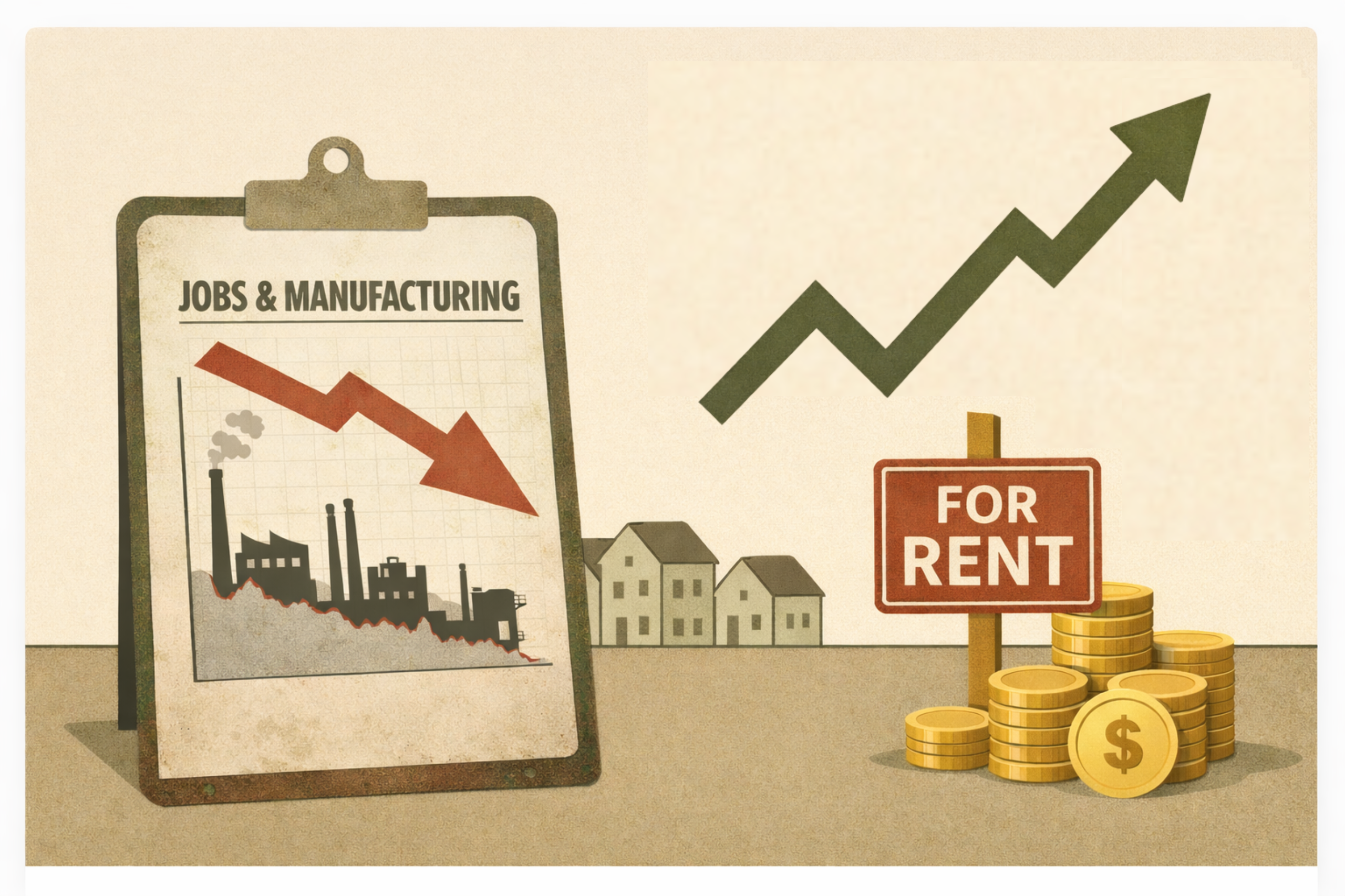
Yet manufacturing declined sharply in real terms. In fact, while overall GDP rose 4.7 percent in 2024, Leon County’s manufacturing sector contracted by roughly 20 percent in real terms — a stark divergence from the growth narrative.
(Readers can drill down into the data themselves, here)
This was not broad-based industrial expansion.
It was concentrated growth in property, services, and government.
The rent year
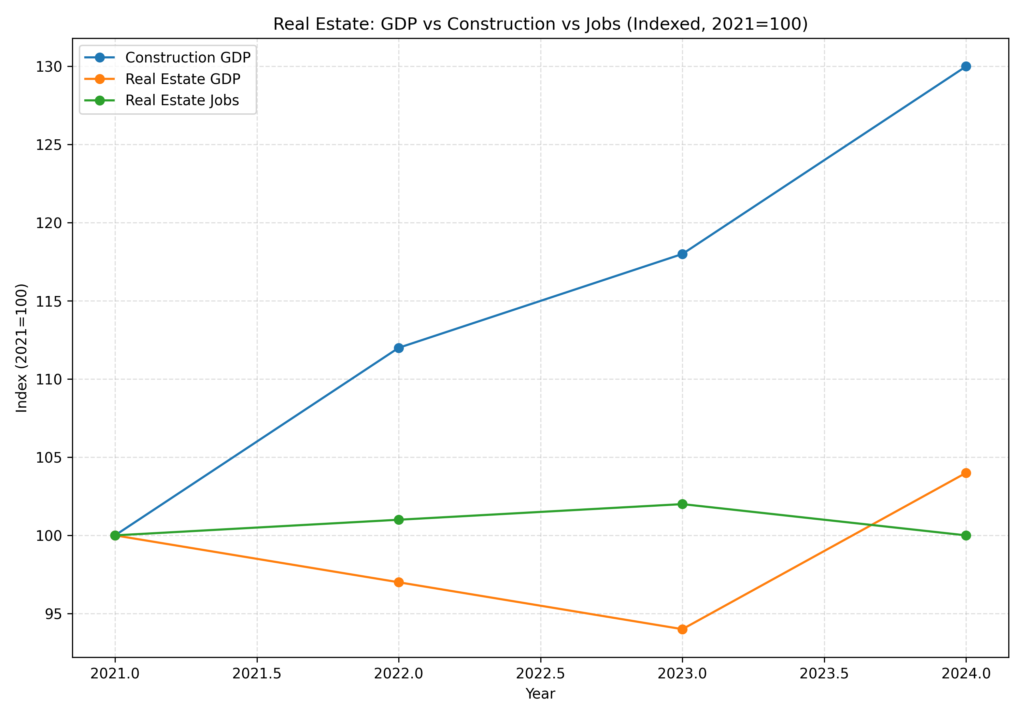
Real estate and rental and leasing rose roughly 11 percent in 2024 — about $275 million in real value added.
That single sector accounted for roughly one-third of Leon County’s GDP growth.
Now here’s what didn’t happen:
- Real estate jobs did not surge. In fact, employment actually declined slightly.
- Total payroll barely moved.
GDP up 11 percent.
Jobs down.
That’s not a hiring boom.
It’s rent.
The U.S. Bureau of Economic Analysis’ real estate category measures value added from owning, renting, and managing property. It includes rental income and imputed housing services. It does not measure housing starts.
Construction rose in 2024 — but by a fraction of the real estate increase.
In a college town dominated by high-end student housing, this pattern makes sense.
When new projects are delivered and lease up at premium rents, net operating income rises. GDP rises with it.
But rising property income is not the same thing as expanding the economic base. If GDP growth is being driven primarily by higher luxury student housing rents in a college town, that deserves explanation — not just celebration.
Productivity, not hiring
Professional, scientific, and technical services rose nearly 9 percent in real GDP — about $206 million.
That sounds like diversification.
But employment in the sector rose just 1.1 percent — 191 jobs.
GDP up almost 9 percent … headcount barely moved.
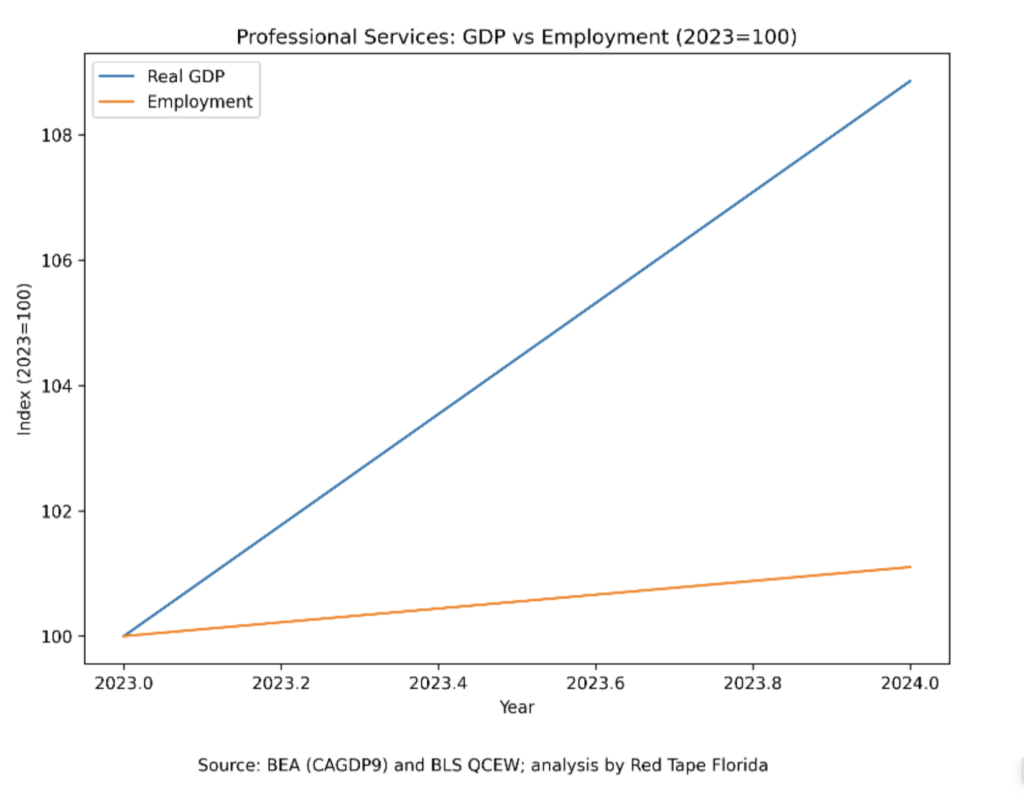
That means output per worker rose sharply.
Inside the sector, architectural and engineering services added jobs — likely tied to development and infrastructure work.
Computer systems design saw payroll jump sharply while employment stayed flat — a sign of higher contract value, not workforce expansion.
Scientific research and development services — where a dramatic university spillover would show up if one existed — grew modestly.
Again, this was more value generated by roughly the same number of people.
Which brings us back to OEV’s claim that GDP is the clearest indicator.
Is it?
The clearer indicator: jobs
In prior Red Tape Florida reporting, we’ve shown that Tallahassee’s job growth since 2023 has been flat to weak relative to peers. Employment gains have slowed materially. The region has struggled to generate sustained private-sector job expansion.
If GDP rises 4.7 percent and employment rises roughly 1 percent, then real GDP per job rises roughly 3–4 percent.
That means the economy produced more output per existing worker.
That is not nothing.
But it is not the same as:
- More residents employed.
- More families earning paychecks.
- A broader tax base.
- A more diversified private sector.
GDP measures value added.
Jobs measure participation.
If the goal is long-term economic vitality, job growth is often the more direct indicator of whether an economy is expanding its base.
A year where real estate value added rises, professional services bill more per worker, government grows steadily, and manufacturing contracts is not a transformational year.
There is one more structural piece of this story that cannot be ignored.
And, of course, government growth drove GDP
One other major contributor to 2024 GDP growth deserves attention: government.
Real (inflation-adjusted) government value added in Leon County rose roughly 3.75 percent in 2024 — an increase of about $169 million in real terms, according to BEA’s county GDP data.
That makes government one of the top three contributors to overall GDP growth last year.
And here’s the critical point:
GDP counts government output the same way it counts private-sector output.
If public payroll rises, if state agencies expand operations, if public enterprises generate more activity … GDP rises.
That’s how the metric works.
But in a state-capital economy like Tallahassee, that distinction matters.
Growth driven by:
- Property income,
- higher billings in professional services,
- and government value added …
… is structurally different from growth driven by new export industries, manufacturing expansion, or sustained private-sector hiring.
In prior Red Tape Florida reporting, we’ve shown that job growth has slowed materially since 2023 and that private-sector expansion has been uneven at best.
Against that backdrop, a year where government and property are major drivers of GDP growth doesn’t signal diversification.
It signals reinforcement of the existing model.
That may produce a strong headline.
But it’s not the same thing as economic transformation.
The bottom line
The ranking doesn’t change the structure
Yes, Tallahassee ranked near the top of Florida metros in 2024 GDP growth. But ranking doesn’t change composition.
The 4.3 percent headline is accurate. But the clearer indicator of where Tallahassee stands may not be GDP. It may be job growth.
We don’t blame OEV for highlighting positive metrics. But rankings and selective statistics can’t change the underlying reality:
- Out-of-town prospects describe a bureaucratic process that caused them to take their business elsewhere.
And, as we’ve said before, the performance is much more about a flawed structure, than poor leadership or performance.
All the rankings and stats and the world can’t change the fact that Tallahassee is not seeing growth in manufacturing, new business and jobs.
The best that can be extrapolated from GDP numbers touted by OEV is that In 2024, Tallahassee had a strong year for asset income, higher billings and the growth of government.
That is optimization.
Transformation looks different.
Until job growth reflects it, GDP alone is not the clearest indicator.