By Skip Foster, Red Tape Florida
Sarasota County is quickly becoming one of the most interesting political laboratories in Florida.
Not because the county is uniquely liberal or uniquely conservative. It is becoming something else entirely: a place where often-wealthy environmental progressives and anti-growth conservatives are increasingly finding common cause around one issue — stopping development.
And now that coalition is running headfirst into Florida’s housing crisis.
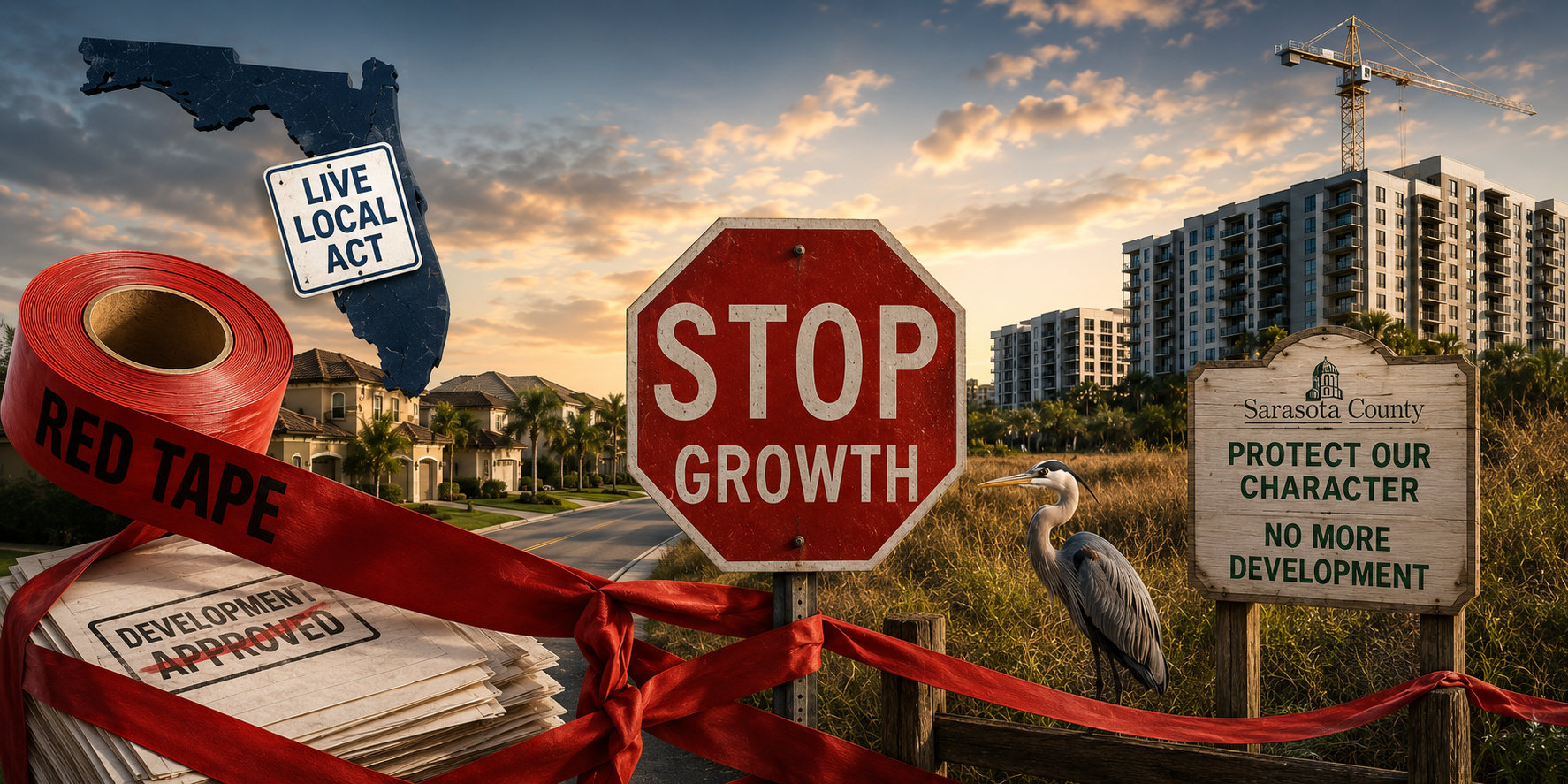
Over the past several months, Sarasota County commissioners have moved aggressively to resist Florida’s Live Local Act, the state law designed to increase workforce and affordable housing by limiting the ability of local governments to block qualifying projects through traditional zoning fights. Under the law, qualifying multifamily or mixed-use projects can be allowed in commercial, industrial, mixed-use and some flexibly zoned areas if at least 40 percent of the units are affordable rental units for 30 years. Sarasota County’s own Live Local page explains that basic framework.
But Sarasota County is trying to draw a much harder line.
In April, commissioners unanimously moved to block Live Local projects from being built on parcels zoned residential, Open Use or Residential Estate. That means the county is trying to prevent the law from being used in exactly the kinds of low-density and semi-rural areas where residents have been most alarmed about apartments, traffic and neighborhood change. Commissioners were warned about litigation exposure. They moved ahead anyway.
Anybody who drives through Sarasota during the season knows the place can already feel strained. Residents worry about roads, evacuation routes, stormwater, schools and traffic. Those are not crazy concerns.
But there is another reality Sarasota increasingly struggles to acknowledge: The people who make the community function still need somewhere to live.
The county still needs nurses, sheriff’s deputies, teachers, restaurant workers, electricians, hospitality workers, construction crews, retail employees and healthcare staff. It still needs the people who clean hotel rooms, pour concrete, install flooring, run landscaping crews and work double shifts in kitchens during tourist season.
Yet many of those workers are being priced out of the communities they serve.
Spectrum Bay News 9 recently reported on Sarasota’s workforce-housing need, including a project designed for teachers, firefighters and police officers with rents around $1,000 a month. That number is important because it shows just how far the actual workforce-housing conversation is from much of the market.
The Barancik Foundation’s Sarasota housing report put the problem more starkly: the median rent for a two-bedroom unit in Sarasota County had reached $2,021 per month, and about 60,000 households were paying more than 30 percent of income on housing, with 20,000 paying more than 50 percent.
That is not a minor inconvenience. That is a community structure problem.
The politics here have become especially revealing. Sarasota politicians talk constantly about affordability while simultaneously fighting the supply increases that might actually relieve some of the pricing pressure. Existing homeowners benefit from appreciating values. Younger buyers, renters and working families absorb the damage.
The anti-growth coalition is now bipartisan.
You have affluent “save our character” progressives standing shoulder-to-shoulder with anti-density conservatives who distrust Tallahassee and resent state interference in local planning. Different rhetoric. Same practical outcome: less housing supply.
The state saw this coming. That is why the Legislature passed the Live Local Act in the first place. Tallahassee essentially concluded that many local governments were never going to voluntarily approve enough housing to meet demand, so the state stepped in and overrode portions of local zoning authority for qualifying projects.
Now Sarasota County is pushing back hard.
The Live Local fight is not happening in isolation. It is part of a broader countywide pattern.
Take the D.R. Horton fight near Celery Fields.
D.R. Horton first proposed turning the Smith Farm property near Celery Fields into 170 new homes. To do so, the developer needed Sarasota County to rezone the land from Open Use Rural to Residential Single Family. The Sarasota County Planning Commission declined to recommend the project in 2024, and the developer later reduced the proposal to 126 homes.
After repeated denials and a dispute-resolution process, D.R. Horton walked away from arbitration and sued Sarasota County. According to WSLR, the company’s petition asks the court to quash the county’s denial and grant the application for 126 homes.
Environmental groups and nearby residents see the project as a threat to Celery Fields, a beloved birding and stormwater area. Sarasota Audubon has said D.R. Horton filed a petition for writ of certiorari after leaving the FLUEDRA process and is asking the court to overturn the denial.
Sarasota’s problem is that every housing fight gets treated like the one project that must be stopped.
Live Local apartments near rural homes? Stop them.
A subdivision near Celery Fields? Stop it.
Density near existing neighborhoods? Stop it.
Housing on land that feels too rural? Stop it.
At some point, the community has to ask a harder question: if new housing cannot go here, and it cannot go there, where exactly is it supposed to go?
Because the demand is not theoretical.
People want to live in Sarasota. Employers need workers in Sarasota. Service businesses need staff in Sarasota. Hospitals need employees in Sarasota. Schools need teachers in Sarasota. Restaurants and hotels need people who can afford to show up to work without driving from another county.
Here is the part Sarasota taxpayers should watch closely. County Attorney Joshua Moye told commissioners that the Live Local Act’s attorney-fee provision allows the prevailing party to recover up to $250,000 in fees and costs per case. Commissioners heard that warning and voted unanimously to proceed anyway. Every case the county loses does not just cost taxpayers in legal fees — it finances the other side’s lawyers too.
There is one more thing the anti-growth coalition rarely mentions: new construction is safer construction. Homes built under Florida’s current building code — strengthened substantially after Hurricane Andrew in 1992 and again after the 2004–2005 storm seasons — are dramatically more resistant to hurricane damage than the aging housing stock they sit alongside. Impact-resistant windows, reinforced roofing systems, elevated foundations and stricter wind-load requirements are standard in new builds. Blocking new construction does not just constrain housing supply. In a coastal county that sits squarely in Florida’s hurricane corridor, it also means the community’s overall resilience erodes as older homes age without replacement.
Housing shortages are not abstract policy discussions. They show up as longer commutes, worker shortages, rising rents, strained local businesses and communities increasingly accessible only to the affluent.
Sarasota County believes it is protecting community character.
Maybe it is.
But Florida increasingly faces a larger question:
What happens when preserving the character of a community also makes it impossible for ordinary working people to live there?