By Skip Foster, Red Tape Florida
The Tallahassee-Leon Office of Economic Vitality turned 10 years old at the end of February.
You probably didn’t notice any 10-year anniversary posts.
There’s a reason.
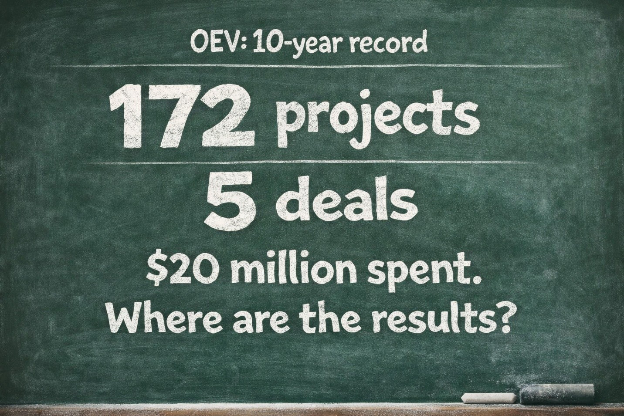
While taxpayers have funded OEV to the tune of $20 million over the last 10 years, the list of wins provided to Red Tape Florida after a public records request was alarmingly short.
First, a word about timing – Red Tape Florida made its public records request to OEV more than two weeks before Thanksgiving. The response came the Thursday before Palm Sunday. That’s a full college football season and it’s not acceptable. Transparency is one easy place for city and county commissioners to demand better performance from OEV.
But there are more.
The results
First, the headline: Since it was born 10 years ago, OEV has recruited precisely one new industry to Leon County: Amazon.
Even that single out-of-market win comes with some hard truth. Red Tape Florida talked to four people intimately familiar with the Amazon deal and all said essentially same thing: Amazon was coming here whether OEV did anything or not.
Amazon had already picked out to which market it wanted to come, the land (owned by Devoe Moore) and other particulars. OEV helped move things along, but this was less “recruitment” and more “facilitation.”
Now, let’s look at the rest of its activity.
Code name: Underachievement
According to OEV’s own data, since 2016, 172 projects have been assigned “code names,” like “Project Santa,” “Project Kong” and “Project Heavy Metal.” This indicates an opportunity is real and being pursued.
Of those 172, a total of 5 turned into deals. That’s 1 every 2 years.
Of the 5 deals, 4 were for existing businesses that were either expanding or relocating. Let’s break those down.
Proof Brewing (2018)
You might recall that Proof wanted to move from the All Saints District to the old Coca Cola Building on South Monroe – about seven tenths of a mile. It obtained the Coca Cola building in a land swap with J.T. Burnette (yes, that J.T. Burnette) and then received from OEV a 70 percent reimbursement for development fees and an additional 70 percent reimbursement of the city property tax paid on the land, improvements and tangible personal property for seven years, according to the Democrat story.
In addition, the county agreed to provide reimbursement of the property taxes equal to the amount reimbursed by the city for the Target Business Program, estimated at $97,400, according to OEV.
Danfoss expansions
Telling the recent story of Tallahassee economic development without Danfoss Turbocorp is like an episode of Seinfeld without Kramer. Danfoss is the only major addition in the 30 or so years of the National Mag Lab’s existence at FSU, and two of the 5 OEV deals are expansions of Danfoss.
There is no way to couch Danfoss’ arrival and expansion as anything other than a positive for our community.
Danfoss Executive Advisor and former CEO and President of Danfoss Turbocor Ricardo Schneider says the Tallahassee facility is nearing 500 employees. He says the while OEV incentives are appreciated, it was proximity to the MagLab that drove Danfoss expansion.
“We are here because of the MagLab and the ecosystem around it,” Schneider said, in an interview with Red Tape Florida. Schneider added that state incentives are actually the most valuable to his company.
Expansions are great and the new jobs created are just as important as jobs that come from out of market. But when expansions are essentially all an economic development organization is creating, something is wrong.
No sunshine on Sunrise
The last is “Project Sunrise,” a $373,000 incentive program for … well, we can’t be sure. While the incentive was approved more than four years ago, OEV has never made public the actual recipient. It is widely believed, however, that the recipient was Golden Lighting, owned by Yuh-Mei Hutt, who chaired Domi Station, an economic incubator and OEV ecosystem partner.
The lack of public disclosure — for a taxpayer-funded incentive — is itself a problem.
Jobs numbers: Who’s on first?
OEV touts jobs that are promised as a part of its incentives, but what exactly is being guaranteed?
As one dives in, the math becomes muddled, to say the least.
Let’s start with Proof.
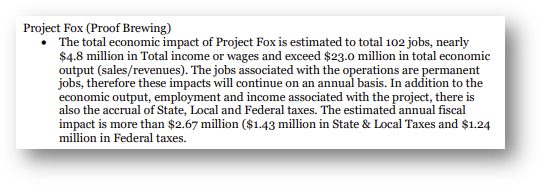
In its response to the Red Tape Florida public records request, OEV claimed that the “total economic impact” of the project would “total 102 jobs.”
But in a 2018 quarterly report to the combined city and county commissioner board (the IA board), the story was different.
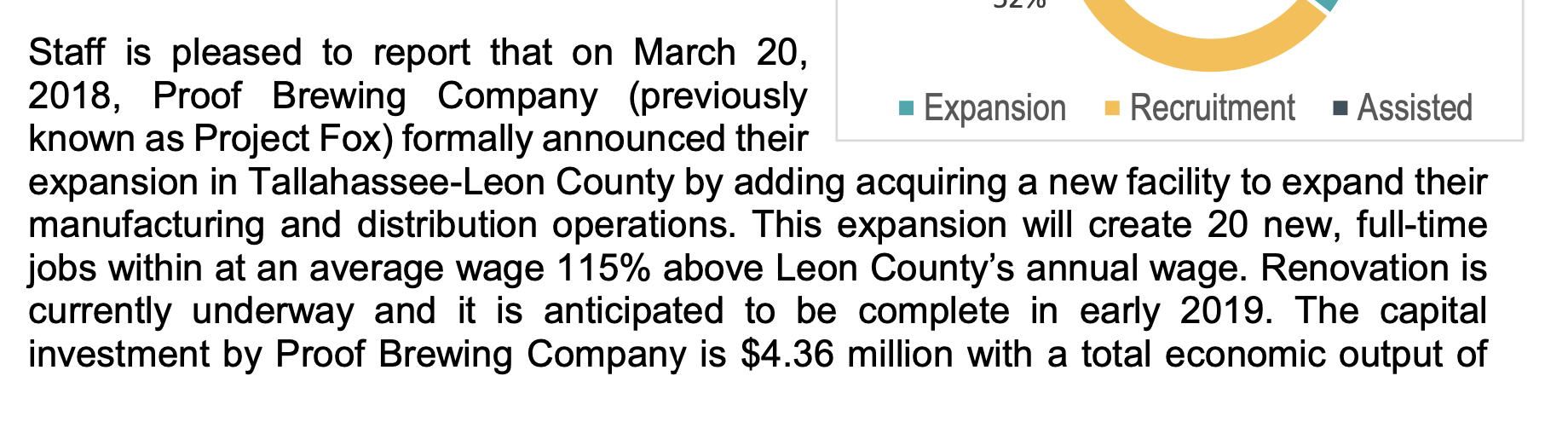
So, was it 20 jobs or 102 jobs?
Or maybe it was 50 jobs? Here is a February 2024 OEV summary of projects in a Blueprint agenda:
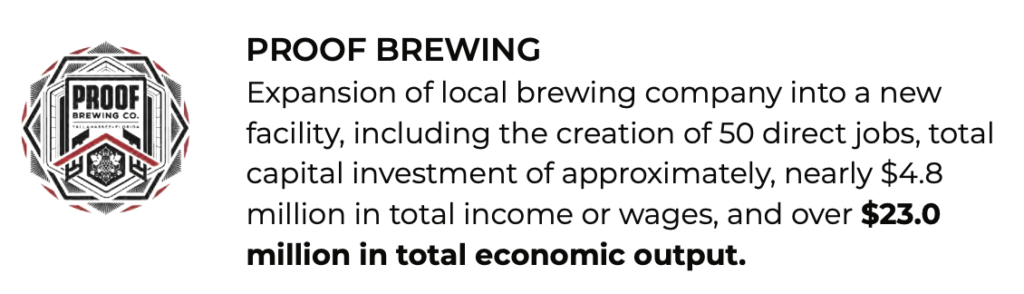
A possible explanation is that Proof added 20 actual jobs, then OEV was attempting to estimate additional jobs created as a part related businesses (“direct jobs” or “total economic impact … jobs”). Even that explanation, however, comes with an unexplained range of jobs — 50 to 100. And remember, the public records request calls these jobs “permanent,” so they can’t just be chalked up to construction jobs as a part of the relocation.
The next question is: where are these additional jobs and who measures them? It’s one thing if Boeing relocates a production facility to a market. One can then expect engine makers, airplane painters and others to follow.
But a relocation of a brewery by seven tenths of a mile?
Has there been some sort of influx of plastic cup makers, barley farmers or coozie manufacturers to Tallahassee – with a bunch of new jobs — that Red Tape Florida has missed?
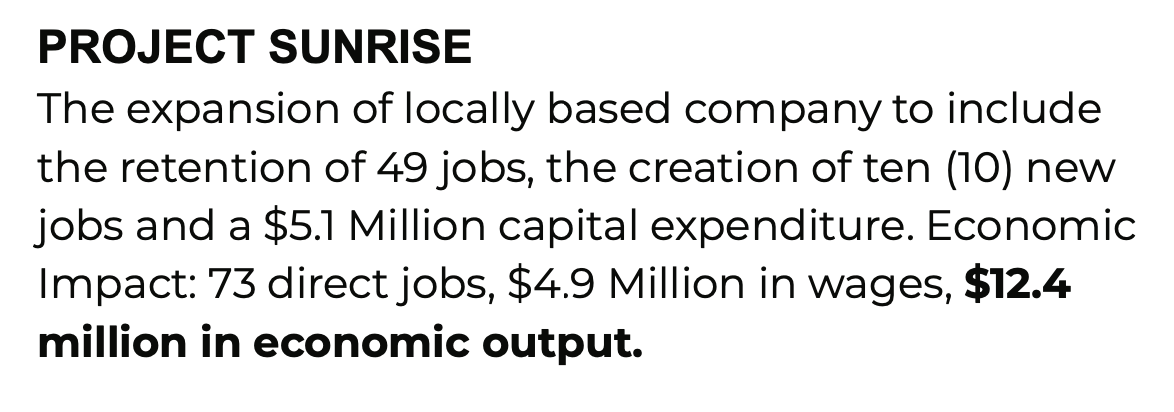
Meanwhile, the Project Sunrise job numbers are equally confusing. In the same 2022 report that mentioned Proof, OEV claims that the Sunrise incentives kept 49 jobs from leaving, added 10 new jobs (that’s a 59) but then somehow came up with 73 “direct” jobs.
But in the public records request recently fulfilled by OEV, the numbers are completely different.
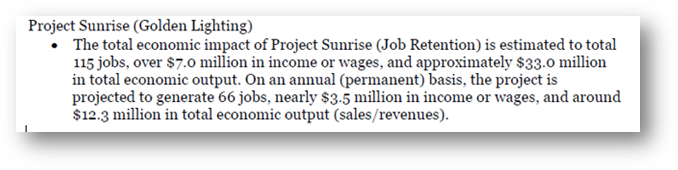
So, 115 jobs? 66 permanent? What’s right?
Red Tape Florida emailed Hutt and Proof owner Bryan Burroughs but neither responded.
Finally, Danfoss
There is no company that engenders more community pride than Danfoss Turbocor. Outgoing CEO Ricardo Schneider has become a Tallahassee icon, deeply invested in Tallahassee’s success, even though he is a relatively recent transplant.
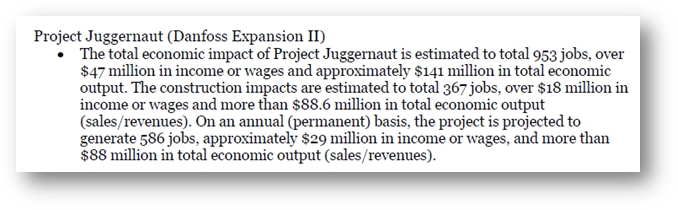
Schneider said that while he definitely knows of national suppliers whose Tallahassee-area operations have benefitted from Danfoss’ expansion, he does not know how many. He added that no one from OEV has ever gotten his input on jobs created in the market outside of those hired by Danfoss directly.
In its recently fulfilled public records request, this is how OEV characterized Danfoss jobs as a part of its second expansion:
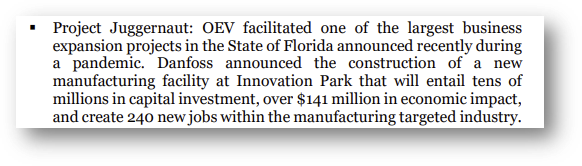
The 2022 quarterly report had completely different numbers:
Trust, but verify
Here’s the real problem, though. Red Tape Florida spent a considerable amount of time and effort trying to find any sort of after-the-fact validation of all these job projections. We scoured OEV reporting, minutes, agendas and supporting documents.
None could be found.
OEV has been very effective at publicizing projections for major projects like Danfoss, Sunrise, Proof, and Amazon. What is much harder to identify in public records is a consistent, project-by-project accounting of whether those projections were met — or independently verified after the fact.
For an organization funded by taxpayers and tasked with delivering measurable economic outcomes, this lack of publicly accessible verification is not a minor oversight — it is a fundamental accountability gap
Here is yet another place for city and county commissioners to demand better performance.
Conclusion
The fulfilled OEV public records request to Red Tape Florida is a double whammy: It reveals anemic performance and contradictory data.
It is part of a mounting case that the structure of OEV is hopelessly broken and chronically ineffective.
It also helps explain Tallahassee’s poor standing in key metrics – job and population growth.
According to OEV’s own data, Tallahassee’s population grew just 1 percent from 2020 to 2025, next to last among the metro areas measured.
And Red Tape Florida has already reported on Leon County’s loss of jobs from 2022 to 2025.
In Florida, this is stagnation. And it raises a basic question: if OEV’s incentives and projects are delivering the kind of economic results being promoted, why isn’t that showing up in the most visible measure of all — whether more people are choosing to live here?
An even more important question: When are local elected leaders, candidates, the business community and citizens at large going to start publicly demanding a discussion about a major change in how our community handles economic development?