By Skip Foster, Red Tape Florida
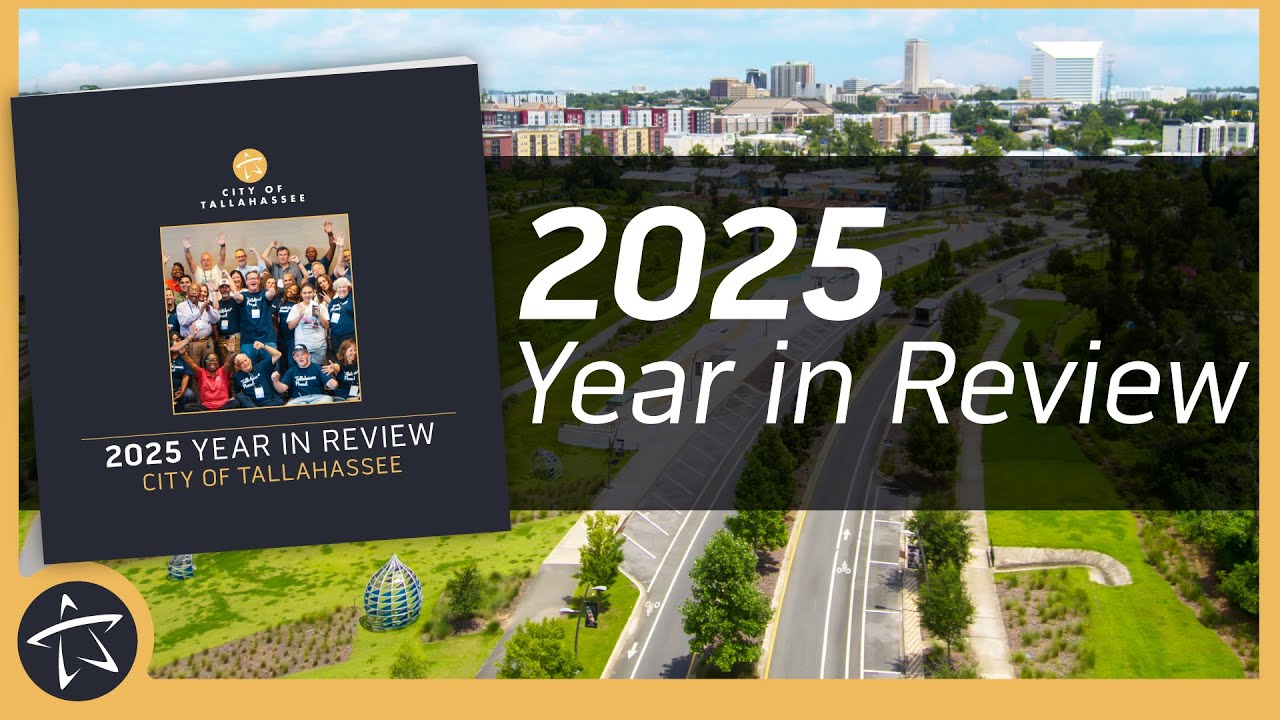
The City of Tallahassee’s 2025 Year in Review is glossy, upbeat, and brimming with accomplishments. It reads like a government that is busy, credentialed, and proud of itself.
In some respects, that pride is justified. In others, it’s doing a lot of work to distract from questions City Hall would rather not answer.
This is not a point-by-point rebuttal of every bullet in the document. Some things genuinely deserve credit. Others sound impressive until you ask the one question the Year in Review consistently avoids: compared to what?
Let’s start where credit is due.
Where the City actually earns it
Parks and quality of life
Tallahassee’s parks, tree canopy, and access to green space are real assets. They matter. They affect daily life. They are one of the few areas where Tallahassee truly punches above its weight. The City deserves credit for protecting and expanding them.
This is not spin. It’s substance.
Community programming
Senior Games participation, neighborhood events, and civic initiatives help explain why people like living here even when they’re frustrated with everything else. These programs aren’teconomic development and don’t need to be. They succeed on their own terms.
The problem begins when City Hall quietly slides from celebrating livability into declaring itself one of the best-run cities in Florida — as if the former automatically proves the latter.
Claims that do real rhetorical work — and deserve scrutiny
“Best-run city in Florida” and All-America City recognition
What the City says: Tallahassee was named a 2025 All-America City and ranked the best-run city in Florida.
What that actually means: The All-America City designation, awarded by the National Civic League, recognizes civic engagement and collaboration based largely on narrative applications. It does not measure wage growth, housing affordability, service speed, or economic outcomes.
The “best-run” label comes from a WalletHub ranking that compares the scope of services to budget per capita. Translation: cities with larger governments and larger budgets can score well even if residents feel nickel-and-dimed, stuck in process, or priced out.
What’s also true — and rarely mentioned: Through a public-records request, Red Tape Florida obtained documents showing that the City of Tallahassee spent approximately $130,000 preparing and submitting its All-America City application. That figure doesn’t even include staff time devoted to the effort — hours the City acknowledged were not tracked.
In other words, this was not a spontaneous external validation. It was a competitive, resource-intensive bid, funded by taxpayers, with no accounting of the full internal cost.
What’s missing:
— Any discussion of cost versus benefit
— Any disclosure of staff time diverted from core functions
— Any evidence that household fundamentals improved as a result
Awards feel less like independent validation when they come with a six-figure application budget and an uncounted amount of staff time.
Crime reduction
What the City says: Violent crime down 6.18 percent year-over-year and more than 30 percent over “the last couple of years.”
What that actually means: A favorable slice of time following a nationwide crime spike. Possibly real progress. Possibly regression to the mean. Impossible to tell from what’spresented.
What’s missing:
— Raw incident counts
— Population-adjusted rates
— Multi-year trends
— Neighborhood-level data
— Any comparison to similar Florida cities
If crime reduction is the crown jewel, show the jewels. Percentages without baselines are comfort food, not accountability.
Economic development and jobs
What the City says: More than 18,000 new jobs over five years. Conferences hosted. Awards received. Dashboards launched.
What that actually means: Five-year aggregates hide churn and allow for larger numbers. Fewer than 4,000 jobs added per year is also true and far less encouraging. Conferences and awards document activity, not employer wins. Dashboards document motion, not outcomes.
What’s missing (and this is the big one)
— Net new jobs by year
— Wage levels of new jobs
— Median household income trends
— Net migration of working-age residents
— A simple list of major relocations or expansions
This omission matters because prior Red Tape Florida reporting has already shown a consistent pattern: extensive economic-development storytelling paired with very few documented private-sector wins. The Year in Review does nothing to rebut that. It reinforces it.
If job growth were truly transformative, residents wouldn’t need to be told. They’d feel it in paychecks, rents, and opportunity.
Construction and capital spending
What the City says: More than $350 million in active construction projects.
What that actually means: The City spent money. Much of it public money. On things it already owns.
What’s missing:
— On-time and on-budget performance
— Change orders
— Long-term operating costs
— Private investment leveraged
— New taxable value created
Capital spending is not growth. It’s maintenance, replacement, and occasionally expansion. Treating dollar totals as success is a classic municipal tell.
Housing and permitting
What the City says: Permits or reviews issued for 548 affordable housing units.
What that actually means: Paper moved.
What’s missing
— Units actually built
— Units actually occupied
— Affordability levels and duration
— Public subsidy per unit
— End-to-end permitting timelines
— Comparison to peer cities
Red Tape Florida has documented repeatedly how time delays and layered reviews drive up costs. The Year in Review avoids that discussion entirely — while quietly counting approvals as victories.
Dashboards and accountability
What the City says: 133 initiatives tracked across seven priority areas.
What that actually means: A government that does many things and measures most of them vaguely.
What’s missing:
— Outcome metrics versus process metrics
— Baselines and targets
— What happens when goals are missed
— Data that can be downloaded and scrutinized
When everything is a priority, nothing is. A dashboard can clarify performance or obscure it. This one leans toward the latter.
Fiscal stewardship and bond ratings
What the City says: AA bond ratings across all categories.
What that actually means: Creditworthiness. The ability to borrow.
What’s missing
— Debt per capita trends
— Fee and utility cost growth
— Government staffing growth versus population
— Whether residents are paying more for the same services
Bond ratings tell investors the City is a safe bet. They do not tell residents they’re getting a good deal.
The omission that ties it all together
What’s striking about the Year in Review isn’t any single exaggeration. It’s the systematic absence of the metrics that actually determine whether a city is thriving:
— Median income
— Wage competitiveness
— Housing affordability
— Permit approval timelines
— Private-sector job quality
— Comparison to peer Florida cities
And our personal favorite: airport traffic.
Those numbers exist. The City simply chose not to show them.
Conclusion
Tallahassee has real strengths. Parks. Green space. Civic culture. Dedicated public employees. None of that needs to be diminished.
But a Year in Review that leans on awards, activity, and spending while avoiding outcome-level scrutiny is not a report card. It’s a highlight reel.
If City Hall, under Reese Goad, wants residents to believe Tallahassee is one of the best-run cities in Florida, it should stop asking them to admire the trophies and start showing them the math.
That’s not negativity. That’s governance.