
By Skip Foster, Red Tape Florida
North Floridians know Busy Bee.
Clean bathrooms. Killer caramel popcorn. Fudge. What more could a weary traveler want?
The prospect of another Busy Bee would surely have I-10 travelers, ahem, buzzing.
But for Columbia County government, the Busy Bee means something else, apparently: A chance for money and control.
Red Tape Florida has obtained internal Columbia County documents that include a dizzying list of permit price quotes for a new Busy Bee. But unlike the iconic gas station, this list is far from spotless. Instead, it’s littered with inconsistent line items, omitted fees, and contradictory explanations.
Columbia County’s whack-a-mole process of pricing a permit for the project is both breathtaking and alarming. And in the process, it sidelined the very private-sector option state law is supposed to protect.
Start with the numbers. We have put key numbers in bold to make it easy to follow.
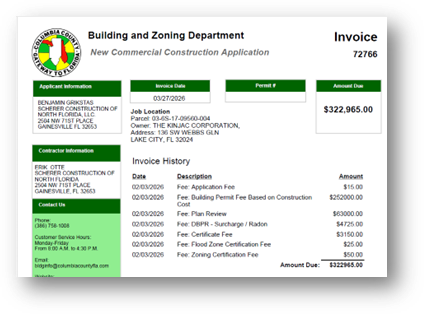
On February 3, Columbia County issued an invoice for $322,965 in permitting fees.
That included a $63,000 plan review fee — more than double the county’s own $25,000 cap.
What makes that initial $63,000 charge harder to explain is that Columbia County clearly knows how to apply its own cap. A review of recent permits shows multiple projects where plan review fees were calculated and then reduced to the county’s $25,000 maximum —

Including projects using private providers. In other words, the system works — when it’s used. The question is why it wasn’t used here until after the issue was raised.
That should have been the first correction.
Instead, it was the beginning of a negotiation. After the contractor engaged a private provider, CT Solutions of Florida — a move specifically contemplated under Florida law — the county revised the total to $242,246.25.
Still high. Still unexplained.

Then, on March 31, a new invoice arrived:
$126,015.
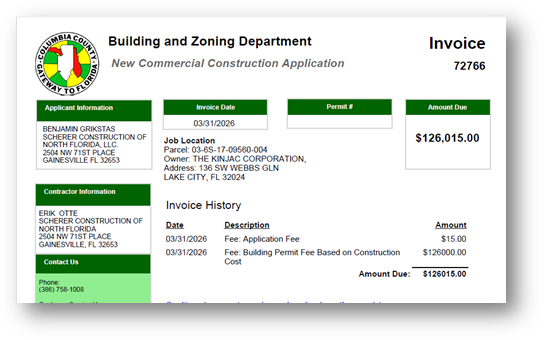
Nearly a 60 percent reduction.
But the details had disappeared. Line items were consolidated into a single figure.
The basis for the calculation was no longer visible.
Later, the county described that invoice as “auto-generated.”
Which raises a basic question: if the system can generate a six-figure invoice in error, what is actually driving the number?
The answer changed again.
On April 16, the total jumped back to $219,440.
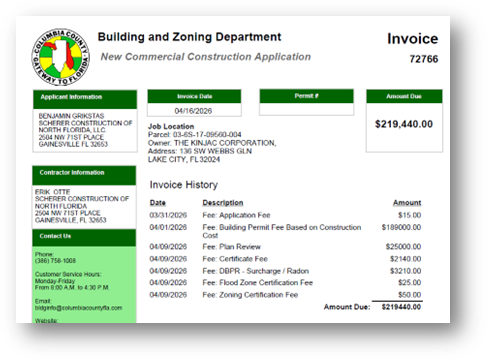
The plan review fee was corrected to $25,000. But the building permit fee climbed to $189,000, pushing the total back toward the original range.
So, in roughly six weeks, the same project produced at least four different answers from Columbia County, with zero changes to the project itself:
$322,965
$242,246
$126,015
$219,440
That’s not a rounding issue.
That’s a moving target.
And the movement matters.
Because under Florida Statute 553.791, when a private provider is used for plan review or inspections, the local government must reduce its fees to reflect actual cost savings — and may not charge for inspections it does not perform.
In other words, bringing in a private provider should make the process simpler and less expensive.
Here, it did neither.
Instead, the introduction of a private provider coincided with:
- prolonged back-and-forth over fee calculations
- invoices that changed materially from one week to the next
- and a final number that remained substantially above what the applicant’s representative argued the statute would allow
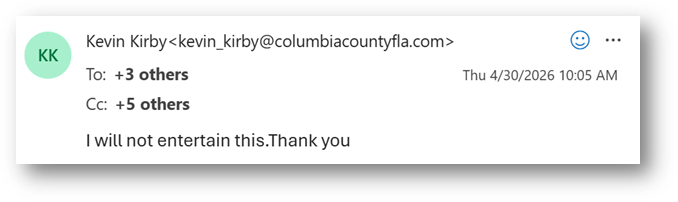
At one point, the contractor’s representative put it directly to the county: if you’re not performing the inspections, you shouldn’t be charging for them.
The county’s response was brief.
“I will not entertain this.”
What followed was not resolution, but fallout.
According to those involved, the prolonged dispute and uncertainty over the permitting process ultimately led to the private provider being removed from the project.
That outcome is hard to ignore.
Because it raises a broader question — not just about this permit, but about the system behind it.
If engaging a private provider leads to higher costs, less clarity, and extended delays, what signal does that send to applicants?
And more importantly: what choice does it leave them with?
To be clear, Columbia County officials have suggested that some of the inconsistencies stem from system limitations and the need to align local ordinances with evolving state law. That may explain part of what happened here.
But it does not explain the pattern.
A capped fee that exceeds the cap — in a system that demonstrably applies that cap elsewhere.
A reduced invoice that cannot be explained.
A revised invoice that climbs back toward the original number.
All in the context of a statute designed to push costs in the opposite direction.
At a minimum, it creates the appearance of a system where the numbers are not fixed — they are negotiated.
And where the path of least resistance may be the one that keeps the process inside government.
For a project like Busy Bee — a recognizable, high-profile investment — that kind of uncertainty carries weight.
Developers can plan for high costs. They can plan for low costs.
What they cannot plan for is a system where the cost depends on how long they are willing to push back.
That’s when the process stops being a calculation.
And starts becoming a decision point.
Not about what the permit should cost.
But about whether it’s worth the fight.
That’s the question Columbia County’s process now puts in front of anyone looking to build.