Commentary by Skip Foster, Red Tape Florida
First, credit where it’s due.
Tallahassee Democrat reporter Jeff Burlew has done important and aggressive reporting on the city’s troubled lead-paint grant program, and without that reporting the public likely still would know very little about what appears to be a significant breakdown involving a federally funded public-health initiative.
HUD has now placed the city’s $4.4 million lead hazard reduction grant on “high risk” status and launched an audit after raising concerns involving contractor expense justification, procurement compliance, unit eligibility and program implementation. The city has already spent roughly $1.6 million and received more than $1 million in federal reimbursements.
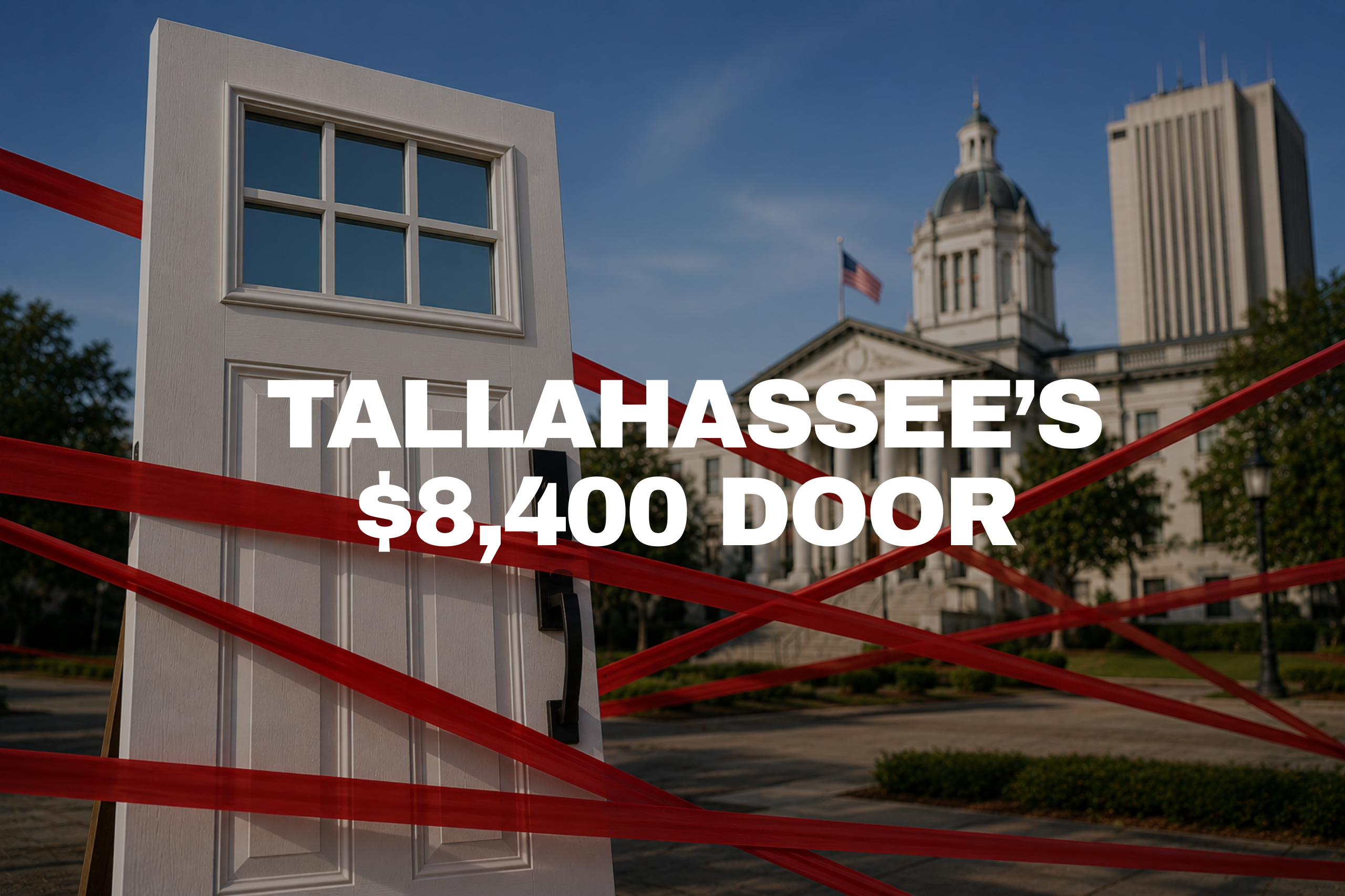
The headline-grabbing detail, of course, is the $8,400 replacement doors.
But the bigger story may be what this says about Tallahassee government priorities and culture.
For more than a year, Red Tape Florida has documented a city government that often seems obsessively focused on performative or marginal matters while struggling with basic competence in areas that actually affect public trust and quality of life.
This is the same local government ecosystem that has devoted extraordinary energy to:
- forcing the tearing down small sheds,
- denying local businesses the use of their own land,
- building infamous “sidewalks to nowhere,”
- and burying ordinary residents, builders and tradespeople under layers of bureaucracy and process.
There is also a broader lesson here. Many of the same voices constantly calling for larger public-sector involvement in housing and affordability rarely grapple with the reality that government systems are often just as vulnerable to waste, inefficiency and mismanagement as the private sector — sometimes more so.
Meanwhile, according to HUD, a federal program designed to protect low-income families and children from lead hazards apparently drifted badly enough off course to trigger federal intervention.
That should concern everyone.
Because this was not some optional arts grant or beautification initiative. This involved lead exposure risks in older housing occupied by lower-income residents. If there is one thing local government should be capable of doing competently, it is administering a straightforward public-health and housing-safety program funded by federal dollars.
Instead, Tallahassee now finds itself facing a federal audit, possible repayment demands, whistleblower allegations and growing questions about oversight.
And those questions keep multiplying.
- Why did a citywide lead-hazard program appear to focus so heavily on one apartment complex?
- Why was work at Palm Beach Pointe apparently never started?
- Who was reviewing invoices?
- Who approved the change orders?
- Who was independently verifying procurement and compliance requirements?
And perhaps most importantly: Why wasn’t anyone inside City Hall empowered to slow things down and ask uncomfortable questions before HUD stepped in?
The controversy has now expanded beyond procurement questions and into the broader political and managerial culture of City Hall. Commissioner and mayoral candidate Jeremy Matlow has seized on the issue as evidence of deeper dysfunction within the Goad administration, even calling for criminal review and the city manager’s resignation.
Matlow’s broader political worldview rarely aligns with RTF’s. But one reason this controversy is gaining traction is that concerns about City Hall competence, bureaucracy and internal culture increasingly transcend traditional political lines.
Meanwhile, according to whistleblower allegations reported by Burlew, former city employee Lisa Robinson says she repeatedly raised concerns involving contractor certifications, safety practices, compliance and excessive costs before eventually being terminated.
The city disputes aspects of those allegations, and the facts will ultimately have to play out through the formal process.
But the broader theme is hard to ignore.
One of the most common refrains Red Tape Florida hears from builders, contractors, business owners and even some current and former government employees is this: raising concerns internally often comes with consequences.
People learn quickly which questions are welcomed and which questions create problems – or get ignored.
That does not mean every whistleblower allegation is automatically true. It does mean governments should be especially careful when allegations of retaliation emerge inside troubled programs already under outside scrutiny.
Because once citizens begin believing that speaking up is punished while bureaucratic failure is protected, trust collapses fast.
The tragedy here is that this program existed for a genuinely important reason. Lead exposure can permanently harm children and families living in older housing stock. This should have been one of the least controversial and most straightforward responsibilities local government handles.
Instead, taxpayers are left wondering how a federally funded safety initiative turned into yet another Tallahassee government controversy.
But in the end, the question is sadly ironic:
Which is more toxic, the harmful chemicals in old paint or the culture of intimidation in the local government that is charged with cleaning it up.