
By Skip Foster, Red Tape Florida
What does the Office of Economic Vitality actually spend all that money on?
It’s a question Red Tape Florida has heard repeatedly from local residents as we’ve reported on OEV’s staffing, business-recruitment record and the millions of dollars flowing through the agency.
So we decided to find out.
OEV’s adopted fiscal-year 2026 budget totals about $9.15 million, although most of that isn’t day-to-day agency spending. The budget includes roughly $3.92 million transferred to capital projects, $2.43 million for debt service and $1.92 million for personnel. Another $436,000 is budgeted in the category labeled “Operating Expenses,” with additional amounts for other services, capital outlay and administrative costs.
But budget documents tell you how money is supposed to be spent. Red Tape Florida wanted to see the checkbook.
RTF obtained OEV’s detailed accounts-payable records for the current fiscal year. The records include invoices dated through July 31 — two months before the end of the fiscal year — and show $812,550.91 in actual payments to companies, consultants, vendors and incentive recipients.
Nearly half of that total — $381,239 — is incentive payments still being made on Amazon’s 2021 fulfillment-center deal. The remaining records provide a much more granular look at what OEV is buying: consultants, studies, databases, marketing, advertising, sponsorships and other economic-development services.
And after looking through the spending, another question naturally follows:
Where are the new wins?
Still Paying Amazon
The largest chunk of the money — $381,239 — is incentive payments associated with Amazon’s massive fulfillment center near Mahan Drive.
That project was announced in 2021.
Local officials approved a $2.565 million incentive package for what was then called Project Mango, with payments spread over six years through reimbursement of eligible development fees and certain property taxes.
Amazon delivered on the promises attached to the deal. By March 2024, Leon County reported the company had invested approximately $250 million in the facility and employed about 1,400 people, exceeding the original requirement of 1,000 jobs.
OEV counts Amazon as one of its biggest economic-development successes and received a Florida Economic Development Council award for the project.
RTF has previously reported another side of the deal.
Multiple sources familiar with the Amazon project have told RTF that the company had already decided to locate the facility in Leon County before the incentive package was approved.
Whatever your view of the original incentive deal, the current records establish something else:
Five years after Amazon was announced, taxpayers are still paying the incentives.
And the $381,239 in Amazon payments accounts for nearly half of the $812,550 in direct payments reviewed by RTF.
Consultants, Data and Marketing
The rest of the spreadsheet provides a window into the day-to-day machinery of economic development.
OEV paid SB Friedman Development Advisors $67,933 for a “Targeted Industry Study Analysis.”
Another $29,999 went to Placer Labs for platform access and ESRI basemaps.
Wall Street Transcript Corp. received $28,000, including $20,000 described in OEV’s records as “2026 MDSM Conference – Carpet” and another $8,000 for an event sponsorship.
GIS WebTech received $25,182 for licenses and renewals. Grova Creative received $24,500 for a website audit/review and Market District marketing. Bludot Technologies received $21,520 for a business database.
Other payments include nearly $18,000 to CoStar, almost $14,000 to InfoUSA, $13,400 to the publisher of Area Development, $11,000 for airport LED advertising and $10,000 to Choose Tallahassee.
There is nothing inherently unusual about an economic-development agency spending money on research, data and marketing. Companies looking to expand need site information. Site selectors need data. Communities market themselves. Consultants conduct studies.
And recruiting a company can take years.
But those expenditures also provide a useful measuring stick for taxpayers: What is all that activity producing?
OEV’s own July economic dashboard doesn’t provide a particularly rosy snapshot. Leon County employment was down 1 percent from a year earlier, unemployment was up 0.8 percentage points and taxable sales were down 15.5 percent year over year.
Another stat: It has been two years — at least — since OEV has announced a single significant economic development win.
Lucy, Charlie Brown and Project Vertigo
That’s not to say there haven’t been prospects. Last fall came Project Vertigo.
The confidential British company was considering Tallahassee for a 216,000-square-foot manufacturing facility and 50,000-square-foot office building at the airport. The potential prize was enormous: more than 2,000 jobs.
The company was expected to make its site decision by the end of 2025.
That was nearly a year ago.
No Vertigo announcement followed.
There was also Project E-Boat, another prospect RTF previously tracked that held out the possibility of more than 500 jobs.
Again, no announced Tallahassee deal.
At some point, the succession of big prospects begins to resemble Lucy holding the football for Charlie Brown.
There’s always reason to believe the big economic-development kick may finally be coming. But the community is still waiting for contact with the ball.
Confidential prospects disappear all the time, of course. Tallahassee competes against other communities, and losing a recruitment prospect doesn’t necessarily mean OEV did anything wrong.
But taxpayers aren’t funding prospects.
They’re funding an economic-development organization to produce results.
Meanwhile, in the OEV Newsletter…
You might not detect the shortage of recruitment announcements from reading OEV’s newsletters.
OEV publishes one roughly every two weeks, and there has been no shortage of material in 2026.
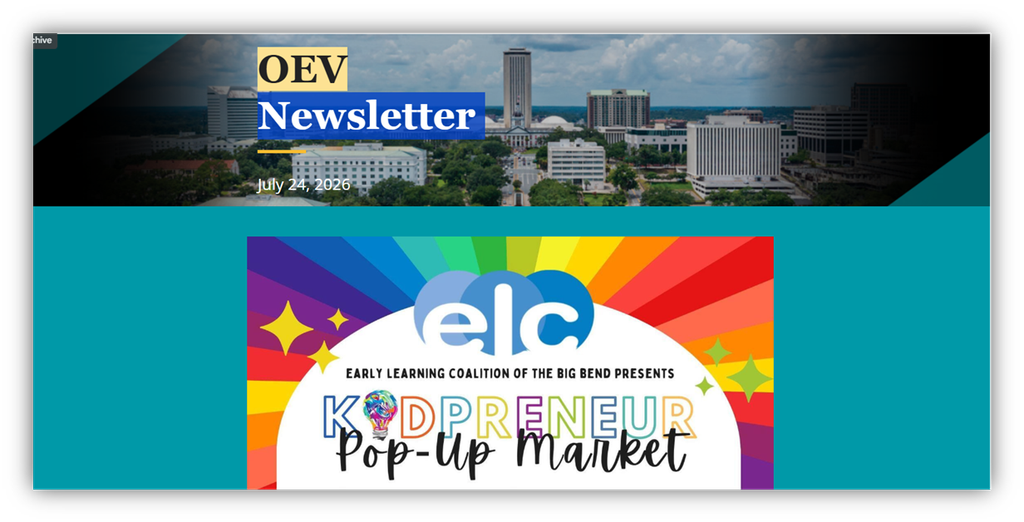
Since March, readers have learned about a Domi Awards celebration, the Leon Works Expo, educational attainment, Small Business Week, hurricane preparedness, the Love Your Local campaign, high-speed internet in rural Leon County, the Kidpreneur program and Tallahassee Restaurant Week.
One May newsletter celebrated an OEV employee’s 30 years of public service.
July brought “Kidpreneurs Launch Their Entrepreneurial Journey.” Two weeks later came an invitation to the Kidpreneur Pop-up Market.
August brought the news that 18 Tallahassee employers made Florida Trend’s Best Companies to Work For list — recognition earned by those companies, not companies recruited here by OEV.
And on Aug. 24, OEV announced that its own podcast, Economic Vitality Unplugged, had won an international Silver Award for economic-development storytelling. OEV says the award recognizes the podcast for making economic development “accessible, engaging, and community-centered.”
There is nothing wrong with promoting local businesses, recognizing employees, helping young entrepreneurs or producing a podcast.
But it’s a striking contrast.
OEV’s newsletter archive documents an extraordinary amount of economic-development activity.
What’s considerably harder to find is a new company announcing: We’re coming to Tallahassee.
OEV did travel to England this summer for the Farnborough International Airshow, where it says it connected with global manufacturers, suppliers and executives considering future expansion. OEV called participation a “strategic investment in long-term business recruitment.”
Perhaps one of those conversations will become the next Amazon.
For now, it remains another investment in a future result.
What did $24,000 Buy?
One smaller expenditure caught RTF’s attention.
OEV paid Strategic Optimization and Research LLC, or SOAR, $24,000 for what the accounts-payable records describe as “OEV Training Academy Facilitation.”
RTF initially couldn’t find evidence that an OEV Training Academy had actually taken place. So we filed another public-records request asking for the contract, invoice, scope of work and whatever taxpayers received for the $24,000.
Turns out, the work did happen.
But it wasn’t a training academy.
SOAR conducted four focus groups involving OEV-certified businesses, prime contractors and government project managers and produced a report recommending nine courses for a Small Business Training Academy OEV hopes to launch in 2027.
The proposed courses include project management, estimating and bid pricing, financial management, procurement, artificial intelligence, leadership, basic Microsoft Office and productivity tools, construction basics and joint ventures.
The $24,000 did not buy finished courses. There are no completed lesson plans, instructor materials or student materials in the final product. SOAR describes what it produced as an “implementation-ready framework” containing course concepts, topics, suggested delivery methods and possible measures of success.
But one recommendation in the report jumped out.
Before launching the academy, SOAR says OEV should review training already available locally through organizations including the Chamber, Small Business Development Center, FAMU, Tallahassee State College, FSU and the Jim Moran Institute.
The reason is “to confirm that taxpayer-funded programming is not duplicating existing offerings.”
That’s a sensible thing to do.
The question is why it wasn’t done first.
OEV spent $24,000 identifying the classes local businesses might need before determining whether those classes were already available.
The academy could ultimately fill legitimate gaps and prove valuable. But taxpayers will have to wait to find out what additional work — and additional money — will be required to turn the recommendations into actual courses.
Activity vs. Results
Taken individually, most of the payments in OEV’s spreadsheet aren’t particularly remarkable.
Taken together, they provide a revealing snapshot.
To be fair, economic development isn’t a vending machine where taxpayers insert $812,000 and a factory drops out.
But OEV’s own description of itself says the agency exists in part to provide “accountability” and “transparency” in economic development and to help companies relocate and expand here.
That makes the distinction between activity and results a fair one.
Amazon is real. It opened. It created jobs.
And five years later, taxpayers are still paying incentives on that deal while waiting for the next major recruitment success.
Project Vertigo could have been it. Project E-Boat could have been it. Perhaps the contacts made at Farnborough will produce it.
But eventually Charlie Brown gets to ask when he’s actually going to kick the football.