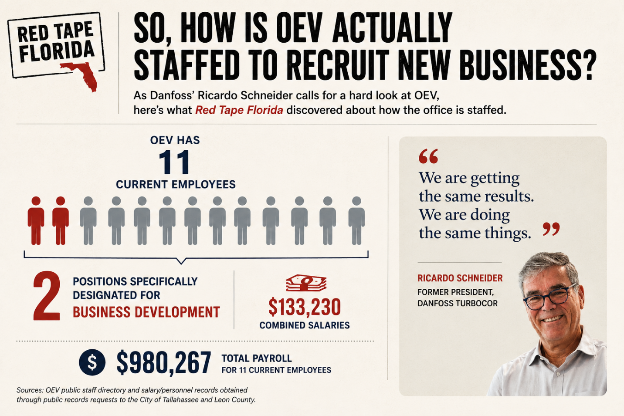
So, how many OEV employees actually recruit new business?
A year ago, Ricardo Schneider — then president of Danfoss Turbocor, one of the few Tallahassee companies expanding at real scale — set a deadline: if the region didn’t land at least two new business commitments within 12 months, it would be a “community failure.” That deadline has now passed. No new businesses have been secured, and Schneider isn’t backing off.
[…]
By Skip Foster, Red Tape Florida
So, how many OEV employees actually recruit new business?
Share this
Share
+1
Tweet
Share
Share
As Danfoss’ Ricardo Schneider calls for a hard look at OEV, here’s what Red Tape Florida discovered about how the office is staffed.
By Skip Foster, Red Tape Florida
A year ago, Ricardo Schneider — then president of Danfoss Turbocor, one of the few Tallahassee companies expanding at real scale — set a deadline: if the region didn’t land at least two new business commitments within 12 months, it would be a “community failure.” That deadline has now passed. No new businesses have been secured, and Schneider isn’t backing off.
“I’m very disappointed with where we are today,” he told the Tallahassee Democrat in a Thursday story, adding it’s time for “a discussion about the future of OEV after the election.”
“We are getting the same results,” he said. “We are doing the same things.”
That’s a pointed call for scrutiny from someone who isn’t a political opponent of OEV — he’s the former head of the company local leaders have repeatedly held up as proof the strategy works.
So Red Tape Florida reviewed OEV’s current public employee directory together with salary and personnel records obtained through public records requests to the City of Tallahassee and Leon County, to see exactly how the office charged with attracting new employers and investment is staffed.
The staffing breakdown looks like this: of OEV’s 11 current employees, two hold positions specifically designated for business development — a Business Development Manager and a Business Development Intern. Four positions are specifically assigned to the Minority, Women and Small Business Enterprise program. Three are categorized under leadership and administration, and two under research, marketing and special projects.
OEV Staff, Titles and Salaries
Listed alphabetically by last name. Based on OEV’s public staff directory (titles) and salary and personnel records obtained via public records requests (annual salary).
| Name | Title | Category | Annual Salary |
| Keith Bowers | Director, Office of Economic Vitality | Leadership & Administration | $148,195.84 |
| Jessica Grant | Administrative Specialist II | Leadership & Administration | $60,371.76 |
| Darryl Jones | Deputy Director, Minority Women & Small Business Enterprise | MWSBE | $111,402.27 |
| Sean Lewis | Special Projects Coordinator | Research, Marketing & Special Projects | $96,719.92 |
| Dan Lucas | Business Intelligence Manager | Leadership & Administration | $102,827.11 |
| Kadin Musco | Business Development Intern | Business Recruitment | $32,448.00 |
| Dineta O’Hara | Business Development Manager | Business Recruitment | $100,782.15 |
| LaTanya Raffington | Senior Manager, Minority Women & Small Business Enterprise | MWSBE | $90,941.71 |
| Wilnick SaintCharles | Senior Coordinator, Minority Women & Small Business Enterprise | MWSBE | $78,000.00 |
| Shanea Wilks | Senior Manager, Minority Women & Small Business Enterprise | MWSBE | $94,578.46 |
| Maegen Wynn | Business Outreach & Marketing Coordinator | Research, Marketing & Special Projects | $63,999.94 |
| Total (11 current employees) | $980,267.17 | ||
Note: A twelfth employee, Violeta Wall, appears in payroll records as a Blueprint Right-of-Way Assistant earning $64,786.42 annually. That position does not appear on OEV’s current public staff directory and is not included in the table above. Combined with the 11 current employees, total salaries across all 12 payroll records reach approximately $1,045,053.59.
OEV employs one Business Development Manager and one Business Development Intern. Together, those two positions account for approximately $133,230 in annual salaries.
By comparison, four employees work in the Minority, Women and Small Business Enterprise program. Their combined annual salaries total approximately $374,922, representing about 38 percent of the office’s current payroll.
The remaining staff includes OEV Director Keith Bowers, Business Intelligence Manager Dan Lucas, Business Outreach and Marketing Coordinator Maegen Wynn, Special Projects Coordinator Sean Lewis and Administrative Specialist Jessica Grant.
To be fair, Bowers surely spends a considerable amount of his time on recruitment, in addition to managing the entire OEV operation. But if Tallahassee-Leon taxpayers were under the impression that most of OEV’s staff positions are specifically dedicated to recruiting new industry to the region, the office’s own staff directory tells a different story.
The MWSBE program certifies and assists minority-, women-, and small-business-owned firms seeking to compete for public contracts. That work is distinct from recruiting companies to relocate or expand into Tallahassee-Leon County.
OEV’s staffing structure comes as the region faces real economic headwinds by the office’s own numbers. Resident employment has fallen from 163,592 in October 2024 to 154,743 as of the most recent reporting — a decline of 8,849, or 5.4 percent — and the unemployment rate stood at 5.0 percent in May 2026, up from the mid-3-percent range a year earlier. Population growth, initially reported by the U.S. Census as a decline in 2024, has since been revised to a bare 0.13 percent gain — essentially flat.
Red Tape Florida has written extensively on these matters:
- OEV’s 2025 scorecard: A goose egg
- Skip Foster’s speech to Tiger Bay on the county’s economic distress and the reasons behind it.
The purpose of this analysis is not to suggest that one function is important and others aren’t. OEV has responsibilities beyond recruiting new industry, including administration of the MWSBE program. But attracting new employers and investment is central to the agency’s economic development mission.
The staffing records do, however, answer one factual question: of OEV’s 11 current employees, two hold positions specifically designated for business development, in a community where economic development wins are practically non-existent.
Schneider, for his part, isn’t blaming any one person. He credited OEV Director Keith Bowers by name, saying Bowers is “pushing very hard.” But his larger criticism is unmistakable: “We are getting the same results. We are doing the same things.”
OEV performs a number of functions assigned by the City and County. But staffing reflects priorities. Other OEV employees may participate in recruitment efforts as part of their broader responsibilities, but their listed positions are not specifically designated as business development — and of the two that are, one is an intern. Whether that’s the right allocation is ultimately a policy decision — one Schneider is now asking the community to have out loud.
Taxpayers deserve to know how their economic development office is actually organized going into that conversation.
August 13, 2026By Skip Foster, Red Tape Florida

Remember those buyout details the City of Tallahassee didn’t have? They did.
When Red Tape Florida asked the City of Tallahassee to show how its voluntary buyout program would save more than $8 million a year, the city’s response was remarkable: there was no spreadsheet, no financial model, and no position-by-position analysis supporting the claim. […]
By Skip Foster, Red Tape Florida
Remember those buyout details the City of Tallahassee didn’t have? They did.
By Skip Foster, Red Tape Florida
When Red Tape Florida asked the City of Tallahassee to show how its voluntary buyout program would save more than $8 million a year, the city’s response was remarkable: there was no spreadsheet, no financial model, and no position-by-position analysis supporting the claim.
No methodology. No documented staffing plan. No record reconciling the promised savings with a salary budget that was still going up.
Which made it all the more surprising when Red Tape Florida uncovered that Commissioner Jack Porter attempted to hire a new legislative aide — at the same salary as the departing aide, with comparable qualifications and consistent with what the City’s other commissioners pay their aides — only to discover City Finance had already reduced the budget for the position without consulting her.
The city assumed – without communicating this assumption – that Porter would hire the replacement aide for approximately $13,400 less. When she didn’t, her office was expected to absorb the difference within its existing budget.
The episode offers the clearest window yet into one of the questions Red Tape Florida has been asking for weeks: How, exactly, did City Hall calculate the savings from its Voluntary Separation Incentive (VSI) program?
According to newly obtained emails, Porter’s longtime legislative aide, Terrie Hookfin, accepted the city’s buyout after earning an annual salary of $90,018, which is commensurate with the other four commissioners’ aides. Red Tape Florida independently confirmed that figure through the city’s VSI severance records.
When Porter selected a replacement, she proposed paying the same salary — $90,018.38, matching Hookfin’s salary to the penny. Porter told Human Resources the new aide possessed qualifications comparable to Hookfin’s and should receive compensation consistent with the legislative aides serving the city’s other four commissioners.
But finance had already made a different assumption. Instead of budgeting the position at its existing salary, the city reset it to what is called the Maximum Hire Rate, or MHR — an existing city compensation practice that generally establishes the highest salary at which a new employee may be hired without additional approval. In this case, Finance applied that existing practice as part of its FY27 budget assumptions, budgeting the position at approximately $76,600, more than $13,000 below the departing employee’s salary.
“The FY27 budget assumption resetting the position to the Maximum Hire Rate did not reflect my intended compensation level for this position and was made without consultation with my office,” Porter wrote Assistant City Manager Abena Ojetayo in an email obtained by Red Tape Florida.
New salary? That was news
In an interview, Porter said she first learned of the reduced budget only after selecting her replacement — and that no one from finance or the City Manager’s Office ever asked whether she intended to refill the position at a lower salary before building that assumption into the budget. Had they asked, she said, they would have learned immediately that her intention was to maintain salary parity with the other commissioners’ aides.
Porter also said the Commission received little discussion about the mechanics behind the city’s projected savings before approving the VSI program. Commissioners were told generally that savings would come from positions left vacant and others refilled at lower salaries, she said, but there was no discussion about budgeting specific vacant positions at the Maximum Hire Rate as part of the city’s projected savings or how those assumptions would affect elected officials and department directors responsible for making hiring decisions.
Hookfin, who spent nearly nine years with the city — including assignments in Human Resources, Housing and Commissioner’s offices — corroborated Porter’s account. She said neither she nor Porter’s office was informed before she accepted the buyout that her position would revert to the Maximum Hire Rate or that her replacement would be budgeted at a substantially lower salary.
“We learned about each new restriction only when it became another roadblock,” Hookfin said.
Hookfin also said legislative aides have historically been paid at roughly comparable salaries because each commissioner employs a single aide performing essentially the same job. “When I left, aides were earning approximately $90,000,” she said. “Requiring Commissioner Porter’s new aide to earn significantly less than every other aide abandons that equity standard without warning or a legitimate operational reason.”
HR, Finance not on same page
Further complicating matters is that apparently one city department didn’t know what the other was doing. The City’s Human Resources had already approved posting the position with a salary range that included Hookfin’s existing salary. Only after Porter selected her replacement and attempted to complete the hiring process did Finance advise that the position had already been budgeted at the Maximum Hire Rate. In other words, one department approved advertising the position at approximately $90,000 while another had already budgeted it at roughly $76,600. Whether that disconnect reflects poor communication, poor planning or something else entirely, taxpayers deserve an explanation.
Assistant City Manager Abena Ojetayo acknowledged the budget reduction in her response to Porter but defended it as routine. Resetting vacant positions to the Maximum Hire Rate, she wrote, is simply “standard for our budget planning.”
That sentence may be the most important one in the entire email chain, because of what it says about the City’s response to Red Tape Florida’s public records requests.
For weeks, Red Tape Florida has been asking City Hall to produce the records explaining how officials calculated the program’s promised $8.46 million in annual savings — specifically, the financial models, the methodology, the records identifying which positions would be eliminated, refilled or left vacant, and the analyses showing how those savings reconciled with a salary budget that nevertheless increased.
The city’s response has been remarkably consistent: no responsive records exist.
Yet here, in that same email, finance had already described that assumption as routine. If it’s really “standard for our budget planning,” where are the records documenting that standard? Because that is precisely the type of methodology Red Tape Florida has been seeking all along.
How does this play out 171 times?
The implications extend far beyond Porter’s office. The City’s voluntary buyout program affected 171 employees across virtually every department in city government. If finance routinely applied the Maximum Hire Rate to vacant positions as part of its budget planning assumptions, how many other positions were budgeted using similar assumptions? Were department directors consulted before those assumptions became part of the FY27 budget? Did every hiring authority intend to refill positions at those lower salaries — or were those assumptions simply built into the City’s projected savings before the people responsible for making the hiring decisions had weighed in?
Hookfin believes at least some positions were never likely to generate the recurring salary savings reflected in the city’s projections. Certain positions — including a commissioner’s sole legislative aide — were always going to have to be refilled, she said, and because of operational needs and longstanding pay equity, some would inevitably have to be filled at or near the incumbent’s salary. “Those positions would produce little or no ongoing salary savings,” Hookfin said.
Perhaps there truly are no spreadsheets. Perhaps there is no master financial model. But there was unquestionably a methodology — and taxpayers are only learning about one piece of it because Commissioner Porter attempted to hire a replacement for her longtime legislative aide.
Which leaves one final question: if this budgeting assumption existed all along, what other assumptions were built into the City’s $8.46 million savings estimate that the public still hasn’t seen?
August 13, 2026By Skip Foster, Red Tape Florida

OPINION: This is what it looks like when the four legs of Leon County’s stool work together
At Tiger Bay a few weeks ago, I talked about what I believe drives successful communities. Economic development isn’t the responsibility of one organization. It’s a four-legged stool.[…]
August 11, 2026Opinion, by Skip Foster, Red Tape Florida
OPINION: This is what it looks like when the four legs of Leon County’s stool work together
Opinion by Skip Foster, Red Tape Florida
At Tiger Bay a few weeks ago, I talked about what I believe drives successful communities.
Economic development isn’t the responsibility of one organization. It’s a four-legged stool.
One leg is local government. One is higher education. One is the private sector. One is state government.
When all four are working together, communities grow.
If you’ve read Red Tape Florida for any length of time, you know we have spent a lot of our energy documenting the opposite. We write about bureaucratic delays, unnecessary regulations, missed opportunities and government policies that make it harder for businesses to invest and create jobs.
That’s not changing.
But criticism without praise is a one-note song.
Here is an example of our community getting it right. The topic? Sports and entertainment tourism.
The story starts in Oregon
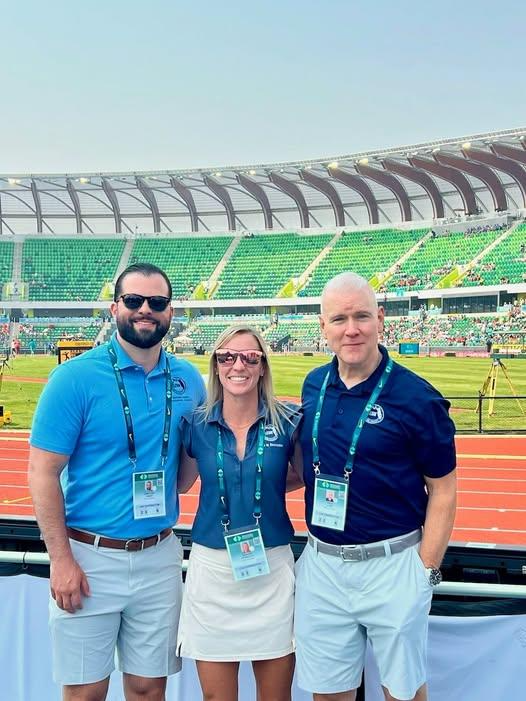
While most people weren’t paying attention, Leon County Commission Chairman Christian Caban and County Administrator Vince Long were recently in Eugene, Oregon, making the case for Tallahassee to host the 2029 World Athletics Cross Country Championships. They weren’t just attending a conference.
They were selling Tallahassee to the world based on the success of this year’s championship at Apalachee Regional Park.
While most people weren’t paying attention, Leon County Commission Chairman Christian Caban and County Administrator Vince Long were recently in Eugene, Oregon, making the case for Tallahassee to host the 2029 World Athletics Cross Country Championships.
They weren’t just attending a conference. They were selling Tallahassee to the world based on the success of this year’s championship at Apalachee Regional Park.
That effort didn’t begin with a plane ticket.
It began more than a decade ago when Leon County made the long-term decision to invest in Apalachee Regional Park as a destination for cross-country competition. Since then, the park has hosted dozens of national, regional and state championships, attracting thousands of athletes and visitors and generating millions of dollars in spending for local businesses. The World Championships weren’t a lucky break. They were the payoff from years of consistent investment.
And that investment is beginning to compound.
The World Athletics Cross Country Championships drew more than 10,000 spectators to Tallahassee, including thousands of visitors from outside Leon County, providing another tangible example of how destination events can fill hotel rooms, restaurants and local businesses.
County leaders aren’t treating that success as a one-off. This summer, they proposed a new performance-based tourism incentive program aimed at attracting even larger events, while simultaneously traveling to Oregon to make the case for bringing the 2029 World Athletics Championships back to Apalachee Regional Park. That’s what strategic economic development looks like. It’s not chasing the next headline. It’s building on success, reinvesting in it and creating a pipeline of opportunities that can pay dividends for years to come.
That’s the first leg of the stool.
The second is our area’s colleges and universities.
Bulls and Bananas
For years, Doak Campbell Stadium was essentially a twelve-day-a-year asset. Athletic Director Michael Alford deserves credit for changing that mindset. The Savannah Bananas filled the stadium. Professional Bull Riders brought thousands more visitors. Concerts followed. Instead of sitting empty most of the year, one of Tallahassee’s largest public assets is becoming an economic engine that benefits the entire community.
The success of those events isn’t going unnoticed.
At the close of last month’s Leon County Commission meeting, Chairman Christian Caban announced plans to bring forward a formal agenda item aimed at creating a more intentional strategy for sports and entertainment tourism. His vision is straightforward: use Tallahassee’s major public venues to attract destination events during traditionally slower tourism periods, bringing visitors here when hotel occupancy and economic activity would otherwise lag.
That’s exactly the kind of long-term thinking communities need. Successful tourism isn’t about landing one headline event. It’s about creating a year-round pipeline of attractions that maximize facilities taxpayers have already paid to build.
The third leg is the private sector.
Chamber checks in
The Greater Tallahassee Chamber of Commerce publicly backed the County’s effort this week, recognizing what local businesses already know: visitors don’t just attend sporting events. They stay in hotels, eat in restaurants, shop in local stores and support local jobs. Several businesses have already reported significant increases in sales during these major events.
The fourth leg is the State of Florida.
Foundational
The Florida Sports Foundation doesn’t build facilities or operate hotels. But it helps communities compete for major sporting events that might otherwise go to Orlando, Tampa or Miami. That statewide support gives communities like Tallahassee a chance to compete on a much larger stage.
None of these organizations could have accomplished this alone.
The County could build a world-class course, but without FSU embracing year-round use of its facilities, the community’s overall sports tourism strategy would be weaker.
The Chamber could promote Tallahassee all day long, but without venues and events, there would be nothing to sell.
The state can help market destinations, but it can’t manufacture local leadership.
It takes all four.
Too often in Tallahassee, these institutions operate in their own lanes. Sometimes they’re indifferent to one another. Occasionally they’re working at cross purposes. When that happens, economic opportunities are lost before they ever reach the starting line.
This is different.
It’s a reminder that economic development isn’t just about recruiting the next manufacturer or announcing another ribbon-cutting. Sometimes it’s about recognizing the assets you already have, investing in them over time and getting multiple institutions rowing in the same direction.
I’ve spent plenty of time pointing out where Tallahassee falls short.
It’s only fair to point out when it gets something right.
The real opportunity isn’t simply bringing another world championship to Apalachee Regional Park.
It’s asking a bigger question:
What if we approached our other economic priorities the same way?
What if the same level of collaboration were applied to expanding air service at Tallahassee International Airport? What if local government, the business community, Florida State and state leaders all treated that as a shared priority instead of someone else’s responsibility?
What if we brought that same alignment to recruiting major employers? To commercializing the incredible research taking place at Florida State and the National High Magnetic Field Laboratory? To creating more startup companies that grow here instead of leaving here?
Those are the kinds of challenges no single organization can solve.
The County can’t do it alone.
Neither can the City.
Neither can FSU.
Neither can the Chamber.
Neither can the state.
But together? That’s a different conversation.
That’s why this story is about much more than cross-country championships, Banana Ball or bull riding.
Those are simply proof of concept.
They’re evidence that when Tallahassee’s four legs of the stool — local government, higher education, the private sector and state government — decide to pull in the same direction, this community can compete with cities much larger than our own.
Imagine what could happen if we made that the rule instead of the exception.
August 11, 2026Opinion, by Skip Foster, Red Tape Florida
The Florida Legislature told local governments to cut permit fees; what’s the holdup?

By Skip Foster, Red Tape Florida
The Florida Legislature made a clear decision this year.
The government shouldn’t get paid for work it didn’t do.
We are talking about the years-long private provider laws in Florida which allow inspections and plan reviews to be conducted by private sector businesses.
The problem is that local government bureaucrats can’t stand private providers. They operate on government turf. And despite often having stronger credentials than their government counterparts, they’re still viewed with suspicion because they work in the private sector.
But the Legislature does trust and value private providers, and rightly so.
The private sector almost always operates more efficiently, quickly and cost-effectively than bureaucracies.
Which is why the Legislature acted on this premise: If a private provider is doing the work, taxpayers shouldn’t be paying the government as if the government did it.
That’s exactly what House Bill 803, effective July 1, requires. On commercial projects, local governments must reduce building permitfees by at least 50 percent when a private provider performs both plan review and inspections, and by at least 25 percent when the private provider performs one of those functions. On residential projects, the permit fee is supposed to reflect the work the building department actually performs. The law also prohibits local governments from tacking on administrative or punitive fees simply because an owner chooses to use a private provider.
Seems straightforward enough.
So how are local governments doing?
Not very well, at least based on an initial review of publicly available fee schedules from around Florida.
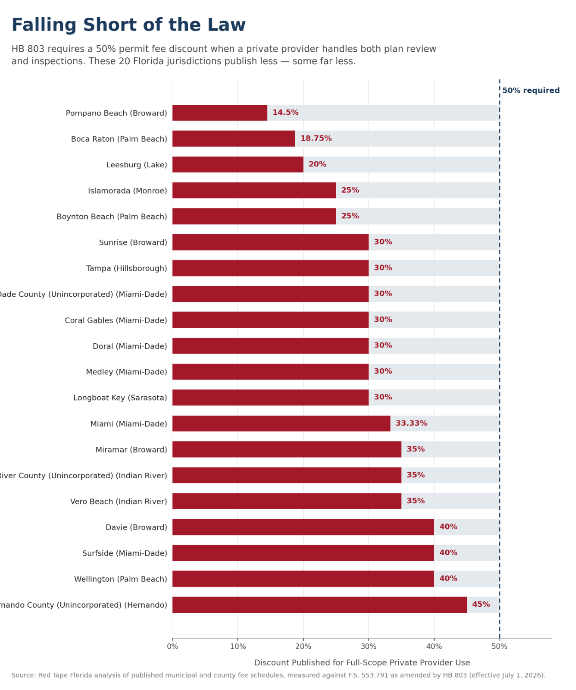
A review of more than 60 jurisdictions found dozens that appear to have fee schedules that don’t match the new law.
Some continue to offer discounts well below the statutory minimum.
Others appear to be charging separate administrative or registration fees for private provider projects. Several adopted new fee schedules after the Legislature passed HB 803 without updating the portions dealing with private providers.
If that’s correct, it raises a pretty basic question: How can local governments insist that builders follow every line of the building code while ignoring a state law that applies directly to them? The examples are hard to ignore.
Pompano Beach appears to provide a discount of about 14.5 percent in some situations where the new law requires at least 50 percent.
Boca Raton’s published schedule appears to reduce the fee from 1.60 percent of project value to 1.30 percent when a private provider performs both functions. According to the analysis, that would amount to more than a $25,000 difference on a $5 million commercial project compared with what HB 803 appears to require.
Leesburg appears to offer two separate 10 percent discounts, one for inspections and one for plan review, while also charging a $50 private provider registration fee.
Islamorada’s published procedures reference a 25 percent discount when a private provider performs both functions and 15 percent when only one function is performed.
Those aren’t isolated examples.
The review also identified published fee schedules in jurisdictions including Miami-Dade County, Coral Gables, Sunrise, Tampa and others that appear to fall below the new statutory minimum. Another group of cities and counties—Cocoa, Collier County, Palm Beach County, Dundee, Coral Springs, Polk County, Miramar, Seminole and Largo—appear to continue charging administrative fees associated with private providers, despite language in the new law intended to prohibit those charges.
Just as interesting is the timing.
Several jurisdictions updated or adopted fee schedules after the Legislature approved HB 803. Yet the published documents still appear to reflect the old approach rather than the new law.
Maybe there’s an explanation.
Maybe some jurisdictions have adopted internal procedures that simply aren’t reflected in the published fee schedule. Maybe amendments are already in the works. Every city and county deserves the chance to explain its position before anyone reaches a final conclusion.
But if the published schedules are accurate, this isn’t a technical issue.
It’s an issue of the rule of law and, ultimately, money.
Permit fees don’t disappear into thin air. They become part of the cost of building a home, an apartment complex, a medical office or a warehouse. Those costs eventually show up in home prices, rents or lease rates.
For years, local governments have defended permit fees by saying they recover the actual cost of providing the service.
HB 803 applies that same logic in reverse.
If the government isn’t doing the work, why should it collect the full fee?
That’s the question the Legislature answered.
The next question is: when are local governments going to start following the law?
August 6, 2026By Skip Foster, Red Tape Florida
FOSTER: What Austin understands that Tallahassee doesn’t
Red Tape Florida’s recent piece on Austin’s successful efforts to tackle affordable housing had a lot of important themes: […]
July 31, 2026Opinion by Skip Foster, Red Tape Florida
FOSTER: What Austin understands that Tallahassee doesn’t
Opinion by Skip Foster, Red Tape Florida
Red Tape Florida’s recent piece on Austin’s successful efforts to tackle affordable housing had a lot of important themes:
- The key to lowering prices is driving up supply
- The cost of red tape is significant
- Time is money and a bogged-down bureaucratic process hurts not just builders but the eventual home and business owners
But it was another theme that struck me. I saw something in Austin Mayor Kirk Watson that I simply haven’t seen within Tallahassee City government: True leadership and vision.
While Tallahassee is paying for awards and positive coverage, renaming streets and issuing proclamations, its economy remainsstagnant and affordable housing persists as an acute problem.
Tallahassee has largely resorted to unoriginal, public-sector driven solutions — subsidizing projects with federal and state housing dollars, supporting community land trusts, offering down payment assistance, funding rehabilitation programs, requiring or incentivizing affordable units through inclusionary housing policies, and partnering with nonprofits and developers on publicly backed projects. Those efforts may help individual families and add some units to the housing stock, but they largely rely on government money, government programs or government direction.
Austin tried something different. It considered an idea that would surely seem novel to Tallahassee leaders: Maybe we are a part of the problem.
It turned a critical eye on itself and hired an outside firm to provide an unbiased report answering this question: is our bureaucracy negatively impacting the issue of affordable housing?
Can you even imagine that happening in Tallahassee?
City leaders are too busy flexing, cheerleading and railroading. Decisions are made in backrooms, not in the public’s view. Data isn’tgathered independently with a “what we can learn” mentality. Instead, it’s cherry-picked and presented only in the most positive light.
The internal culture is toxic and that actually becomes a self-fulfilling prophecy. Let me explain.
Tallahassee is known across the state and even the nation as a business-unfriendly city. This is simply a fact – I’ve heard it so many times from so many people in so many sectors I don’t need a poll to tell me it’s true.
But part of the culture that leads to this business unfriendliness is arrogance. An insular attitude. A “we know best” mentality.
Why, Tallahassee government leaders would likely say, do we need to survey our own operation when we already know we’re right and everybody else is wrong?
It’s that mentality that leads to absolutely inane results, like the shed from hell, that, according to my sources, STILL hasn’t been approved for use by the City. Or the Midtown Reader grass field, which STILL hasn’t been allowed to be turned into desperately needed parking. And the list goes on (and is growing, as Red Tape Florida is now receiving tips from Tallahassee and across the state on a daily basis).
The Austin mayor was willing to cross party lines — and other imaginary political boundaries — to gather information to actually solve a problem. He was willing to admit a fault so that it could then be fixed.
In Tallahassee, we are hopelessly divided by a 3-2 dynamic where if one side suggested an ordinance banning the torture of puppies and kittens, the other side would immediately claim to be pro-puppy and kitten torture.
Sadly, even business leaders have become so invested in this 3-2 fable that they will support completely unqualified candidates simply to maintain “control,” when all they are really doing is sentencing the city to another two to four years of ineptitude and weak leadership.
Heck, even when it is obvious that there is a problem – a floundering economy, or a failing Office of Economic Vitality – there doesn’tappear to be the gumption for government leaders to admit it.
We are left with another generation’s worth of problems that never get solved because no one is willing to ask the first question Austin asked:
Could we be part of the problem?
That’s not a partisan question. It’s not a liberal question or a conservative question. It’s a leadership question.
Until Tallahassee has leaders willing to challenge their own assumptions, invite outside scrutiny and admit that City Hall itself may be standing in the way of progress, we’ll continue treating symptoms instead of causes.
Austin’s mayor had the confidence to look inward before pointing outward.
That’s the kind of leadership Tallahassee has been missing.
July 31, 2026Opinion by Skip Foster, Red Tape Florida

This city disproved everything you’ve heard about affordable housing; take note, Florida
July 28, 2026By Skip Foster, Red Tape Florida
This city disproved everything you’ve heard about affordable housing; take note, Florida
By Skip Foster, Red Tape Florida
Regardless of what Floridians think about Austin, Texas, consider these four facts:
- Austin added roughly 120,000 housing units between 2015 and 2024 — a 30% increase in its housing stock — and inflation-adjusted rents have since fallen about 19% from their 2021 peak.
- City leaders commissioned an independent, top-to-bottom review of their own permitting and development process.
- Instead of asking what developers or the market were doing wrong, they asked a far more uncomfortable question: Was City Hall itself making housing more expensive?
The answer was yes.
Those four facts deserve more than a passing glance.
For years, the national debate over housing affordability has followed a familiar script. One side blames developers. Another blames zoning. Others point to interest rates, Wall Street investors, labor shortages or rising construction costs. All of those factors matter.
Austin decided to ask a different question.
Instead of beginning with the housing market, it began by examining City Hall.
During a recent appearance on Bloomberg’s Wall Street Week, Mayor Kirk Watson explained that the city deliberately focused on the things it could actually control. That meant asking whether Austin’s own permitting process had become so slow, unpredictable and unnecessarily complicated that it was driving up housing costs before construction even began.
It had.
“We focused on what we could control,” Watson said.
That’s what makes Austin’s experience so instructive. And its leadership so impressive.
Too often, governments begin with conclusions. They defend existing systems, blame outside forces or search for confirmation of policies they already support. Austin did the opposite.
It commissioned what Watson described as a “soup-to-nuts” review of its development process — not to validate City Hall’s performance, but to challenge it.
Government commissions studies all the time. Most examine problems outside government. Austin turned the spotlight inward.
That question alone deserves the attention of every mayor, county commissioner, city manager and planning director in Florida.
Whether Austin’s politics appeal to you is beside the point.
“We did a soup-to-nuts review of our entire development review process,” Watson said.
Leadership is measured by the willingness to examine your own institution before assigning blame to someone else.
When 1,500 Steps Isn’t About Exercise
Austin hired McKinsey & Company to evaluate its development review process. The consultants didn’t recommend eliminating environmental protections or gutting regulations. They concluded the city’s permitting system had become so fragmented that it was difficult to navigate — for applicants and, in many cases, for the city itself.
A typical site plan required review by 11 different city departments. More than 250 city employees participated in the approval process. Depending on the project, an application could pass through nearly 1,500 separate process steps before reaching the finish line.
Imagine running a private business where a customer request had to move through 11 departments, involve more than 250 employees and survive 1,500 procedural steps before anyone could say yes.
Nobody would expect that organization to be fast.
Nobody would expect it to be inexpensive.
Housing is no different.
The consultants also measured what applicants had experienced for years.
The average initial review approached a year. About 80 percent of applicants reported having to revise and resubmit plans at least three times before receiving approval. Some projects remained in review for well over 18 months. Customer satisfaction with the site-plan review process was effectively nonexistent.
The review identified problems that will sound familiar to anyone who has spent time around local government.
Departments interpreted the development code differently. Reviews were duplicated. Communication between departments broke down. Technology lagged behind the organization’s needs. Applicants often received conflicting comments from different reviewers, forcing another round of revisions, another round of meetings and another round of delays.
None of those obstacles were created by the private sector.
They were created inside City Hall.
Perhaps McKinsey’s most important contribution wasn’t identifying the delays.
It was measuring what those delays cost.
The consultants estimated that every additional month of permitting delay added roughly $9,700 to the carrying cost of a typical single-family redevelopment project and approximately $546,000 to a multifamily project.
Based on Red Tape Florida’s experience, those numbers actually seem low.
Regardless, this is the point where red tape stops being an abstraction.
Every unnecessary review, every redundant approval and every avoidable month of delay eventually shows up somewhere.
Usually, it’s in the price of housing.
Those costs don’t disappear.
They become part of the final price of the home or apartment.
Austin’s leaders viewed those findings not as an indictment of government, but as a management challenge.
Rather than defending the existing system, they standardized reviews, improved coordination between departments, clarified expectations, introduced performance metrics and began publicly tracking review times. According to McKinsey, initial review times were reduced by roughly 50 percent after the reforms began.
But faster permitting was never the goal.
More housing was.
Supply, Supply, Supply
Austin’s permitting reforms were simply the means to a larger objective.
As Watson put it, “The biggest thing we needed to do was reduce the red tape and the bureaucracy associated with building housing.”
The city wanted more homes built.
Anyone who has taken middle school economics understands the principle: prices are determined by supply and demand.
Permits determine when – and whether – homes get built.
When projects become more predictable, financing becomes less risky. When financing becomes less risky, more projects move forward. When more projects move forward, supply increases. And when supply begins catching up with demand, upward pressure on prices begins to ease.
That’s exactly what Austin set out to accomplish.
Rather than trying to solve housing affordability by having government build enough housing itself, city leaders focused on creating conditions that allowed the private sector to build more housing.
Over the past several years, Austin added roughly 120,000 housing units. As that inventory entered the market, rents declined from their pandemic-era highs, making Austin one of the few major metropolitan areas in the country to experience meaningful rent declines.
No serious economist would argue that permitting reform alone produced that outcome. Interest rates, migration patterns and broader market conditions all played a role.
But virtually every economist agrees on one principle.
When demand consistently exceeds supply, prices rise.
When supply begins catching up, price pressures ease.
Austin also examined whether its land-use regulations unnecessarily constrained housing supply. Changes such as allowing smaller lot sizes made it possible to build more homes on the same amount of land without expanding the city’s footprint. Combined with permitting reforms and other housing initiatives, those changes created conditions for a significant increase in housing construction.
None of this means every subdivision should be approved or every regulation eliminated.
Communities have every right to protect wetlands, preserve neighborhoods, require adequate infrastructure and insist on responsible development.
But every regulation should be measured against both its benefits and its costs.
That’s ultimately what makes Austin’s experience so relevant to Florida.
Tallahassee and Leon County have their own permitting challenges. Red Tape Florida has documented examples of departments working at cross-purposes, unnecessary delays and bureaucratic friction that increase costs before a shovel ever reaches the ground.
What Austin did differently was ask the difficult question first.
Is government itself contributing to the problem?
That’s a question every city and county in Florida should have the courage to ask.
Austin couldn’t lower interest rates.
It couldn’t reduce the cost of concrete.
It couldn’t stop people from moving there.
But it could examine the one thing completely within its control:
Its own bureaucracy.
That’s leadership.
July 28, 2026By Skip Foster, Red Tape Florida

Florida promised less red tape; now it’s time for DBPR to keep that promise
Florida has spent the last several years telling local governments to get out of the way. Gov. Ron DeSantis has made cutting bureaucracy a cornerstone of his administration. The Legislature has repeatedly strengthened Florida’s private-provider law, most recently through HB 803, to speed permitting and prevent local governments from inventing new obstacles.[…]
July 23, 2026By Skip Foster, Red Tape Florida
Florida promised less red tape; now it’s time for DBPR to keep that promise
By Skip Foster, Red Tape Florida
Florida has spent the last several years telling local governments to get out of the way.
Gov. Ron DeSantis has made cutting bureaucracy a cornerstone of his administration. The Legislature has repeatedly strengthened Florida’s private-provider law, most recently through HB 803, to speed permitting and prevent local governments from inventing new obstacles.
So, here’s a simple question.
What happens when a local government appears to ignore those reforms?
That’s where this story gets interesting.
A Florida contractor spent months asking what should have been a straightforward question: Can Marion County require paperwork and notarization that don’t appear on the state’s own form when state law appears to prohibit local governments from imposing more stringent procedures?
He never got an answer.
Not from Marion County.
Not from the Florida Building Commission.
Instead, each level of government found a reason not to decide.
Marion County concluded its own appeals board couldn’t determine whether the county’s interpretation of state law was correct. The contractor then appealed to the Florida Building Commission, the agency responsible for administering the Florida Building Code. Rather than determine whether Marion County’s additional requirements complied with state law, the Commission’s Code Administration Technical Advisory Committee recommended declining to answer because staff concluded that the appeal had been brought through the wrong procedural vehicle.
Think about that for a minute.
If neither the county imposing the requirement nor the state agency charged with interpreting the Building Code will decide whether the requirement is lawful, who does?
This is a bureaucratic maze that would make 1970s Kremlin workers blush.
The paperwork itself may sound insignificant until you think about what it means at scale. Imagine if your electric company required every monthly payment to be notarized before it would accept it. You’d rightly wonder why government had inserted another unnecessary step into something that already worked. Contractors who work across multiple jurisdictions face those kinds of extra requirements every day.
And that’s why this story isn’t really about Marion County.
It’s about whether Florida’s promise to reduce red tape survives once local governments decide to test the limits.
Here’s what happened.
CT Solutions Vice President Tim Hunt wasn’t asking Marion County for special treatment. He was asking the county to use the form the state had already adopted.
The Florida Building Commission has adopted an official Notice to Building Official for Florida’s private-provider program. Marion County instead requires applicants to use a county version that adds paperwork and notarization that do not appear on the Commission’s form. Florida law also says local governments may not adopt procedures or standards more stringent than those prescribed in the private-provider statute.
Hunt first tried to resolve the issue locally, meeting with county officials and appealing the building official’s decision. But before the appeal could be heard, Assistant County Attorney Linda Blackburn concluded the county’s own License Review Board lacked the authority to determine whether Marion County’s interpretation of state law was correct.
So, Hunt did what the law appeared to contemplate. He appealed to the Florida Building Commission.
During the hearing, Hunt repeatedly tried to explain that wasn’t what he was asking for.
“I was not asking for a petition for a declaratory statement,” he told the committee. “I was asking for an appeal on the building official’s refusal.”
He explained that he had already exhausted the local administrative process before turning to the Commission because state law appeared to direct him there.
The committee never answered the question.
Instead, it answered a different one.
One exchange captured exactly why this case matters.
Committee member Julio Boza confirmed with staff that the Florida Building Commission had adopted an official Notice to Building Official form and that Marion County’s version added a notarization requirement that did not appear on the state’s form.
That should have been the beginning of the discussion.
Instead, it was the end.
To be fair, Marion County has raised separate legal arguments involving utility releases and the authority of private providers under another section of the Building Code. Those arguments deserve consideration and may ultimately prove persuasive.
But they aren’t this issue.
The question presented to the Commission was much narrower: Can a local government require additional forms, signatures and notarization beyond what appears on the state’s adopted form when state law prohibits more stringent local procedures?
That question is no longer confined to Marion County.
Even as Hunt’s appeal was working its way through the state process, a remarkably similar dispute surfaced in the Town of Oakland. Acting as Oakland’s contracted Building Official, former Marion County Building Official Michael Savage rejected a homeowner’s authorization to use a private provider, arguing the revised statute requires “explicit written authorization” beyond the paperwork submitted. Savage wrote that the city was simply enforcing “the minimum” requirements of the new law because “an acknowledgement as submitted is significantly different than an authorization.” The contractor responded that Florida law requires written authorization but “does not prescribe specific wording,” arguing the homeowner had already authorized the use of the private provider in writing.
The Oakland dispute illustrates why the state’s silence matters.
Contractors and local governments are already reaching different conclusions about the same statute, with no statewide authority stepping in to resolve the disagreement.
And that’s what should concern every contractor, developer and property owner in Florida.
Because this isn’t really about Marion County.
It’s about whether local governments can effectively become the final authority on state law simply because the state declines to rule.
The Legislature has already spoken.
The Governor has already spoken.
Heck, last week the attorney general spoke, ruling on a number of issues related to private providers.
Nobody is asking the state to pass another bill.
They’re asking the state to enforce the ones it already has.
That responsibility now rests with DBPR Secretary Melanie S. Griffin. No new legislation is needed. No special task force is required. What is needed is leadership — a willingness to tell local governments when they’ve crossed the line and to ensure the reforms passed by the Legislature are applied consistently across Florida. If the DeSantis administration is serious about reducing red tape, Secretary Griffin has an opportunity to prove it.

The process also raises uncomfortable questions about appearances.
One of the members who voted to recommend that the Commission decline Hunt’s appeal was Michael Savage. Before joining the Code Administration Technical Advisory Committee, Savage served as Marion County’s Building Official and later defended the county’s position before seconding the motion recommending that the Commission decline to answer the appeal.
Since then, Savage has continued advancing essentially the same interpretation in another jurisdiction. This week, acting as the contracted Building Official for the Town of Oakland, he rejected a homeowner’s authorization for use of a private provider, writing that the revised statute requires “explicit written authorization” beyond the paperwork submitted and that the city was simply enforcing “the minimum” requirements of the new law.
No one is suggesting Savage violated any law by participating.
But when the state declines to answer a question involving an interpretation you previously defended — and continue to advocate elsewhere — reasonable people are going to ask whether you should have participated in that decision at all.
Public confidence depends not only on avoiding actual conflicts, but also on avoiding circumstances that create the appearance the outcome was predetermined.
If Florida is serious about reducing red tape, it can’t simply celebrate reform when bills are signed.
It has to defend those reforms when local governments test their limits.
Otherwise, “cutting red tape” becomes just another campaign slogan.
And the bureaucracy wins again.
July 23, 2026By Skip Foster, Red Tape Florida

Where’s the math?
City Hall claims $8.46 million in buyout savings. But when Red Tape Florida asked to see the records behind the number, the City said: There aren’t any. […]
July 15, 2026By Skip Foster, Red Tape Florida
Where’s the math?
City Hall claims $8.46 million in buyout savings. But when Red Tape Florida asked to see the records behind the number, the City said: There aren’t any.
By Skip Foster, Red Tape Florida
Last week, Red Tape Florida reported on what appeared to be a glaring contradiction in the City of Tallahassee’s proposed FY 2026-27 budget. City officials have repeatedly claimed the voluntary employee buyout program will save taxpayers $8.46 million, yet the proposed salary budget actually increases from approximately $181.5 million this year to roughly $187.1 million next year.
That prompted an obvious follow-up request: Show us the math.
So, we did.
Red Tape Florida filed a public records request seeking the spreadsheet, financial model, workbook or other document used to calculate the $8.46 million savings figure presented during the June 10 budget workshop. We also requested any emails, memoranda or presentations explaining the calculation, records identifying which of the 171 vacated positions would ultimately be eliminated, frozen or refilled, and documents explaining how those projected savings square with a salary budget that nevertheless increases next year.
The city’s response was extraordinary.
No spreadsheet.
No financial model.
No workbook.
No memorandum.
No presentation.
No email.
According to the city’s public records response, there isn’t a single responsive document explaining how City Hall arrived at one of the largest financial claims made during this year’s budget process.
The city’s production, limited as it was, raises still more questions.
The city says decisions regarding which of the 171 positions will ultimately be eliminated, held vacant or refilled are still “ongoing,” and that the projected savings estimate itself will be updated before the budget is adopted in September.
Read that again.
The city publicly presented a savings estimate of $8.46 million, yet now says the decisions that largely determine those savings haven’t been finalized. If those decisions are still being made in July, how was the city able to calculate projected savings to the nearest $10,000 more than a month ago?
Here, by the way, is exactly what Red Tape Florida requested:
“All records, including emails, memoranda, or presentations, prepared by or for the Office of Resource Management, the Office of Management and Budget, or any other City department, analyzing or explaining the relationship between the buyout program’s projected savings and the proposed FY 2026-27 salary budget line, which increases from approximately $181.5 million (FY 2025-26) to approximately $187.1 million (FY 2026-27 proposed).”
The city’s response was equally direct:
“No such record exists.”
It then immediately added:
“The salary account line item increased from FY26 to FY27 due to the current fiscal year’s approved raise.”
That’s it. That’s the response.
Think about that.
The city says there is no document analyzing or explaining why a buyout program projected to save $8.46 million coincides with a salary budget that nevertheless increases by roughly $5.6 million.
Yet, in the very next sentence, explains the increase away by pointing to an across-the-board raise passed – much like the buyout – by the commission’s ruling majority.
Question to readers: is it believable to you that there wasn’t a single email, memorandum, presentation or written analysis prepared before the budget was presented publicly?
The Numbers Tell Their Own Story
Red Tape Florida reviewed the city’s last four budget cycles.
| FY23-24 | FY24-25 | FY25-26 | FY26-27 | |
| Salaries | $168,340,457 | $175,446,839 | $181,517,491 | $187,066,364 |
The salary line has grown every year — 4.2 percent, then 3.5 percent, then 3.1 percent — the same gradual slowdown the city was already on for two straight years before anyone left. The one line most directly tied to headcount is the one line that shows no sign anything changed.
If $8.46 million in savings is real, and if city staff meant for taxpayers to understand that as fewer salary dollars going out the door, it should show up there. It doesn’t. Whatever produced the slowdown in total personnel costs isn’t showing up where the city told commissioners it would.
Taxpayers are being asked to accept one of the largest financial claims made during this year’s budget process without being shown a single contemporaneous record explaining how that figure was developed.
And that brings us back to the same simple question.
Where’s the spreadsheet?
Or the financial model?
Or the workbook?
Or the memorandum?
Or the presentation?
Or the email?
Maybe there is a perfectly reasonable explanation.
But it’s the city’s job — not the public’s — to provide it.
Government doesn’t build public confidence by asking taxpayers to trust the answer.
It builds confidence by showing its work.
On one of the biggest budget claims City Hall has made this year, the city says there isn’t any.
July 15, 2026By Skip Foster, Red Tape Florida
Sign ON 250: Why Red Tape Florida Is Proud to Join This National Effort
Most days, Red Tape Florida writes about government at its most frustrating.
We write about permits that take too long, regulations that don’t make sense, public officials who lose sight of the people they serve and bureaucracies that forget they exist to solve problems—not create them.[…]
July 6, 2026Sign ON 250: Why Red Tape Florida Is Proud to Join This National Effort
By Skip Foster, Red Tape Florida
Most days, Red Tape Florida writes about government at its most frustrating.
We write about permits that take too long, regulations that don’t make sense, public officials who lose sight of the people they serve and bureaucracies that forget they exist to solve problems—not create them.
Some readers have asked whether that means we’re anti-government.
Nothing could be further from the truth.
We’re pro-accountability.
We’re pro-transparency.
Most of all, we’re pro-citizen.
That’s why Red Tape Florida is proud to support Sign ON 250.
As our divided nation struggles to understand the stark partisan differences between the Freedom 250 and America 250 brands that divide rather unite, Sign ON 250 seeks to unite us all around those founding principles of Freedom, Independence, Equality, and “Life, Liberty and the Pursuit of Happiness.”
Launched this week by the National League of Cities, and the brainchild of Tallahassee PR legend Ron Sachs, Sign ON 250 is a year-long initiative inviting Americans to symbolically add their names to the Declaration of Independence as the nation approaches its 250th birthday. The effort encourages citizens to publicly reaffirm the timeless principles that united the original signers in Philadelphia and continue to unite Americans today.
What makes this initiative particularly compelling is the coalition behind it.
Alongside the National League of Cities and America’s Newspapers are the Bob Graham Center for Public Service at the University of Florida, The James Madison Institute, the Pennsylvania Municipal League and other civic-minded organizations that don’t always approach public policy from the same direction but agree on one fundamental idea: citizenship requires participation.
Former Florida Governor and U.S. Senator Bob Graham often reminded us that “democracy is not a spectator sport.”
James Madison spent his life arguing that self-government only works when citizens remain informed and engaged.
America’s newspapers have spent more than two centuries informing their communities.
The National League of Cities exists to strengthen local government.
All of these are different organizations with different missions.
But one common belief.
America works best when citizens show up.
That philosophy has always been at the heart of Red Tape Florida.
Every public records request we file. Every city commission meeting we attend. Every permitting story we investigate. Every local government decision we question.
Those aren’t acts of cynicism.
They’re acts of citizenship.
The Founders didn’t risk everything so future generations could simply complain about government from the sidelines. They created a system that depends on informed citizens paying attention, asking questions, participating in their communities and expecting public officials to be accountable.
That’s why Sign ON 250 resonates so strongly with our mission.
The Declaration of Independence wasn’t merely a historical document. It was a declaration of values — freedom, equality, representative government and the belief that power ultimately belongs to the people.
Those ideals remain just as relevant today.
Whether you’re a builder frustrated by unnecessary red tape, a homeowner trying to navigate local government, an elected official striving to serve your community or simply someone who believes America is worth preserving, this initiative offers an opportunity to make a simple but meaningful statement.
Not about politics. About citizenship.
Not about left versus right. About the enduring principles that have carried this nation for nearly 250 years.
America wasn’t signed just once.
It has been signed by every generation that chose to preserve what the Founders created.
Now it’s our turn.
I hope you’ll join the movement by visiting SignON250.org and adding your name to the Declaration of Independence.
Because government works best when citizens show up — and America’s next 250 years deserve nothing less.
And when the fireworks are over and the path cleared from the first days of America’s 250th year, Sign ON 250 will continue to unite AMERICANS THROUGH JULY 4, 2027.
July 6, 2026An Ordinary American: Reflections on America’s 250th Birthday

By Kyndra Light, Special to Red Tape Florida
As our family pulled our RV onto the highway this week, I found myself thinking about the weight of this Independence Day.
Two hundred and fifty years.
It is difficult to comprehend that number.
Behind it are generations of ordinary Americans who built homes, tilled fields, started businesses, served in uniform, raised children, buried loved ones, worshiped together, argued with one another, and somehow kept moving forward.
This Fourth of July feels different.
Not because America is perfect. No nation ever has been.
But because for two and a half centuries, generation after generation, ordinary people have believed this country was worth building, improving, defending, and passing on.
Like many families, mine stretches deep into that story.
My roots reach into the hills of Virginia and North Carolina and even farther across the Atlantic to Scotland and Ireland. One branch of my family traces back to Richard Henry Lee who signed the Declaration that forever changed the course of history. Other branches tell quieter stories of military service, public service, farming, teaching, and raising families. My father retired as an Air Force lieutenant colonel. My brother serves as an Air Force pilot. Today, my oldest son serves as a submariner in the United States Navy.
Every time I look in the mirror, my red hair reminds me of those Scottish hills.
But what I inherited is far more important than genetics.
I inherited a spirit.
A spirit that whispers there is always another mountain to climb, another frontier to explore, another generation to prepare.
A spirit that urges us to learn, to build, to serve, to love, and to multiply the gifts God has entrusted to us.
Even writing those words, my heart swells.
My skin tingles.
It is difficult to explain, but I suspect many Americans know exactly what I mean.
For years I thought patriotism was mostly about remembering the past.
Lately, I have come to believe it is equally about stewarding the future.
History is rarely made by those who seek it.
More often, it is made by ordinary people who become so devoted to truth, duty, faith, or freedom that when history comes knocking, they answer. Until then, they are simply living ordinary lives with extraordinary faithfulness.
Think about the men who signed the Declaration of Independence.
They did not sign because they wanted statues.
Quite the opposite.
They signed knowing they were risking everything. Their livelihoods. Their homes. Their reputations. Their fortunes. Even the safety of their families.
They were not pursuing greatness.
They were answering conscience.
History remembered them because conviction demanded action, not because fame did.
That truth did not end in 1776.
It simply became our turn.
Most of us will never sign a declaration, command an army, or hold elected office.
Instead, history has entrusted us with something different.
A family.
A classroom.
A small business.
A church.
A neighborhood.
A community.
History is not written only in capitols or on battlefields.
It is written around kitchen tables.
In welding shops.
On baseball fields.
Inside classrooms.
Around conference tables.
In church pews.
In the quiet decisions no one else ever sees.
A republic is not preserved by extraordinary people doing extraordinary things once in a generation.
It is preserved by ordinary people doing ordinary things extraordinarily well, generation after generation.
That is why I believe work matters.
Work is service.
Service gives us purpose.
Purpose is one of the ways we honor both God and the gifts we have been entrusted to steward.
Whether we are raising children, teaching students, starting businesses, serving in uniform, caring for aging parents, coaching Little League, or quietly doing our jobs with excellence, every honest day’s work contributes something to the country we all share.
Someone recently said, “If you want to hate America, watch the news. If you want to love America, drive through it.”
I smiled because I knew exactly what they meant.
As I write these words, our RV is rolling down the interstate toward Orlando. My husband is driving. My youngest son is looking out the window. My oldest son is home from the Navy. Soon all four of our children will be together for the first time in months. I cannot think of a better way to celebrate America’s 250th birthday than surrounded by the people I love most in the country I have always been grateful to call home.
Drive through America for a few days and you’ll begin to understand her.
You’ll find the woman selling peaches from a roadside stand.
The campground neighbor who walks over just to welcome you.
The veteran quietly mowing his lawn.
The father coaching Little League after work.
The mechanic who stays late so a family can continue their vacation.
The waitress who remembers your name.
The stranger who says, “You’ve never been on the lake? Come with us.”
The family proudly flying a flag from the front porch.
These are the people who quietly sustain a nation.
Not because anyone is watching.
Not because history will remember their names.
But because they choose faithfulness again and again.
America has never been perfect.
Neither have I.
Neither has any family.
Neither has any generation.
The miracle is not that we have always gotten everything right.
The miracle is that every generation has been given another opportunity to leave something better than it found.
Mother Teresa once said, “If you want to change the world, go home and love your family.”
I believe she was right.
Perhaps preserving a republic begins the same way.
Love your family well.
Raise children who surpass you.
Teach them to love God.
Teach them to work.
Teach them to seek truth.
Teach them to serve others with humility.
Teach them that freedom is not merely inherited.
It is practiced.
Every single day.
Two hundred and fifty years after America’s founding, I am not a founder.
I am not a statesman.
I am simply an ordinary woman raising her family in Tallahassee.
Perhaps that is exactly where history has always been made.
Quietly.
Faithfully.
One generation at a time.
Perhaps that is the American spirit.
Not the promise that life will always be easy.
Not the claim that we have always gotten everything right.
But the enduring belief that, with God’s grace, each generation can leave the next with more freedom, more opportunity, more wisdom, and more hope than it inherited.
That is the inheritance I received.
It is the inheritance I pray my children will one day pass to theirs.
Kyndra Light is Senior Consultant at Tallahassee State College, where she works to strengthen workforce development and build partnerships that connect education, industry and community.
July 4, 2026