Hotel Tallahassee: You Can Check Out Anytime You Like, But You Can Never Get Permitted
Share this
Share
+1
Tweet
Share
Share
By Skip Foster, Red Tape Florida
Here’s a sentence we did not expect to write: Among the reasons the City of Tallahassee gave for delaying power to a $25 million hotel was the color of a sticker.
Not a missing permit.
Not exposed wiring.
Not anything resembling an actual electrical hazard.
A sticker.
According to members of the development team and the project’s private provider, city officials insisted the black-and-gold address numbers on the meter can be replaced with black-on-white numbers before early power would be approved.
The city’s written inspection comment, however, described the issue differently, stating simply: “Numbers peeling on CT meter.”
Whatever the explanation, the result was the same: a $25 million hotel project waited 25 days — from June 5, the date of the city’s first inspection, to June 30, the date power was finally turned on — for what should have been a routine early-power approval.
First, the hotel waited on the City of Tallahassee building department. Then, the City of Tallahassee utility department.
The Eagles wrote of the Hotel California, “This could be heaven or this could be hell.”
In Tallahassee permitting, it’s definitely hell.
A Routine Request, Treated Like a Hostage Negotiation
“Early power” is about as exotic as a parking permit. It’s the standard, garden-variety step that lets contractors install elevators and finish electrical work before the building earns its certificate of occupancy. Every hotel gets it. Every office tower gets it.
Somehow, at the $25 million hotel rising at Summit East, it became a 25-day siege.
Al Wilson is the private provider hired to inspect the project under Florida Statute 553.791 — not the city, not a city contractor, but an independent, state-licensed inspector retained directly by the project.
Wilson says the city’s inspector failed the project’s early-power inspection over a short list of items.
Let’s take them one at a time.
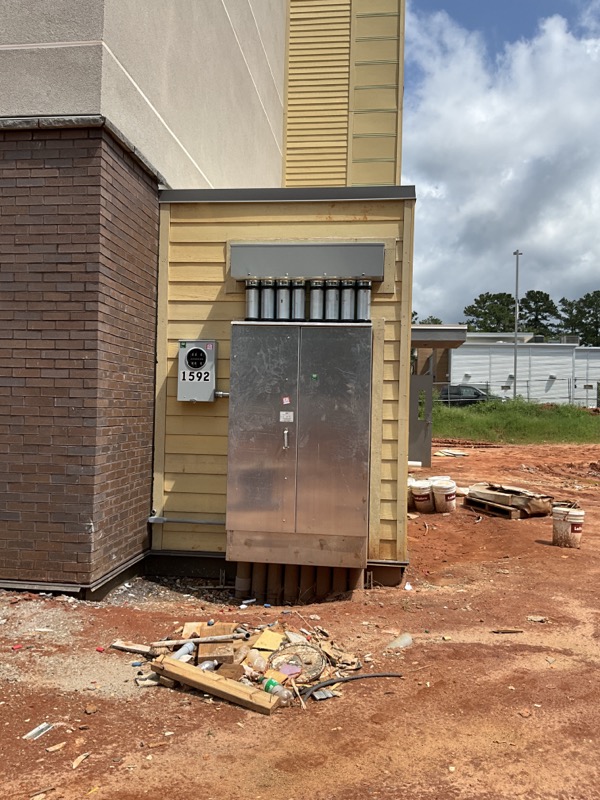
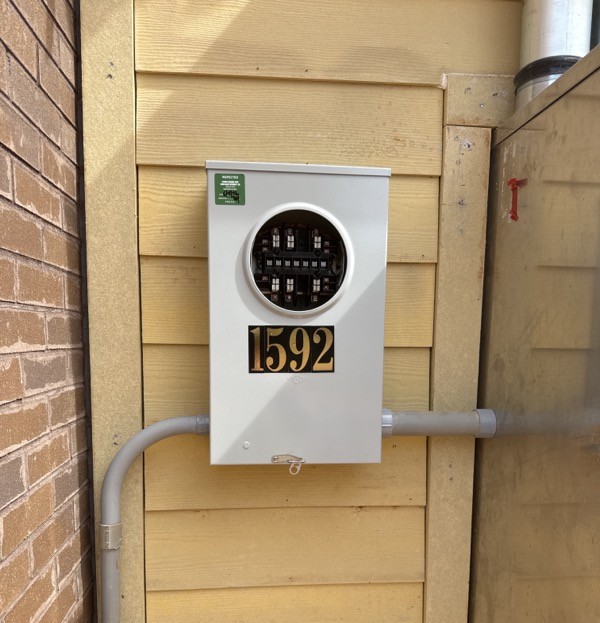
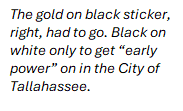
Exhibit A: The Sticker
We already gave away the ending on this one.
The color of address stickers is apparently very important to Tallahassee inspectors.
In his response, City of Tallahassee Building Official Glenn Dodson noted that the city requires an address to be posted on a building before permanent power is connected, “in case of an emergency,” and that the temporary address posting was, in fact, one of the items corrected before power was ultimately approved.
He did not, however, address the specific complaint at issue here — that the dispute was over the color of the numbers on the meter can, not whether an address was posted at all.
Wilson says that gap is the point: a general, undisputed safety rule about address visibility doesn’t explain why a specific color preference for the numbers held up early power.
A project that will eventually employ dozens of people and add badly needed hotel rooms to a market starved for them was delayed—at least in part—over address numbers on a meter can.
This isn’t caution. It’s a complete loss of proportion between the size of the problem and the size of the response.
Exhibit B: The Loose Wires That Weren’t the Contractor’s to Lose
Loose wires in the “CT can” drew a citation.
Wilson inspected them and found the wires sufficiently tight and within industry standards.
Observers at the job site say city officials repeatedly pulled on the wires in an effort to demonstrate movement.
The city offers a more dramatic account. Dodson told Red Tape Florida that loose lugs in the main electrical cabinet were found on three separate site visits — not one — including one attempt where the conductors had not even been run to the building yet.
“The loose connections of the wires in the main cabinet and the main disconnect could potentially cause an electrical arc that could harm workers and cause a fire,” Dodson wrote.
Wilson says city officials were observed pulling on the wires with full body weight.
Of note, Wilson is an International Code Council (ICC) “master code professional” and has “every certification there is,” as he puts it. There is no one on the city’s staff that can match Wilson’s credentials.
Exhibit C: Panic Hardware, Several Inspections Early
Missing panic hardware on the electrical room door also made the list.
Except panic hardware isn’t required until final inspection. Remember, this was an early-power inspection.
Dodson disputes that timeline. He says the code requirement isn’t tied to final inspection at all, but to whether the room is energized. “The panic hardware is required on an electric room when there is a large electrical service, and this type of door latch should be in place when the electrical system is energized for the safety of the workers that may be in that room in case of an emergency,” Dodson wrote — meaning, in the city’s reading, the requirement attaches at early power, not final inspection.
Wilson maintains that’s not how the requirement has been enforced on comparable projects, and that the city is applying a final-inspection standard at the early-power stage — selectively, in his view, and not as a matter of routine practice.
This is the bureaucratic equivalent of pulling someone over because their registration expires three months from now.
Exhibit D: The Locked Door
The electrical room was locked, so the inspector couldn’t access the disconnect.
Never mind that the room contained thousands of dollars in electrical equipment on an active construction site. Never mind that the construction superintendent had no idea anyone was coming.
Nobody called ahead. Nobody asked for access. The inspector arrived, found a locked electrical room on a construction site, failed the item and left.
Dodson said it was a safety issue.
A Bigger Dispute Than Stickers
Wilson’s broader complaint isn’t really about stickers or panic hardware. It’s about authority.
Florida created the private provider program so qualified, state-licensed inspectors could perform building inspections in place of local building departments. Wilson argues Tallahassee is defeating the Legislature’s intent by conducting many of the same inspections anyway simply because it owns the electric utility.
“I am not the electrical contractor,” Wilson told Red Tape Florida. “I am the private provider hired to inspect the project, yet the city insists that they must inspect the electrical system because they own the utility.”
As Wilson sees it, that’s exactly what Florida’s private provider law was designed to prevent. He also rejects any suggestion that the city cares more about safety than he does. “I have millions of dollars in professional liability insurance, while they enjoy sovereign immunity.”
The city points to a carve-out in Florida Statute 553.791(9) it says allowed the visits as verification rather than duplicate inspection. Wilson calls that a distinction without a difference — four site visits that each had the power to hold up the project looks more like reinspection than verification, whatever you call it.
The Legislature apparently agreed. HB 803, signed by Gov. DeSantis on May 6 and effective July 1, now requires actual written notice and substantiated cause before a local official can revisit work a private provider already cleared. The law had been on the books for nearly two months when these inspections happened. Dodson chose to run out the clock on the old rules anyway. Why wait until the law makes you do the right thing?
This Is Not A Private Provider’s First Rodeo
Red Tape Florida has previously documented complaints from private providers and contractors who believe they face a far more difficult path through City Hall than others.
This project appears to fit that pattern. Routine requests become prolonged negotiations. Inspection items appear before they’re due. Minor issues become major obstacles.
And the clock keeps ticking.
The Real Cost of a Permanent Hotel Shortage
It’s easy to dismiss a 25-day permitting delay as somebody else’s problem.
It isn’t.
Tallahassee has struggled for years with an undersupply of hotel rooms. Anyone who has tried to book a room during an FSU football weekend, graduation or the legislative session already knows what happens.
Prices don’t just rise. They spike. That’s what happens when demand is predictable and supply never quite catches up.
A new, large-scale hotel is exactly the kind of project that helps relieve that pressure.
This 25-day delay postponed bringing additional hotel rooms online in a market that desperately needs them.
More importantly, time is money. Every day a project sits idle costs someone money. Construction schedules slip. Trades get pushed back. Financing costs continue. Opening dates move farther into the future.
That’s not just a developer problem. It’s a visitor problem. It’s a tourism problem. It’s an economic development problem.
‘But, It’s Just 25 Days, Right?’
Think about the big picture.
Twenty-five days on one project may not be earth-shattering. But what about 25 days on 100 projects? Or 1,000? Now we are talking about a cumulative effect of years of delays.
And what about the reputational hit? Red Tape Florida has had numerous builders from all across the state – and other states – say that Tallahassee is the most business-unfriendly city in Florida.
Even in just this case, while it doesn’t sound like much, every idle day costs money — slipped schedules, pushed trades, financing that keeps running whether the elevator moves or not. Opening dates don’t just delay. They compound.
Finally, on Friday, June 26, the Building Department cleared early power. The private provider was present. The green sticker was applied. That battle, at least, was over.
Then the City of Tallahassee Utilities showed up.
Act Two: The Utility Department Has Its Own Ideas
The Building Department is one arm of the city. The Utilities Department is another. And after 21 days of fighting the Building Department over stickers, loose wires, panic hardware, and locked doors, the project team discovered that clearing the Building Department was not the same thing as getting the power turned on.
COT Utilities had a condition of its own: the UL-certified locks on the electrical cabinets had to be drilled out before the city would energize the building.
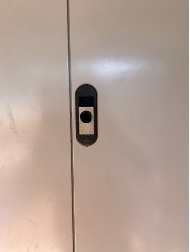
The reason, according to Wilson, was stated plainly: “We’re not cutting on power until you drill these locks out. If you don’t pay your bill, we’ve got to be able to cut your power off.”
The locks were drilled out. The cabinets — the kind that sometimes carry OSHA-required locking hardware — were opened on demand so the city could guarantee access to a building that hadn’t received its first utility bill yet, for a business that hadn’t served its first guest.
This was not a safety requirement. It was a revenue-protection demand — enforced as a condition of service, on day one, before a single dollar had been billed or missed.
Power was finally turned on June 30 — 25 days after the city’s first inspection on June 5.
The elevators could finally be installed.
The project could finally move forward.
But the larger question remains.
If this is how Tallahassee handles a $25 million investment that will create jobs, generate tax revenue and help ease one of the city’s most persistent hotel shortages, what message does that send to the next developer deciding where to invest?
That’s a question worth far more than the color of a sticker.
July 2, 2026By Skip Foster, Red Tape Florida
Red Tape Florida applauds OEV’s new marketing focus on the MagLab
When Red Tape Florida launched, the mission wasn’t simply to criticize local government. […]
June 24, 2026By Skip Foster, Red Tape Florida
Red Tape Florida applauds OEV’s new marketing focus on the MagLab
By Skip Foster, Red Tape Florida
When Red Tape Florida launched, the mission wasn’t simply to criticize local government.
The mission was to encourage better local government.
That’s why it’s worth recognizing when public agencies move in the right direction.
This week, the Office of Economic Vitality issued a Request for Proposals seeking a marketing firm to promote Tallahassee as the “Magnetics Capital of the World.” The initiative would build a multimedia campaign centered on one of the community’s greatest economic assets — the National High Magnetic Field Laboratory — and its potential to attract companies, investment and talent.
The timing is noteworthy.
In April, Red Tape Florida published an analysis questioning why OEV’s marketing efforts largely overlooked the MagLab while emphasizing more generic quality-of-life messaging. The argument wasn’t that Tallahassee needed more marketing. It was that Tallahassee needed to market the right thing.
This RFP suggests OEV is doing exactly that. And that’s great news.
Tallahassee-Leon appears to be placing greater emphasis on one of its most distinctive competitive advantages. For more than three decades, the MagLab has been the world’s premier magnetics research facility. Communities across America would gladly trade places with Tallahassee if they could.
Yet the region has struggled to build the kind of private-sector ecosystem that often grows around world-class research institutions.
Marketing alone won’t solve that challenge.
But it’s an important place to start.
The RFP calls for a comprehensive campaign to improve brand recognition, increase awareness of Tallahassee’s magnetic technologies, market targeted industries and position the community as the “Magnetics Capital of the World.”
It also asks that this newly developed creative be marketed, through paid digital channels, among others. This is an important change from prior marketing efforts that led to award winning creative sitting on a shelf.
Perhaps most importantly, the project would tie marketing efforts to growing the local magnetics industry cluster — not simply creating a new slogan.
The real measure of success won’t be impressions, clicks or social media engagement.
It will be whether more magnetics companies relocate here. Whether more startups commercialize MagLab research. Whether more suppliers choose Tallahassee. Whether more high-paying private-sector jobs follow.
Those are the outcomes that matter.
Red Tape Florida will continue asking difficult questions when warranted. But credibility also requires acknowledging progress.
When government makes decisions that better position Tallahassee for long-term economic success, those decisions deserve recognition as well.
June 24, 2026By Skip Foster, Red Tape Florida
Skip Foster brings the receipts at Tiger Bay
Skip Foster, publisher of Red Tape Florida and president of Hammerhead Communications, addressed the Capital Tiger Bay Club Thursday with a blunt diagnosis of Tallahassee and Leon County’s economic condition. The speech argued that population, job, and sales numbers all point the same direction — down — and laid out a six-point prescription for reversing course. We’re publishing the full remarks below, word for word. […]
June 18, 2026Skip Foster
Skip Foster brings the receipts at Tiger Bay
Skip Foster, publisher of Red Tape Florida and president of Hammerhead Communications, addressed the Capital Tiger Bay Club Thursday with a blunt diagnosis of Tallahassee and Leon County’s economic condition. The speech argued that population, job, and sales numbers all point the same direction — down — and laid out a six-point prescription for reversing course. We’re publishing the full remarks below, word for word.
Good morning and I just want to say how great it is to be here.
Being asked to speak at the Capital Tiger Bay club is one of the highest honors anybody in our community can receive … in mid-June.
So hello and welcome to the capital of the third largest state in the union, the second-fastest growing state in the U.S. and the 15th largest economy in the world.
This is it – the center of government in a bustling, thriving state!
Or is it?
Today I’m going to offer you an assertion, the proof to back it up, some context, and then a prescription for change.
The assertion is this: Tallahassee and Leon County are – right now – in the midst of a serious period of economic distress that is decades in the making.
The Proof
Now, the stats.
Let’s start at the very most basic statistic – population growth.
Just a month or so ago the U.S. Census Bureau released new population information. It showed that in the 12 months ending last July, Leon County LOST population.
1,440 residents.
That’s the equivalent of all registered voters in the Betton Hills voting precinct leaving in a year.
The capital county of Florida is LOSING population. If you aren’t shocked by that, you should be.
Consider just one consequence. Leon County Schools are already fighting fierce headwinds from school choice, and the state funds districts largely on a per-student basis. If only a couple hundred of those 1,440 residents were school-age children—and that’s a reasonable estimate—that represents roughly $2 million in annual education funding disappearing with them.
This latest population drop fits with a years-long trend. Leon County’s population in 2010 was a little over 275,000. We still haven’t cracked 300,000. That’s .55 annual growth – anemic. Florida is growing 3 times faster than its capital county.
Job numbers are similar.
Leon County is losing jobs – the Florida Chamber says so and so does the Tallahassee-Leon Office of Economic Vitality’s OEV’s own web site.
In October of 2024, according to the OEV’s own data center, there were 163,592 jobs in Leon County. The latest reporting data – it’s down to 158,830. Almost 5,000 jobs have vanished in 18 months.
What about sales?
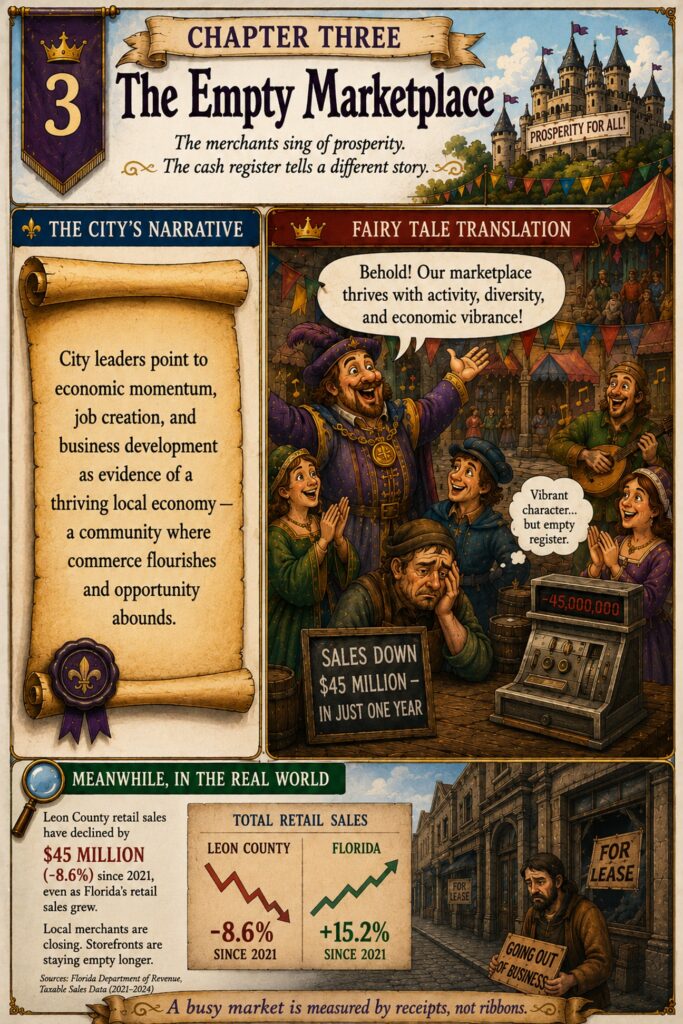
In January of 2025, Leon County posted $437 million in retail sales. 12 months later, Leon County posted $391.6 million in taxable sales. That’s down $46 million. Again, these are OEV numbers. And that’s a big loss during a time of high inflation when just selling the same amount of stuff should have led to higher dollars.
These are the three key legs of any community’s economic stool – employment, sales, population. All down.
“These are the three key legs of any community’s economic stool – employment, sales, population. All down.”
The reality of these numbers matches the truth on the ground.
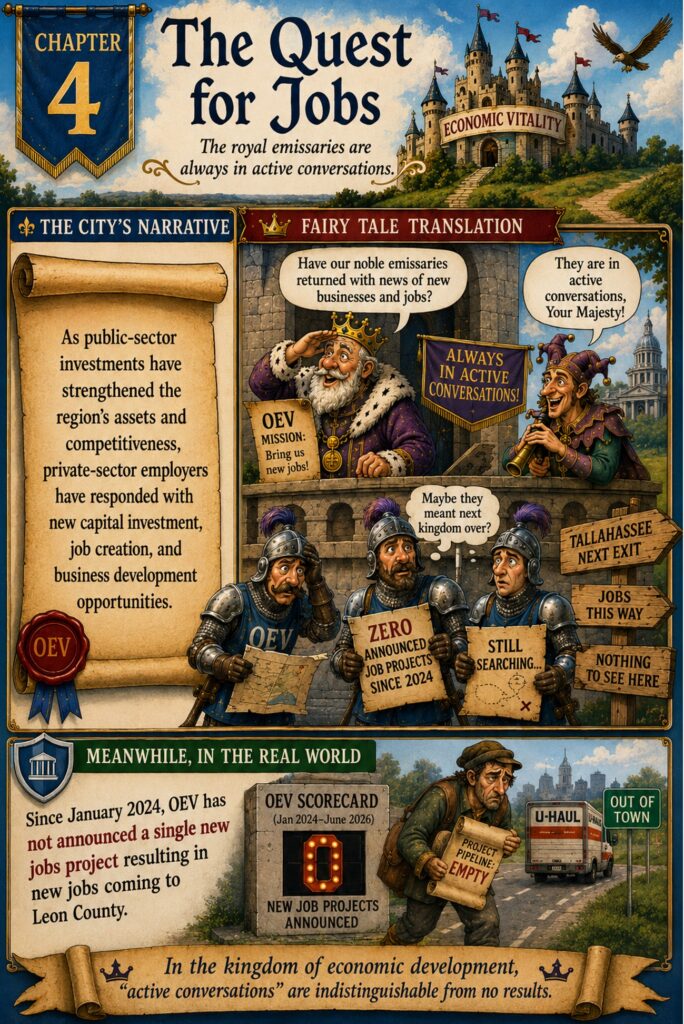
OEV hasn’t announced a successful recruitment since 2024. According to its own records, the only out-of-market win in its 10-year history was Amazon – anybody that had anything to do with that project will tell you OEV had nothing do with Amazon choosing Tallahassee.
The other wins for OEV are relocating a local brewery and expansions of two existing businesses.
How is that possible?
Just between me being asked to write this speech and today, major new jobs projects were announced in Thomasville, Ga. and Bay County with over 100 new jobs each.
Leon hasn’t had a win like that in years.
***
Speaking of years, way back in 1994, then-Vice President Al Gore came to Tallahassee to celebrate the opening of the Mag Lab.
Let’s play a little Tiger Bay game.
Imagine it’s 1994. You’re sitting at your tables for a strategic planning retreat. The facilitator gives your table this assignment:
“What can Tallahassee do to ensure that as little economic development as possible is ever created around this one-of-a-kind national scientific asset?”
You could hardly do better than our community has while TRYING!
Thirty-two years later, the Mag Lab remains one of the most unique research facilities in the world. Yet the private-sector economic activity generated around it is astonishingly small.
Can you imagine what that asset would look like today if it had landed in Austin? Raleigh-Durham? Huntsville?
The failure to build a meaningful innovation economy around the Mag Lab is one of the greatest economic development underachievements in Florida history, much less Tallahassee.
“One of the greatest economic development underachievements in Florida history, much less Tallahassee.”
Now, the impacts of this flailing economy and scant economic development shouldn’t be surprising. One of them is crime.
The state stopped publishing municipal crime rankings a few years ago, which probably came as a relief to local leaders. From 2014 through 2018, Tallahassee repeatedly led Florida in violent crime. While things have improved, they remain troubling. Today Tallahassee’s violent crime rate is still roughly three times the state average.
Another byproduct is a frustrating situation with air travel.
Guess how far you can go back and find a year when TLH Intergalactic had the same number of passengers as it does today?
Here’s a hint: Puntrooski.
That’s right, 1988, the same year Leroy Butler raced down the sidelines in Death Valley.
TLH had 949k passengers in 1988 – OEV says in 2025 it was 902k.
In the same period, Jacksonville went from roughly 3 million passengers to 7.6 million
And none of us needed the national survey to tell us that TLH is one of the most expensive airports in America. Subsidies are being thrown at airlines every few years, but when the subsidy runs out, so does the new service. Red Tape Florida just published a story about how Breeze has dropped 18 routes in the last year and at least half of them were subsidized.
So … why? Why is it like this?
The Golf Analogy
Golf analogy time: For those of you who play, you know there are four major parts of the game: driving, iron play, short game and putting.
You can survive with one weakness.
Sometimes even two.
But if all four are out of sync, it’s time to flag down the beer cart.
Communities are the same way.
Tallahassee has four major power centers:
The private sector.
State government.
Local government.
Higher education.
If those four are rowing in the same direction, amazing things happen.
If they’re pulling against one another, stagnation is inevitable.
And in Tallahassee, they are almost never aligned.
The red “state” government doesn’t trust blue “local” government.
Our universities often pursue institutional priorities that don’t necessarily align with community priorities.
Local government has too often been mired in bureaucracy, ineffectiveness and even corruption.
And the private sector has largely failed to provide the leadership necessary to bring everyone together.
Now, if you think that’s too harsh, let’s look at the most important civic issue we’ve faced in years.
The proposed TMH-FSU partnership should have been a year-long celebration.
Think about it.
A major community hospital.
A major research university.
The capital city.
The capital county.
Every leg of the stool pointed in the same direction.
Instead, the TMH CEO found out about the possible sale of his hospital while attending a United Way board meeting.
“What should have been a model of collaboration became a case study in dysfunction.”
The city manager and mayor conducted secret discussions with FSU leadership.
Things got sideways with FAMU and TSC.
And the Chamber did what the Chamber does best. It sat that one out.
What should have been a model of collaboration became a case study in dysfunction.
Unfortunately, back to golf, that example is just par for the course for our community.
Local government leadership in our community has been obsessed with petty politics, devoid of a shared vision and unable to grasp the fundamental role government should play in building prosperity. The City of Tallahassee culture, in particular, is business unfriendly and driven by PR wins not on the ground accomplishment. To wit, the City devotes more than $1.5 million and 9 employees to its communications department alone.
“The City devotes more than $1.5 million and 9 employees to its communications department alone.”
Meanwhile, for the City, the first quarter of the 21st century has been marked by scandal, corruption and, with regards to economic development, apparent indifference.
The private sector leg of the stool has, sadly, also been rickety.
Tallahassee-Leon’s private sector has not done its job.
It has not articulated the benefits of growth. It has not cultivated a generation of business-savvy public sector leaders. And, perhaps most importantly, it has allowed a select few – whose businesses are intimately connected to local government – to, in effect, neuter the Chamber and other business organizations and abdicate their responsibilities to drive growth and vision and progress.
I want to make sure I’m not being ambiguous. Private sector companies in segments such as legal, lobbying, engineering, finance, real estate, development and many others have chosen control and influence over local government rather than cultivating a crop of visionary leaders who are beholden to what’s best for our community’s vitality rather than their own interests.
This has led to ineffective, tightly controlled governance, which has had the unintended consequence of allowing the anti-growth movement to flourish. It has fostered a regulatory environment that is widely known around the state and region as the most business-unfriendly around.
Tallahassee-Leon has a “closed for business” sign hanging around its neck and the statistics from the start of this speech are proof that this is real.
“Tallahassee-Leon has a “closed for business” sign hanging around its neck.”
How many of you read the Midtown Reader story in Red Tape Florida?
A local business – a BOOKSTORE – decided it wanted to expand. Local government should have come rushing in with flowers saying: “Oh my goodness, this is fantastic – HOW CAN WE HELP?”
Instead, it was all sidewalks and parking and bike racks and red tape and lots of time and money.
A friend who works with local busineses recently told me – there are so many more Midtown Reader stories out there, you wouldn’t believe it.
It’s a culture.
And our compromised business community hasn’t solved the problem.
I once asked a longtime business leader: When is the last time this Chamber took a public position contrary to that of local government?
Silence.
Couldn’t think of one.
Now, my dear friend Eddie Gonzalez Loumiet brings me great hope as the current Chamber chair. He is a visionary and the truth is if Tallahassee had 100 Eddies we would be a much better place.
But action has to be dramatic and it won’t be easy.
The Chamber made a strategic decision to deeply align itself with the majority on the Tallahassee city commission. I know because I helped develop that strategy.
It was a mistake.
The Chamber forgot something as it worked to keep progressives out of power – it forgot to hold the majority accountable. Can anyone name pro-business policies adopted by the Dailey-Goad regime. Tax cuts? Regulatory reform? Economic development success? Business incentives? Anything?
The Anti-Growth Disaster
Tallahassee also has to break out of its “sense of place” ruts. Terms like “quality of life” and “walkability” are not bad things. In fact, they’re important.
The problem is that they’ve too often been used as conversation stoppers rather than starters.
Over time, those concepts have been co-opted and weaponized by anti-growth ideologues who invoke them whenever a new housing development, business expansion, parking deck or infrastructure project is proposed.
The implication is always the same: growth threatens quality of life.
But that’s backwards.
Growth is what pays for quality of life.
“Growth is what pays for quality of life.”
Growth is what funds parks, trails, public safety, arts and recreation.
Without a thriving private sector, “quality of life” becomes little more than a slogan.
Those fighting new parking decks in Midtown, new housing developments, even in urban areas, and new development need to understand the effects of their efforts:
– They are killing jobs. Red Tape Florida recently did a piece citing two models that show how many blue-collar jobs are created when a 100-house development is built. When you show up wearing the same colored t-shirts to oppose a new development, you are campaigning against dozens of good paying trades jobs – plumbers, landscapers, cabinet makers, painters, electricians and more. The anti-growth movement is, by definition, an anti-labor movement.
– As mentioned, eventually they are drying up the government coffers that help preserve the things we all love about Tallahassee.
– They are contributing to the affordable housing crisis. Suppressing supply will drive up price EVERY TIME. And by the way, building $500k homes absolutely DOES help affordable housing for the same reason that somebody buying a $50k new car eventually helps a college kid buy and $8k Civic with 100,000 miles.
– Perhaps most importantly, a stagnant city has the most profound impact on its most vulnerable residents. While you fight to protect the pristine nature of your Betton or Killearn existence, those in other parts of town where you never travel are fighting for their very lives. That plumbing job you are killing could be a lifesaver or a ticket out of poverty for someone else.
“… for others, a ‘sense of place’ means simply living without the fear of violence…”
Not everybody’s “sense of place” is the same.
While for some it means majestic oaks and serene parks, for others a sense of place means simply living without the fear of violence or knowing where the next meal is coming from.
The Prescription
So, I promised you a prescription and here it comes.
– First, rebuild an independent private sector voice.
For decades, Tallahassee’s business community has allowed itself to become too intertwined with the very governments it is supposed to hold accountable. That’s not a criticism of any one person or company. It’s a structural problem.
At a minimum, The Chamber and other business organizations should adopt stronger conflict-of-interest standards, greater transparency and a renewed commitment to speaking plainly when local government is failing.
Some will say, “Come on, Skip. That’s not realistic. Too many businesses in this town depend on city and county government.”
My answer? Yeah. That’s the problem.
– Measure outcomes – honestly.
A business leader is equally interested in the good and bad news on his P&L. In Tallahassee bad news is ignored.
Dashboards are only useful if fully utilized as a tool, not cherry picked for positive press. Tallahassee is far too dependent on obscure web site rankings, the same people getting awards every month and proclamations. Private and public sector leaders should be obsessed with job growth, population, wages, taxable sales and private investment.
Local government leaders should demand more transparent and regular updates and constantly push staff to talk about what is being done to improve. If those numbers are moving in the right direction, celebrate. If they aren’t, stop pretending they are.
– Declare Tallahassee-Leon Open for Business
Every permitting process, zoning review and development decision should start with one question: How do we make this happen responsibly instead of why can’t it happen?
Local government should create a system to seek and receive relentless feedback from those trying to navigate the system. Not even a whiff of retribution should be tolerated in response to whistleblowers or those who issue complaints.
A full analysis of needed infrastructure should be conducted (Thomasville just landed a new industry in an existing industrial park – 100 jobs), including available land, utility capacity, zoning hindrances and more.
Then, every anti-growth rally should be met with statistics on how many jobs would be killed, how much new government revenue would be lost and real stories of poverty and crime that are the clear result of economic stagnation.
The embarrassing, gaslighting cry: “We are going to turn into Orlando,” needs to be countered with a more realistic cry: “We are going to turn into the only town left behind from Florida’s boom.”
“We are going to turn into the only town left behind from Florida’s boom.”
– Demand more from higher education
FSU, FAMU and TSC are not simply located in Tallahassee. They are among the most powerful institutions in Tallahassee. With that comes responsibility. Our institutions of higher education should be judged not only by enrollment and research dollars but by the economic impact they create for the community around them. They should be involved in community leadership not just with obligatory board seats but with active engagement. Even if some leaders are short-timers in Tallahassee, find those who are committed to the community and who can advocate for it and then empower them to bring about change.
I should add that TSC is really modeling this behavior best, taking the lead in AI education and trying to pull the rest of the community along on job readiness and new training models.
– Bring together the four legs of the stool
Find willing and able representatives from state and local government, higher education and the private sector – including a notable lack of usual suspects — to start developing a new vision for our community. Then lock them in a room and don’t let them out until they can answer one simple question: What should Tallahassee’s economy look like in 2040? Because right now, if you asked 20 influential people that question, you’d probably get 20 different answers.
And if those four major segments of our community can’t agree on where we’re going, why should anyone be surprised we’re drifting?
– Replace a scarcity mentality with abundance.
This community is underachieving in a dramatic and dangerous way. Too many private sector leaders choose control and self-interest over vision and creativity. Too many long-time residents choose NIMBYism and a plantation mentality over growth and opportunity for all.
Tallahassee spends too much time fretting about dividing the pie and not enough about growing it.
It’s time to find ways to expand. Growth vs. protecting our quality of life is a false choice. And remember, for many, urban living IS a better quality of life.
The Close
Tallahassee may not be dying. But it’s ill. And the first step in treating any illness is admitting you have one.
We don’t have a geography problem.
We don’t have a university problem.
We don’t have a natural-resources problem.
We don’t have a talent problem.
We have a leadership problem.
“We have a leadership problem.”
The good news is leadership problems can be fixed.
This community has extraordinary assets.
World-class universities.
The nation’s premier magnetics laboratory.
The center of government in one of the fastest-growing states in America.
Beautiful natural resources.
And a location that should make us the economic hub of North Florida.
The question is not whether Tallahassee can succeed. The question is whether we are finally willing to demand that it does.
Thank you very much.
June 18, 2026Skip Foster
What the heck is the ‘Chief of Unsafe Structures?’

By Skip Foster, Red Tape Florida
A few days ago, a government job posting stopped Red Tape Florida cold.
Palm Beach County is hiring.
The salary: $79,156 to $133,598 annually.
The title?
Chief of Unsafe Structures.
I read it three times. Not because I was confused. Because I wanted to make sure the English language hadn’t quietly changed on me.
It had not.
And so, as a public service to taxpayers who may one day interact with this office, I began wondering what a typical day in the life of Palm Beach County’s future Chief of Unsafe Structures might look like.
Here goes:
7:00 a.m.
Arrive at office.
Review overnight Unsafe Structure Report.
One gazebo remains under observation.
No immediate threat to public safety.
Gazebo issued a warning.
Gazebo does not respond.
This is noted in the file.
7:30 a.m.
Meeting with Assistant Deputy of Inspections.
Discuss strategic vision for unsafe structures.
Consensus reached that structures should ideally become less unsafe over time.
This is described as a “bold goal.”
Action items assigned.
Action items will be revisited at next meeting.
8:15 a.m.
Coffee break.
Coffee station informally inspected.
Found to be structurally sound.
No enforcement action required.
Coffee consumed without incident.
Coffee station will be monitored.
9:00 a.m.
Field inspection.
Citizen reports suspiciously unsafe structure.
Structure confirmed to be unsafe.
Department celebrates another successful identification.
Structure remains unsafe.
But we know about it now, which is progress.
10:30 a.m.
Staff meeting.
Reminder issued that structures found to be safe should be referred to another department.
This department does not handle safe structures.
That is somebody else’s problem.
11:45 a.m.
Lunch.
Restaurant selected after brief structural assessment.
Booth chosen over table near load-bearing wall.
Professionally, you can’t turn it off.
12:30 p.m.
Annual performance review.
Goals established:
- Identify unsafe structures.
- Reduce unsafe structures.
- Discourage creation of additional unsafe structures.
Progress deemed satisfactory.
Reviewer notes that “structures remain a concern.”
Reviewer does not elaborate.
Meeting adjourned.
2:00 p.m.
Emergency briefing.
Report received regarding structure exhibiting advanced unsafeness.
Response team mobilized.
Response team reminded to park in designated spaces.
Structure briefed on its rights.
Structure does not respond.
This is also noted in the file.
3:15 p.m.
Personnel recognition ceremony.
Inspector Jones commended for identifying a structure that was significantly more unsafe than initially believed.
Inspector Jones accepts award.
Inspector Jones notes he just walked past it.
Award stands.
4:00 p.m.
Budget planning session.
Proposal submitted for Assistant Chief of Moderately Unsafe Structures.
Also floated: Deputy Director of Structures That Could Go Either Way.
Both requests referred to committee.
Committee has not yet formed.
Formation of committee referred to subcommittee.
4:45 p.m.
Conference call.
Thirteen attendees.
Discussion centers on whether a structure can be considered officially unsafe if it is only unsafe on weekdays.
No consensus reached.
Legal review requested.
Legal advises it depends.
5:15 p.m.
Task force formed.
5:30 p.m.
Subcommittee formed to advise the task force.
5:45 p.m.
Structure remains unsafe.
5:50 p.m.
New hire raises hand. New hire asks: If we inspected all the structures in the first place, how are there any unsafe ones?” Brief silence. New hire’s question is moved to “parking lot.” HR informed that new hire isn’t going to work out.
6:00 p.m.
Depart office.
Reflect on career path.
Parents once dreamed of doctor. Lawyer. Astronaut.
Instead: Chief of Unsafe Structures.
$133,598 a year.
Full benefits.
Life takes unexpected turns.
To be fair — and I am straining to be fair here — Palm Beach County is not doing anything particularly unusual. Large governments create specialized units for specialized problems. Dangerous buildings are real. Hurricane damage is real. Somebody does need to deal with those situations.
What fascinates me is not the position.
It is the title.
Because somewhere, sometime, a room full of otherwise functional adults looked at what appears to be a senior building-safety position and concluded that Chief of Unsafe Structures was the clearest, most professional way to describe the job.
Not Director of Building Safety.
Not Chief Building Official.
Not Director of Structural Integrity.
Chief of Unsafe Structures.
Government has a remarkable gift for organizing itself around its own failures. Not around solving them. Around managing them. Naming them. Staffing them. Forming subcommittees to advise task forces about them.
Which makes me wonder what other positions may soon become available.
Director of Potholes.
Chief of Traffic Congestion.
Assistant Deputy of Unreturned Phone Calls.
Administrator of Missed Garbage Pickups.
Deputy Director of Projects That Were Supposed to Be Done Last Spring.
Executive Director of Things That Really Shouldn’t Be Happening.
Chief of Explaining Why the Website Is Still Down.
I made those up.
But the Chief of Unsafe Structures is real.
June 18, 2026By Skip Foster, Red Tape Florida
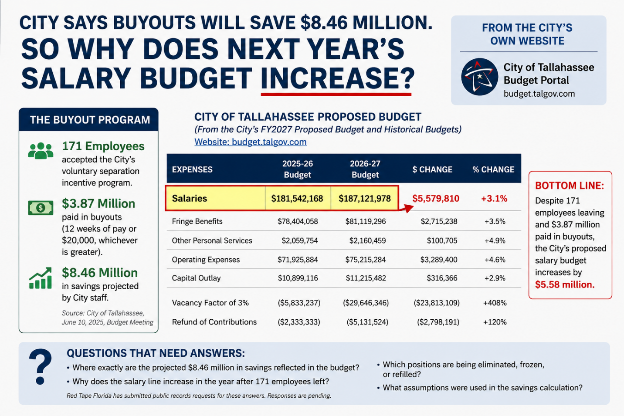
City says buyouts will save millions … so why is new salary budget going up?
The City of Tallahassee paid 171 employees a combined $3.87 million to walk away this spring. City staff told commissioners the program would save taxpayers roughly $8.46 million. […]
June 17, 2026By Skip Foster, Red Tape Florida
City says buyouts will save millions … so why is new salary budget going up?
By Skip Foster, Red Tape Florida
The City of Tallahassee paid 171 employees a combined $3.87 million to walk away this spring. City staff told commissioners the program would save taxpayers roughly $8.46 million.
So, Red Tape Florida went looking for those savings in the proposed FY 2026-27 budget.
We couldn’t find them.
According to the City’s own online budget portal (which was updated June 9), the total salary line doesn’t shrink after 171 departures — it grows.
From roughly $181.5 million in the current budget to roughly $187.1 million proposed for next year. That’s $5.6 million more being spent on salaries, not less, following the departure of 171 people the City itself credited with generating millions in savings.
For context: those 171 employees likely represented well over $10 million in annual salary alone, and substantially more once benefits are included. The program had age and service requirements, which tends to select for longer-tenured, higher-paid employees — 28 of the 171 made six figures, and the ten highest-paid alone accounted for more than $1.8 million in salary. Factor in the City’s own fringe benefit rate of roughly 43 to 45 percent, and the true compensation value of those positions was likely as much as $18 million a year, perhaps more.
An $8.46 million savings figure out of that much payroll may not be an outlandish number to land on. But that’s exactly what makes the salary line increasing by $5.6 million so hard to square. If the City already expected to refill some of these positions — staff has confirmed at least nine so far, with that number expected to grow to around 30 — then say so, and show the math. Right now, the public has a savings claim, a budget that moves in the opposite direction, and no explanation connecting the two.
Red Tape Florida has submitted public records requests seeking:
- The model or spreadsheet City staff used to calculate the projected $8.46 million in savings
- Records identifying which of the 171 vacated positions are being eliminated, frozen, or refilled
- Documentation explaining why the proposed salary budget increases despite the workforce reduction
If a document exists showing how the $8.46 million figure was calculated, it should also show which positions were assumed vacant and which were assumed refilled. If no such document exists, that’s worth knowing too.
Public budgets should be understandable without a records request. When government asks taxpayers to believe a program will save millions while the largest salary line in the budget increases instead, the burden is on government to explain why — not on the public to assume there’s a good reason.
We’ll update this story when the City provides the records.
June 17, 2026By Skip Foster, Red Tape Florida
Tallahassee’s dam in search of a flood
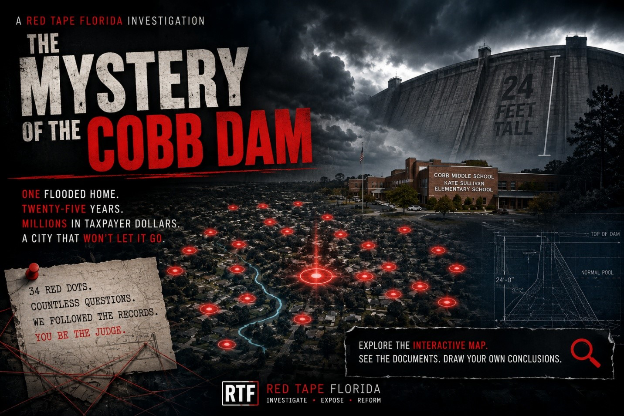
Why is the City hellbent on spending millions to build an in-town dam?
Special Investigation by Skip Foster, Red Tape Florida
The City of Tallahassee wants to build a massive new dam next to Cobb Middle School.
The question is why.
Depending on the option selected, the project could create a wall as much as 27 feet high and roughly 240 feet long — about the same area as Florida State University’s largest Doak Campbell Stadium video board.
The City estimates the project will cost about $5 million, though experts contacted by Red Tape Florida believe the final price could be substantially higher.
And one of the City’s own maps carries a warning that, if selected, the project would flood the Cobb Middle School athletic field during severe storms.
But here is the real head-scratcher.
This is a dam in search of flooding.
To justify the project, the City has assembled a map containing 34 red dots representing what it calls “reported stormwater problems.” It has cited flooding concerns throughout the area. It has persuaded community leaders that the project is urgently needed. And it is advancing a proposal that differs dramatically from the recommendation contained in its own earlier engineering study.
There is just one problem.
After reviewing a quarter-century of flooding complaints, engineering reports, studies, emails and public records connected to those 34 properties, Red Tape Florida found a collection of facts that are difficult to reconcile with the City’s narrative.
Residents included on the map say they should not be there.
Several red dots represent vacant City-owned lots.
The City’s own consultant once recommended a different solution.

And according to City records, only one home — a rental duplex on a lot which had recently been sold by the City to a private developer –experienced documented in-home flooding associated with this drainage system.
That flooding happened in June of 2001.
Before Facebook.
Before smartphones.
Before 9-11.
The question bears repeating:
Why is the City of Tallahassee so intent on building this dam?
Welcome to the Mystery of the Cobb Dam.
34 red dots
Kimberly Studley really didn’t understand. She had experienced some minor stormwater issues on her property on McClendon Drive but was told by the City that it had nothing to do with the dam project.
Yet, she discovered that her home was a “red dot” on the City map entitled: “HILLCREST & LUCY STREETS STORMWATER IMPROVEMENTS REPORTED PROBLEMS & FLOOD EXTENTS.”
Here is what Studley wrote to the City:
I recently learned despite the city staff themselves telling me my flooding issue was completely unrelated to the project, my property was then added to the dam project’s map as one of the “35 properties reporting stormwater issues” represented by a red dot. I understand that there are numerous other red dot properties on the project map like mine with flooding issues completely unrelated to anything the dam is supposed to fix. This has already misled the civic process and calls into question the project’s fiscal justifiability, especially with city-owned properties on Sauls Street available for use, not requiring the building of an expensive dam.
That was in November of 2025.
The Studley home is still a red dot on the City’s web site justifying the dam.
There are a total of 34 dots on the map the City still has on its web site. Only 16 of them were on the red- and purple-colored areas on the map labeled as areas that are “flood extents” either now or after the dam is erected.
But the map has obvious and deep flaws.
Here is one of them – three red-dotted properties near the intersection of Saul Street and Spottswood Drive – are empty lots.
The lots’ owner? The City. The three lots were purchased 10 years ago. Why would the city be including vacant, government-owned lots on a graphic justifying the construction of a multi-million-dollar dam?
A 34-dot breakdown
Here is a more detailed breakdown of the “red dots” which the City labels as “reported stormwater problems” on its map included in materials supporting the construction of the dam.
- A dot in the Sequoia Drive area includes a resident complaint in 2024 that a pond at the end of Belmont Road was not being maintained and had become “a nesting site for rats.” The city found it was not a pond, but an undeveloped lot. An earlier 2002 finding on the same house from the City concluded: “The house does not have chronic flooding problems.”
- A flood report in 2012 from a home on Devil’s Dip resulted in a visit from City officials who concluded “the flood was probably mainly due to seepage.” In other words, it had nothing to do with the drainage ditch to her south. The city official also pointed out that the homeowner’s gutters needed work.
- A recurring theme is the ditch that runs from near Cobb all the way southeast, under Mahan to the neighborhood just northeast of the former home of the Tallahassee Democrat on Magnolia. The ditch often became clogged with debris. Ditch maintenance would obviously be millions of dollars cheaper than a large dam.
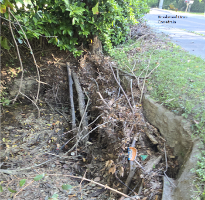
- Another of the complaints was from a Brookwood Drive resident, who reported water in her yard overflowing from the ditch. The homeowner included pictures. But the City’s response was telling: “I called her back on August 6, 2018, and said that this was private property with no easements for drainage.” Three years later, after another complaint, the City decided it would work on the problem and sent out a crew to clear the ditch and drains.
Twenty of the dots reference flooding from Tropical Storm Allison which plagued Texas and much of the southeast with copious amounts of rain as it meandered along the Gulf Coast in June of 2001 … more than 25 years ago. For perspective, Tropical Storm Allison led to the wettest 24-hour period in the recorded history of Tallahassee weather. More than 10 inches of rain fell – a once-in-a-century flood.
Rather than asking readers to take our word for it, Red Tape Florida is publishing the City’s map and has made it interactive with links to the underlying records used to justify it. Review them yourself. Then decide whether they support construction of a jumbotron-sized dam.

You can also check out the City’s own design concept maps here, including Design Concept B, which includes a reference to the Cobb’s athletic fields flooding if one option is selected.
2010 recommendation: No dam
The City of Tallahassee’s current push for a dam near Cobb Middle School is especially noteworthy because it differs from the recommendation contained in the City’s own 2010 engineering study. That study, prepared by GPI Southeast, a division of one of the nation’s larger engineering firms, examined flooding concerns in the area and evaluated multiple potential solutions.
GPI concluded that the most appropriate course of action was not an upstream dam on school property, but rather a series of critical maintenance and safety upgrades to the existing drainage system. The firm found that those improvements could be completed within existing City rights-of-way, without acquiring land, obtaining major permits, or constructing a new stormwater facility.
Did City Hall give Rocky Hanna bad information?
Responding to criticism of the City’s stormwater spending, Leon County Schools Superintendent Rocky Hanna told the Tallahassee Democrat last spring: “I think the person that is raising this issue needs to have a conversation with the residents downstream that are being flooded out of their homes every time there’s a major storm.”
That is a powerful image.
It is also completely unsupported by the City’s own records. If residents were being “flooded out of their homes every time there’s a major storm,” the City should be able to document that clearly.
Where are the records?
Where are the repeated home-flooding reports?
Where are the addresses?
Where are the damage claims?
The City’s own “red dot” map shows that the last time someone in the affected area was “flooded out of their home” because of the drainage ditch overflowing was 25 years ago on a day when Tallahassee received more rain than any time in its recorded history.
Hanna may have been acting in good faith. He may simply have repeated what City officials led him to believe.
But if the City’s own records do not support the claim that residents were being flooded out of their homes every time there is a major storm, then Hanna deserves better information — and residents deserve better answers.
Flooding is serious. So is misleading the public – and superintendents – about it.
Fifteen years later, the City is pursuing a far more ambitious approach. The current proposal, developed with assistance from local engineering consultant Eutaw, would require construction of a large stormwater impoundment adjacent to a school campus, along with easements, environmental permitting, floodplain mitigation, and long-term maintenance obligations.
Of note, since the 2010 recommendation, Tallahassee experienced another major flooding event – the “Bicentennial Storm” of April 11, 2024. The City created a web page to document the 42 structures that flooded from that storm, including Godby High School. Guess how many of those structures fell into the area impacted by the proposed dam?
None.
Pay a Tallahassee utility fee? This section is for you
The City of Tallahassee is not approaching stormwater with a skeleton staff. According to the City’s own budget materials, Stormwater Management has a 2025-26 operations budget of $12,989,898, with 21 employees assigned to Stormwater Management and another 67 employees in Drainage Operations.
That does not mean the City should never hire outside engineers. Complex stormwater modeling, design and permitting often require specialized consulting work. But the scale of the City’s own stormwater operation makes the Cobb Dam’s long and winding path harder to understand, not easier.
City checkbook data reviewed by Red Tape Florida shows that Eutaw, the local engineering firm now associated with the Hillcrest & Lucy stormwater project, has received $3,389,961.39 from the City since 2018 across 269 payments. Of that, $59,970.75 is identified in the City’s checkbook as payments for “Hillcrest & Lucy St Stormwater.”
That may be the real mystery of the Cobb Dam. How did a City with a nearly $13 million stormwater operation, 88 stormwater and drainage employees, and multiple outside engineering consultants end up pursuing a major new dam on school property after an earlier City-commissioned study recommended a simpler path?
Now, the questions
Tallahassee utility customers are left with a lot of questions:
If the City claims there is a widespread flooding crisis that justifies a large new dam, where is the proof of it?
If the red-dot map is intended to demonstrate need, why do so many of the underlying records appear unrelated to the project?
If the problem is as urgent as City officials suggest, why did the City’s own consultant recommend a different solution in 2010?
If one documented in-home flooding event in the affected area occurred 25 years ago during a record-setting storm, what exactly is the emergency?
And perhaps most importantly:
Why does the City seem so eager to spend the millions and millions of dollars it will require to construct a dam that abuts two public schools?
That last question is the one that lingers.
June 16, 2026
The Price of ‘No’: If you’re anti-growth you’re also anti-jobs and anti-labor
In the past 12 months, five Florida counties — Sarasota, Brevard, Manatee, Lake, and Volusia — blocked or effectively killed housing developments totaling 2,469 homes. In each case, the formula was familiar: concerned neighbors, packed commission chambers, petitions, warnings about traffic and flooding and neighborhood character. In each case, the commission obliged. […]
June 12, 2026By Skip Foster, Red Tape Florida
The Price of ‘No’: If you’re anti-growth you’re also anti-jobs and anti-labor
We’re looking at you, Manatee, Brevard, Sarasota, Lake and Volusia
By Skip Foster, Red Tape Florida
Nobody who showed up to fight a housing development ever carried a sign that said “I oppose plumber jobs.”
But that’s what they support.
In the past 12 months, five Florida counties — Sarasota, Brevard, Manatee, Lake, and Volusia — blocked or effectively killed housing developments totaling 2,469 homes. In each case, the formula was familiar: concerned neighbors, packed commission chambers, petitions, warnings about traffic and flooding and neighborhood character. In each case, the commission obliged.
Red Tape Florida applied the National Association of Home Builders’ Local Economic Impact Model — the industry standard for measuring residential construction’s economic footprint — to each of the five projects. The results should be posted on the wall of every county commission chamber in Florida.
The Jobs Florida Never Created
| County | Project | Homes Blocked | Jobs Never Created | Income Never Generated |
| Manatee | Lennar / Lone Valley, Parrish | 2,047 | 10,490 | $763.8M |
| Brevard | June Park apartments | 186 | 681 | $49.6M |
| Sarasota | D.R. Horton / Celery Fields | 126 | 635 | $46.3M |
| Lake | Crescent Pines, Clermont (KB Home) | 79 | 301 | $21.9M |
| Volusia | Ormond Beach subdivision | 31 | 111 | $8.1M |
| TOTAL | 2,469 | 12,218 | $889.7M |
Twelve thousand jobs. Nearly $900 million dollars in wages and income. Gone — not because of a recession, not because of a hurricane, not because of some market failure. Gone because of petition drives and planning board testimony and commission votes cast to preserve neighborhood character.
The Manatee County figure alone should stop a room. In February 2026, commissioners unanimously denied Lennar Homes’ “Lone Valley” project — 2,047 single-family homes on 683 acres near Buckeye Road in Parrish. The vote is especially notable because the county’s own Planning Commission had already unanimously recommended approval. Professional planners endorsed it. Elected commissioners killed it anyway. The NAHB model puts the economic cost of that single vote at more than 10,000 jobs and $763 million in income. That is not a development project that was denied. That is an economy.
Birds, Flooding, Trees, and Traffic
The stated reasons varied by county. In Sarasota, it was proximity to the Celery Fields — a beloved bird sanctuary adjacent to the proposed D.R. Horton development. The commission rejected the project twice; D.R. Horton has since sued the county. In Ormond Beach, it was flooding concerns in a hurricane-battered Volusia County. In Brevard’s June Park community, 706 petition signatures produced a unanimous Planning and Zoning Board denial before the developer withdrew. In Lake County, commissioners denied the same 79-home Clermont subdivision twice — in November 2025 and again in April 2026 when KB Home returned with a reduced plan. In Manatee County, the Lone Valley project fell to concerns about nearby grocery stores, road capacity, and the pace of growth in a community that is, by all accounts, already growing rapidly.
At an earlier Manatee County commission meeting on a separate but related housing denial, landowner Marilyn Moran — whose family has owned land in the area for over a century — offered the most direct assessment of what was happening: “Your decision today needs to be based on the evidence and the legal principles at issue, not unsupported, emotional pleas or the screeching of anti-development activists.”
The commission voted no anyway.
What the NAHB Model Tells Us
The NAHB Local Economic Impact Model calculates three phases of economic impact from residential construction: the direct effect of construction activity itself, the ripple effect of construction workers spending their wages locally, and the ongoing annual effect of new residents paying property taxes and participating in the local economy.
The jobs lost are not abstractions. They are carpenters, plumbers, electricians, roofers, painters, concrete finishers, and the truck drivers, lumber yard workers, hardware store clerks, and restaurant owners who depend on their paychecks. They are the kinds of jobs — blue-collar, trade-based, family-sustaining — that politicians across the spectrum claim to champion.
There is also a second table that rarely gets discussed: the ongoing annual economic loss. Once those homes go unbuilt, thousands of jobs that should exist every year — generated by property tax revenue, resident spending, and local economic participation — also disappear. Permanently.
| County | Homes Blocked | Annual Ongoing Jobs Lost |
| Manatee | 2,047 | 1,837 |
| Brevard | 186 | 119 |
| Sarasota | 126 | 111 |
| Lake | 79 | 53 |
| Volusia | 31 | 19 |
| TOTAL | 2,469 | 2,139 every year |
A Statewide Pattern With a Local Address
These five cases are not outliers. They are the visible tip of a statewide pattern documented repeatedly in Florida housing research. A 2024 report by the Florida Office of Program Policy Analysis found that local opposition to development is one of the primary drivers of housing unaffordability.
The data connecting anti-growth sentiment to poverty, stagnant wages, and housing unaffordability is no longer theoretical. It is documented. It is measurable. It has a price — one paid not by the people who show up to commission meetings, but by the people who can never afford to.
Next time someone hands a commissioner a petition against a housing development, someone should hand the commissioner these tables.
June 12, 2026By Skip Foster, Red Tape Florida
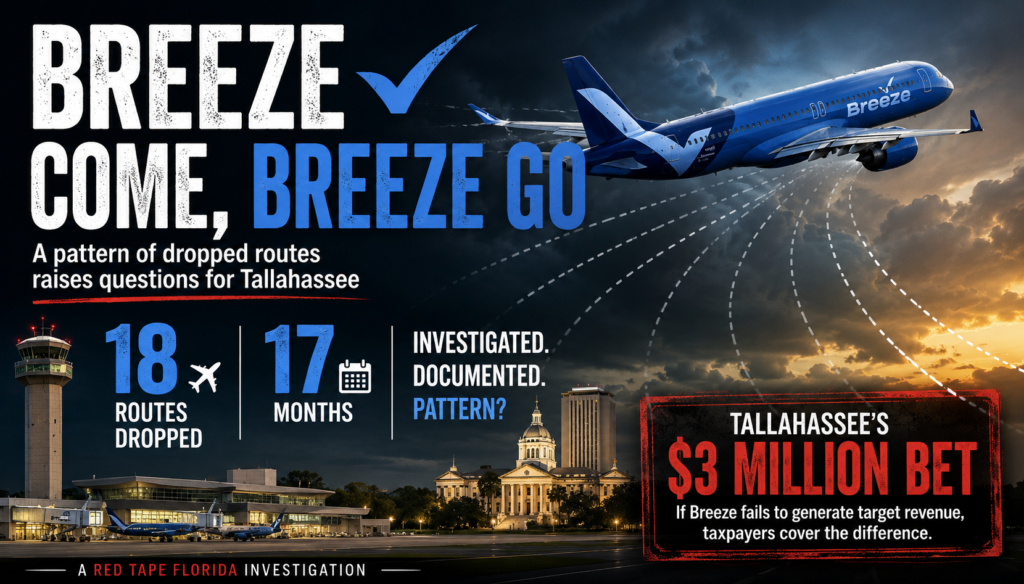
Breeze come, Breeze go … once incentives run out
The Tallahassee City Commission was practically giddy.
A shiny new airline named Breeze. Nonstop flights to Fort Lauderdale and Raleigh-Durham. Affordable fares. A 137-seat Airbus A220-300 — described, without apparent irony, as a “Goldilocks-size” plane for Tallahassee’s market.[…]
June 9, 2026Special Investigation by Skip Foster, Red Tape Florida
Breeze come, Breeze go … once incentives run out
Breeze Airways dropped 18 routes in 17 months. In about half (or more) of them, public money was involved. Now it’s coming to TLH. Buckle up.
Special Investigation by Skip Foster, Red Tape Florida
The Tallahassee City Commission was practically giddy.
A shiny new airline named Breeze. Nonstop flights to Fort Lauderdale and Raleigh-Durham. Affordable fares. A 137-seat Airbus A220-300 — described, without apparent irony, as a “Goldilocks-size” plane for Tallahassee’s market.
What could go wrong?
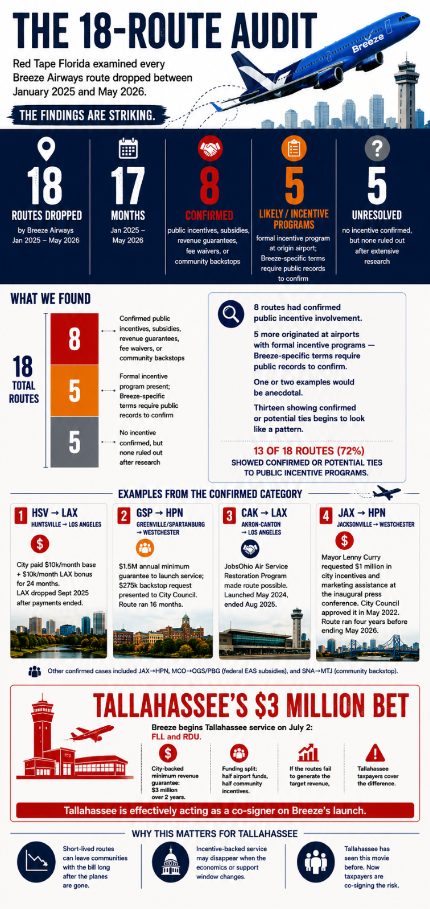
Quite a bit, as it turns out. Red Tape Florida has meticulously researched every route Breeze Airways has dropped since January 2025 — 18 in total — and what we found should give Tallahassee taxpayers serious pause before the confetti hits the floor on July 2.
The deal the city struck is structured as a minimum revenue guarantee: if Breeze’s Fort Lauderdale and Raleigh-Durham routes don’t generate $3 million over two years, Tallahassee taxpayers pay the difference. Half comes from airport funds. Half from community incentives. It’s the aviation equivalent of a co-signer — and Breeze has left a lot of co-signers holding the bag.
Breeze’s Business Model, Decoded
Breeze Airways was founded in 2021 by David Neeleman, the airline entrepreneur behind JetBlue, WestJet, and Azul. The pitch is elegant: connect underserved secondary airports with nonstop service, bypass the hubs, keep costs lean. Five years in, Breeze has carried 16 million passengers and calls itself the fastest-growing airline in America.
It is also, Red Tape Florida has found, extraordinarily good at landing in communities carrying public incentive money. What is harder to prove is precisely how much those incentives influence Breeze’s decisions. What is clear is that public dollars appear repeatedly in the story of Breeze’s expansion — and in many of the routes it later abandoned.
In the 17 months between January 2025 and May 2026, Breeze dropped 18 domestic routes. RTF examined every one of them.
The findings were striking:
- 8 routes involved confirmed public incentives, subsidies, revenue guarantees, fee waivers, or community backstops.
- 5 more originated at airports with formal airline incentive programs, though Breeze-specific participation requires public records confirmation.
- 5 could not be confirmed or ruled out after extensive research.
One or two examples would be anecdotal. Eight confirmed examples and five more under investigation begin to look like a pattern.
The Strongest Examples
The clearest case came from Huntsville, Alabama. The City of Huntsville signed a Memorandum of Understanding with Breeze paying $10,000 per month in base incentive payments, with an additional $10,000 per month bonus specifically designated for flying to Los Angeles. The MOU ran 24 months. The LAX route dropped in September 2025. The city then renewed its MOU with Breeze — this time without LAX as a destination. The city paid Breeze to fly to Los Angeles. When the check stopped, so did the flight.
In Greenville-Spartanburg, the airport CEO appeared before Spartanburg City Council in September 2024 specifically requesting $275,000 to fulfill a backstop agreement with Breeze Airways. He told the council the total minimum annual guarantee required to get Breeze to launch was $1.5 million. The route launched May 2024. It ended September 2025. Sixteen months.
Ohio’s economic development agency, JobsOhio, operates a $10 million annual Air Service Restoration Program providing short-term revenue guarantee incentives to airlines. JobsOhio’s own press release for the Breeze inaugural LAX flight names the program as the vehicle that made the route possible. The Akron-Canton airport CEO said at launch: “It’s our commitment, with partners like Breeze and JobsOhio — who offer the air services incentive program that brought Breeze here.” The route launched May 2024 and ended August 2025. It has not returned.
At the inaugural press conference announcing Breeze service to Jacksonville in 2022, Mayor Lenny Curry announced he was asking City Council for $1 million in incentives and marketing assistance. The council approved it in May 2022. The Jacksonville-Westchester route ran four years before ending in May 2026.
RTF’s complete route-by-route analysis, including source documents and links, is available here.
What the Counterexamples Tell Us
Not every route fit the theory.
Raleigh-Durham to Los Angeles ended in January 2026 despite an 82.1% load factor and no confirmed incentive involvement. That appears to have been a straightforward competitive decision: Breeze held just 7.8% of the RDU-LAX market against Delta’s 50.6% and American’s 41.4%. Breeze subsequently named RDU as an operating base and launched new California service to Orange County — a far less competitive market than LAX.
But exceptions do not erase the broader pattern. Public incentives appeared repeatedly in markets Breeze entered and repeatedly in routes Breeze later abandoned.
Tallahassee’s Turn
Tallahassee has seen this movie before.
JetBlue arrived with fanfare in 2022 and left in October 2024, citing underperformance. Silver Airways filed for bankruptcy and stopped all operations in June 2025. The city is now down to four American Airlines routes and a single Delta route — a skeleton crew for the capital of the third most populous state in America.
Into this void flies Breeze, which described Tallahassee as a market that has “really struggled for kind of low-cost or value service” — and which said it thinks it is “the perfect carrier for that.”
The city has committed $3 million in minimum revenue guarantees to make Breeze feel welcome. Tallahassee taxpayers are effectively co-signing Breeze’s launch. If the routes underperform, the city covers the difference. Half comes from airport funds. Half from community incentives.
The routes begin July 2.
The incentive window is two years.
Red Tape Florida will be watching the calendar.
June 9, 2026Special Investigation by Skip Foster, Red Tape Florida







At Florida’s Building Officials Conference, a Quiet Reckoning Over Private Providers
ORLANDO — When you pull a permit to remodel your kitchen, add a room, or build a commercial building in Florida, someone has to inspect the work. For most of American history, that someone worked for the government — a county or city building inspector on the public payroll, scheduling inspections on the government’s timeline. […]
June 5, 2026At Florida’s Building Officials Conference, a Quiet Reckoning Over Private Providers
Three separate sessions at BOAF’s annual meeting addressed the same issue: the strained relationship between building officials and private providers. The message from the floor was unmistakable.
By Red Tape Florida
ORLANDO — When you pull a permit to remodel your kitchen, add a room, or build a commercial building in Florida, someone has to inspect the work. For most of American history, that someone worked for the government — a county or city building inspector on the public payroll, scheduling inspections on the government’s timeline.

Florida changed that. Under a state law that has been expanded nearly every legislative session for the past decade, property owners and contractors in Florida can hire a licensed private firm — a “private provider” — to conduct plan reviews and building inspections instead of waiting for the government to get around to it. The private provider is licensed by the state, carries insurance, and is held to the same building code standards as a government inspector. The difference is speed and accountability: a private firm competing for business has strong incentives to show up when scheduled and do the job right.
In South Florida’s most active construction markets, the private provider system is not an alternative to government inspection — it is the only way projects get built on any reasonable timeline. A Miami Beach building official said it plainly at a conference session last week: there is “absolutely no way” the Miami Beach skyline gets built without private providers. The city simply does not have enough inspectors.
That system — and the relationship between private providers and the government building officials who are supposed to work alongside them — was the dominant topic of the Building Officials Association of Florida’s annual conference here last week. Not a single session. Three separate sessions addressed the private provider relationship, which in a conference setting is about as loud a signal as you can send. Red Tape Florida attended two of them.
The Mood: Resignation, With Some Seething
There was a feeling of resignation in the air that was hard to miss. Building officials understand that they have been losing at the legislative level year after year — and that aggressive resistance to private providers does nothing but provide the blueprint for the following year’s session. Florida’s legislature has consistently sided with the private sector on this issue, and the officials in the room largely know it.
Make no mistake, seething was observed. But mostly those flames have been extinguished by the cold waters of legislative defeat. The dominant posture among the building officials who attended the private provider sessions was not defiance but uncertainty — a genuine desire to understand what the new rules require and how to implement them without creating additional legal exposure.
That posture deserves credit. The officials who showed up for these sessions are self-selected for good faith. They are trying to figure out how to make a system work that some of their colleagues have spent years trying to undermine.
The Loudest Voices Were the Diplomatic Ones
The most notable thing about both private provider sessions was who was doing the talking — and what they were saying.
Building officials from Miami Beach, Manatee County, Indian River County, and Lake County were among those who spoke most forcefully — not against private providers, but for a functional working relationship with them. The message from the floor was consistent and worth noting: the era of treating private providers as adversaries is over, and the building officials who haven’t figured that out yet are the ones driving unfavorable legislation for everyone.
One building official put it plainly: “For every nuance we create as an AHJ, it’s going to be in the bill next year. Let’s stop trying to manipulate and learn how to work together.” That line landed in the room. It was broadly endorsed.
Indian River County was cited repeatedly as a model of how the relationship can work — a jurisdiction where private providers are treated as an extension of the building department, given portal access, and integrated into the permitting workflow rather than managed at arm’s length. The contrast with unnamed obstructionist jurisdictions was pointed.
The most memorable moment came from a private provider in the room who described the relationship from his side: “I’m not a bastard son — I’m part of a family. An extension of the building department.” The room received it well. Several building officials nodded.
What the Legislature Got Right
The private provider sessions were, implicitly, a referendum on the legislature’s approach to this issue over the past several years. The verdict in the room — even from building officials who would privately prefer more restrictive rules — was that the legislative direction has been correct.
Florida’s private provider statute exists because the construction industry — contractors, developers, private inspectors, and ultimately consumers — needed a check on building department delays and inconsistencies that were adding real cost and time to projects. The legislature responded to those concerns by expanding the private provider system, reducing the ability of building departments to obstruct private provider work, and streamlining the paperwork requirements that had become a tool for delay in some jurisdictions.
One jurisdiction had developed a 16-page form requirement for each private provider job. It was told at the conference, explicitly, that those forms are out. That is the legislature working as intended — identifying a specific abuse, naming it, and eliminating it.
The updated statute also removed the notarization requirement for the notice to building officials — a small change that eliminated a friction point with no legitimate regulatory purpose. These are exactly the kinds of adjustments that make a system more functional for the businesses and consumers who depend on it.
Why This Matters Beyond Permitting
It is worth stepping back from the technical details of inspection fees and private provider portals to make a larger point.
Every day a permitted project sits waiting for an inspection is a day that costs money. For a commercial developer, that cost is real but manageable. For a homeowner waiting on a kitchen remodel or a contractor trying to close out a job, it is genuinely disruptive. For a housing developer trying to deliver affordable units on a schedule that pencils out financially, inspection and permitting delays are not a minor inconvenience — they are a project risk that gets priced into rents and sale prices.
Florida is in the middle of a housing affordability crisis that has multiple causes, most of them structural and difficult to address quickly. Permitting and inspection efficiency is not the biggest driver of housing costs. But it is one of the few levers that state and local government can actually pull without spending money it doesn’thave. A private provider system that works — that gets inspections done faster, keeps projects moving, and reduces the carrying cost of construction — is a meaningful, if modest, contribution to housing affordability. The legislature understands this. The building officials who are embracing the new system understand it too.
HB 803: The Unsettled Fee Question
The third major topic at the conference — addressed in a separate session on permitting costs — was HB 803, the new law that prohibits inspection fees from being based on total project cost and requires that fees reflect actual inspection costs.
The mood in that session was anxious. Most building officials were candid that they do not yet know what compliance looks like in practice. The cross-subsidy model that has sustained building department budgets for decades — using revenue from large projects to cover the cost of small ones — is under legal pressure, and nobody in the room had a clean answer for how to handle it politically. One official estimated that a water heater changeout could cost $500 or more under a true cost-reflective model. That is a number that will get attention.
The clearest consensus from that session: inspection fee schedules are going up statewide, most building departments will be conducting formal fee studies in the next 12 to 24 months, and the era of minimum flat fees tied to project value is ending.
HB 803 is also a piece of legislation that responded directly to private sector concerns — specifically, the complaint that fee structures based on project cost were disconnected from the actual cost of providing inspection services and were being used to generate revenue rather than recover costs. Whether the cure creates its own complications remains to be seen. But the diagnosis was correct.
What Comes Next
The private provider relationship in Florida is not fixed. There are still jurisdictions that treat private providers as adversaries, still officials who will find new ways to create friction, and still a legislative cycle ahead that will test whether this year’s progress holds.
But the conference left a cautiously optimistic impression. The building officials who are advocating for detente — and there are more of them than the frustrated-officials narrative would suggest — are making a practical argument that is hard to refute: the industry works better when everyone in it is pulling in the same direction. The private providers who were in the room, asking for consistency and stable rules and the professional respect their work deserves, are making the same argument from the other side.
They are both right. And the legislature, to its credit, has been nudging them toward each other for several years. The nudging appears to be working.
Red Tape Florida attended the BOAF Annual Conference on June 2–3, 2026 in Orlando.
June 5, 2026