What HUD found in Tallahassee is much worse than what you were told
HUD just ordered Tallahassee to repay federal money. The findings are much worse than the public was led to believe. […]
June 2, 2026By Skip Foster, Red Tape Florida
What HUD found in Tallahassee is much worse than what you were told
Share this
Share
+1
Tweet
Share
Share
By Skip Foster, Red Tape Florida
HUD just ordered Tallahassee to repay federal money. The findings are much worse than the public was led to believe.
For weeks, Tallahassee residents have heard about an $8,450 door at the Holton Street Apartments.
The figure became a symbol of government waste, sparked a political firestorm, and generated days of headlines. Along the way, many residents were left with the impression that the controversy centered on a questionable contractor invoice, an unusually expensive repair, or perhaps a paperwork dispute that had gotten out of hand.
That is not what HUD found.
Last week, the U.S. Department of Housing and Urban Development ordered the City of Tallahassee to reimburse all federal funds associated with the Holton Street project. After reading the agency’s findings, it becomes clear that the federal government was examining something much larger than a door. HUD was trying to determine whether the City could demonstrate compliance with the most basic requirements of the grant itself.
At the May 13 City Commission meeting, Commissioner Curtis Richardson described accusations related to the matter as “unfounded.” Commissioner Dianne Williams-Cox urged caution and noted that residents had benefited from lead-removal efforts. Mayor John Dailey warned that certain allegations could expose individuals to legal liability.
HUD was not evaluating political accusations. It was evaluating compliance. And after months of review, repeated requests for records and examination of the City’s responses, HUD concluded that it could not verify that fundamental requirements of the grant had been satisfied.
One of the first lessons children learn in school is that getting the right answer is only part of the assignment. You also have to show your work. HUD’s letter reads like a federal agency that repeatedly asked the City to show its work and concluded that the documentation simply wasn’t there.
The project was funded through a federal lead-hazard reduction grant designed primarily to protect children under six from lead exposure. Yet HUD concluded that the City “did not sufficiently demonstrate compliance with these core program requirements and objectives.” It found that the City could not adequately demonstrate that housing units containing children under six were consistently prioritized, even though protecting those children is the central purpose of the program.
HUD also found:
- Records did not support that all firms and workers involved in the project possessed the certifications required to perform federally funded lead-hazard work.
- It could not verify tenant eligibility.
- It could not verify procurement decisions.
- It could not verify that costs charged to the grant were reasonable.
- It could not verify that turnover work had been separately procured or competitively evaluated.
Much of the public debate focused on the now-famous $8,450 doors. The assumption was that the controversy revolved around price: were taxpayers getting a reasonable deal or not?
HUD’s concern was different. The agency noted that lead-hazard reduction methods are supposed to be selected based on lead inspections, risk assessments and healthy homes evaluations. Yet HUD found that the City had not provided sufficient documentation demonstrating that the replacement activities were selected in accordance with those requirements. In one of the most striking passages in the letter, HUD wrote that it was “unable to verify that these standards were met for all (or any) of the door replacement activities conducted under the project.”
The public was debating the price of the doors while HUD was asking for the paperwork. The issue is not whether a door should have cost $8,450. The issue is whether the City can show that the work was selected, approved and documented in the manner required by the federal program that paid for it.
The questions facing City Hall are now much larger than the price of a door. Was this actually the lead-hazard reduction program HUD thought it was funding? How did a federal grant intended to protect children from lead exposure become associated with a project that HUD says it cannot verify met core program objectives? What did commissioners know about contractor qualifications, procurement options and project scope when approvals were sought? And if HUD now says it cannot verify eligibility, necessity, procurement and certifications, what exactly did taxpayers pay for?
The City of Tallahassee’s Housing and Community Resilience Department employs 42 people and oversees housing programs, community development initiatives, resilience efforts, neighborhood services and federal grants. Yet when HUD examined one project, the agency repeatedly reached the same conclusion: it could not verify that key requirements had been met.
That should concern taxpayers regardless of their political views. The purpose of a bureaucracy is not simply to spend money. The purpose of a bureaucracy is to create accountability. Citizens accept forms, procedures, compliance reviews, procurement rules, reporting requirements, certifications and oversight mechanisms because those systems are supposed to demonstrate that public dollars were spent properly.
When the agency providing the money concludes that it cannot verify whether those requirements were satisfied, the conversation is no longer about a door. It becomes a question of competence.
The door got the headlines.
The findings are the real story.
June 2, 2026By Skip Foster, Red Tape Florida
What the heck is happening with Leon County’s economy?
Leon County’s retail sales dropped 10% in 2025. Population actually fell while Florida grew at the second-highest rate in the nation. And the county lost jobs from 2024 to 2025, according to the Florida Chamber Foundation. […]
May 28, 2026By Skip Foster, Red Tape Florida
What the heck is happening with Leon County’s economy?
From population to jobs to retail sales, the local economy is in distress
By Skip Foster, Red Tape Florida
Leon County’s retail sales dropped 10% in 2025. Population actually fell while Florida grew at the second-highest rate in the nation. And the county lost jobs from 2024 to 2025, according to the Florida Chamber Foundation.
The capital county of the nation’s third-largest state has an economy in distress. The people responsible for doing something about it do not appear to be measuring the right things – or even paying attention.
Start with retail sales, the clearest measure of whether people who live here are earning money and spending it locally. According to OEV’s own dashboard, which draws on Florida Department of Revenue sales tax data, Leon County posted $391.6 million in taxable sales in January 2026. Twelve months earlier, in January 2025, the number was $437 million.
That is a $45 million decline in one year, in nominal dollars, before any inflation adjustment.
In one year, Leon County lost the equivalent of a mid-sized regional employer’s annual payroll in consumer spending. Not during a recession year. Not after a hurricane. Just a regular year in which people apparently spent significantly less money in Leon County, or spent it somewhere else.
And that single-year drop is the sharp end of a longer, uglier trend. Pull back to January 2022 and Leon County’s taxable sales were $404 million. Four years later, they were $391 million, lower in nominal dollars despite four years of inflation that should have pushed the number higher automatically.
Here is what matters about taxable sales data: it is not inflation-adjusted. It is raw dollars collected at the register. As the state’s own economists have noted, the immediate response to inflation is an increase in sales tax collections because prices are higher. In other words, if you sell the same number of goods at higher prices, taxable sales go up without any real growth at all. Leon County’s went down.
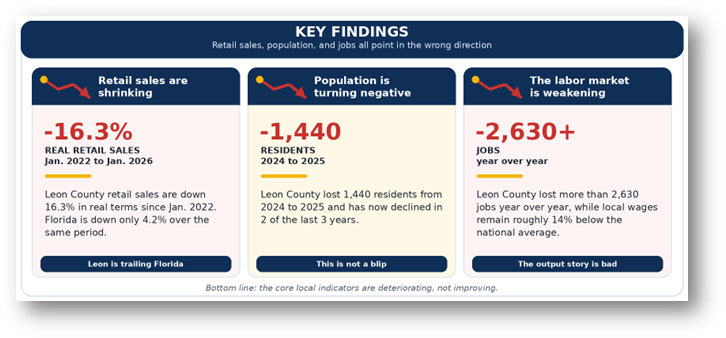
Using standard inflation adjustment based on Bureau of Labor Statistics data, Leon County’s real retail sales have declined by approximately 16.3% since January 2022. Florida statewide declined too, but only 4.2% in real terms over the same period. Leon County’s real decline was nearly four times as severe as the state average.
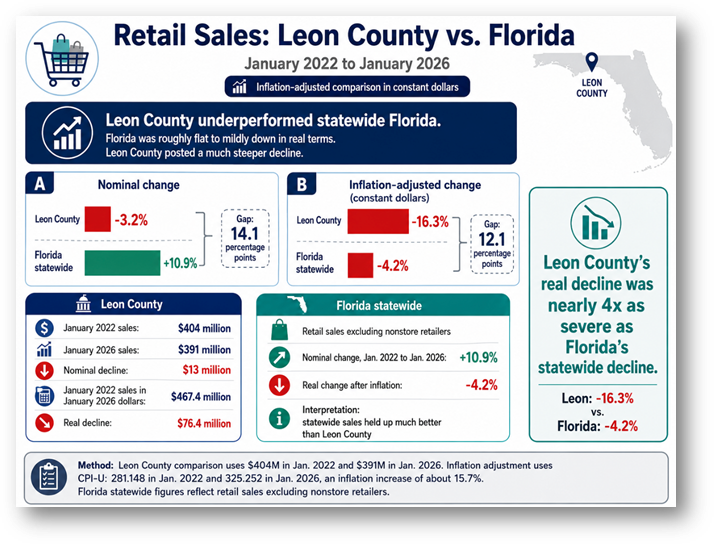
In dollar terms, Leon County would need roughly $467 million in monthly retail sales today just to keep pace with inflation. It is posting $391 million. The gap, $76 million a month, is the purchasing power that has quietly drained out of the local economy while OEV issued press releases about GDP growth and leading-metro rankings.
OEV and those trying to defend the county’s anemic economic performance will likely point to COVID-era distortions. It is a convenient argument, but it does not hold up. The baseline here, January 2022, was chosen precisely because the stimulus sugar high had largely burned off by then. Federal pandemic relief money had already cycled through the economy. Consumer spending had normalized. That makes January 2022 the honest starting point, not the artificially inflated peak months of 2021.
The problem with the COVID defense is straightforward: Florida statewide, starting from the same post-pandemic baseline, grew nominal retail sales by 10.9% through January 2026. Leon County, starting from the same baseline, fell 3.2% in nominal terms. If pandemic distortion explained the weakness, it would show up across the state. It does not.
This is not a COVID story. It is a Leon County story.
The Population Problem Nobody Wants to Talk About
You cannot separate the retail sales story from the population story, because they are the same story.
According to the U.S. Census Bureau’s most current estimates, data released this spring, Leon County’s population stood at 299,048 as of July 1, 2025. That is a decline of 1,440 residents from the 300,488 counted in July 2024.
Over the full five-year period from 2020 to 2024, Leon County grew 2.8 percent, ranking 56th out of 67 Florida counties and 29th out of the 30 largest counties in the state. Florida as a whole grew 8.5 percent over the same period. Neighboring Bay County grew 14 percent. Even Alachua County, home to a similarly government-heavy economy in Gainesville, outpaced Leon at 4.8 percent.
Harvard economist Edward Glaeser, one of the nation’s leading scholars of urban growth and decline, has shown that population loss and economic weakness are deeply connected. Cities that lose their productive edge often struggle to attract the people, talent, and investment needed to regain momentum.
The Jobs Picture
At the Tallahassee Chamber’s own Economic Forecast earlier this year, the Florida Chamber Foundation delivered a candid assessment that did not match OEV’s marketing materials: Leon County lost more than 2,630 jobs compared to the prior year, with the growth rate dipping 1.6%. The Florida Chamber Foundation said Leon County will need more than 6,630 new jobs by 2030 just to stay competitive.
“With 25% of our GDP being attributed to government,” the Florida Chamber Foundation’s keynote speaker said, “that means we need to be more active in driving private-sector growth.”
That is the business community’s own verdict, delivered at the business community’s own event.
Meanwhile, workers in the Tallahassee metro area earn an average hourly wage of $27.99, roughly 14% below the national average of $32.66, according to the Bureau of Labor Statistics.
The Inputs and the Outputs
OEV’s response to data like this is predictable: point to GDP. In February 2026, OEV Director Keith Bowers declared that Tallahassee had its best economic year in more than a decade, citing 4.3% real GDP growth. The press release went out on the city’s own email list.
What the press release did not mention is that the underlying Bureau of Economic Analysis data shows Leon County’s GDP growth was driven disproportionately by government spending and rising real estate values, not broad private-sector expansion. Manufacturing contracted sharply in real terms in 2024, even as the headline number rose. GDP counts a government payroll increase the same way it counts a new factory. In a state-capital economy, that distinction matters enormously.
OEV’s broader economic narrative is built almost entirely on input metrics: GDP figures, R&D spending, university enrollment and rankings placements purchased in Area Development magazine. These are measures of activity. They are not the same thing as outcomes.
The output metrics, the ones that tell you whether people actually want to live here, work here and spend money here, are telling a different story: retail sales down sharply, population declining, jobs lost and wages 14% below the national average.
The question worth asking, and the one that a national search for a new city manager and a county commission facing tough budget decisions should both be asking, is simple: what are we actually getting for the investment, and who is measuring the right things?
Right now, the agency tasked with answering that question is the same agency producing the marketing materials. And the dashboard they built themselves suggests the answer is not what the press releases claim.
May 28, 2026By Skip Foster, Red Tape Florida
Florida’s housing crisis meets Sarasota’s anti-growth reality
Sarasota County is quickly becoming one of the most interesting political laboratories in Florida. […]
May 22, 2026By Skip Foster, Red Tape Florida
Florida’s housing crisis meets Sarasota’s anti-growth reality
By Skip Foster, Red Tape Florida
Sarasota County is quickly becoming one of the most interesting political laboratories in Florida.
Not because the county is uniquely liberal or uniquely conservative. It is becoming something else entirely: a place where often-wealthy environmental progressives and anti-growth conservatives are increasingly finding common cause around one issue — stopping development.
And now that coalition is running headfirst into Florida’s housing crisis.
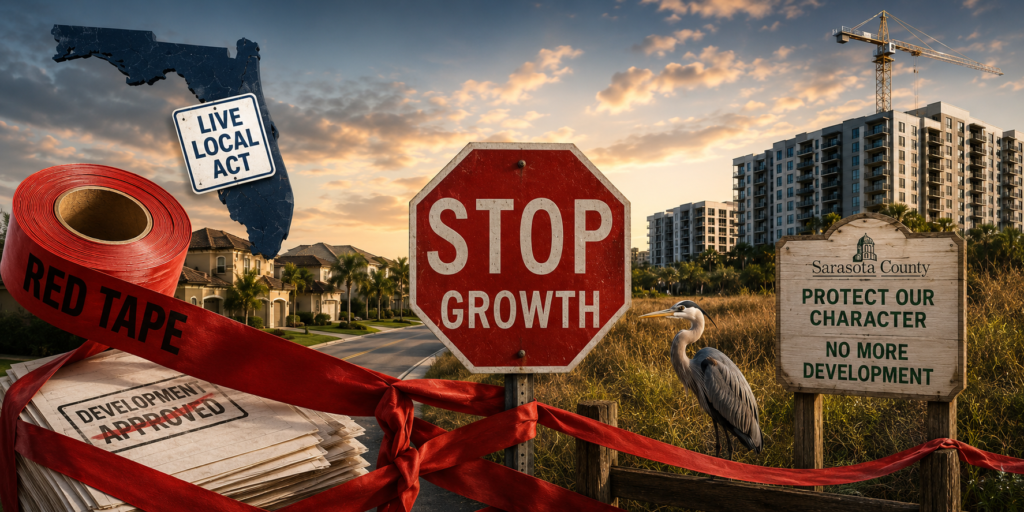
Over the past several months, Sarasota County commissioners have moved aggressively to resist Florida’s Live Local Act, the state law designed to increase workforce and affordable housing by limiting the ability of local governments to block qualifying projects through traditional zoning fights. Under the law, qualifying multifamily or mixed-use projects can be allowed in commercial, industrial, mixed-use and some flexibly zoned areas if at least 40 percent of the units are affordable rental units for 30 years. Sarasota County’s own Live Local page explains that basic framework.
But Sarasota County is trying to draw a much harder line.
In April, commissioners unanimously moved to block Live Local projects from being built on parcels zoned residential, Open Use or Residential Estate. That means the county is trying to prevent the law from being used in exactly the kinds of low-density and semi-rural areas where residents have been most alarmed about apartments, traffic and neighborhood change. Commissioners were warned about litigation exposure. They moved ahead anyway.
Anybody who drives through Sarasota during the season knows the place can already feel strained. Residents worry about roads, evacuation routes, stormwater, schools and traffic. Those are not crazy concerns.
But there is another reality Sarasota increasingly struggles to acknowledge: The people who make the community function still need somewhere to live.
The county still needs nurses, sheriff’s deputies, teachers, restaurant workers, electricians, hospitality workers, construction crews, retail employees and healthcare staff. It still needs the people who clean hotel rooms, pour concrete, install flooring, run landscaping crews and work double shifts in kitchens during tourist season.
Yet many of those workers are being priced out of the communities they serve.
Spectrum Bay News 9 recently reported on Sarasota’s workforce-housing need, including a project designed for teachers, firefighters and police officers with rents around $1,000 a month. That number is important because it shows just how far the actual workforce-housing conversation is from much of the market.
The Barancik Foundation’s Sarasota housing report put the problem more starkly: the median rent for a two-bedroom unit in Sarasota County had reached $2,021 per month, and about 60,000 households were paying more than 30 percent of income on housing, with 20,000 paying more than 50 percent.
That is not a minor inconvenience. That is a community structure problem.
The politics here have become especially revealing. Sarasota politicians talk constantly about affordability while simultaneously fighting the supply increases that might actually relieve some of the pricing pressure. Existing homeowners benefit from appreciating values. Younger buyers, renters and working families absorb the damage.
The anti-growth coalition is now bipartisan.
You have affluent “save our character” progressives standing shoulder-to-shoulder with anti-density conservatives who distrust Tallahassee and resent state interference in local planning. Different rhetoric. Same practical outcome: less housing supply.
The state saw this coming. That is why the Legislature passed the Live Local Act in the first place. Tallahassee essentially concluded that many local governments were never going to voluntarily approve enough housing to meet demand, so the state stepped in and overrode portions of local zoning authority for qualifying projects.
Now Sarasota County is pushing back hard.
The Live Local fight is not happening in isolation. It is part of a broader countywide pattern.
Take the D.R. Horton fight near Celery Fields.
D.R. Horton first proposed turning the Smith Farm property near Celery Fields into 170 new homes. To do so, the developer needed Sarasota County to rezone the land from Open Use Rural to Residential Single Family. The Sarasota County Planning Commission declined to recommend the project in 2024, and the developer later reduced the proposal to 126 homes.
After repeated denials and a dispute-resolution process, D.R. Horton walked away from arbitration and sued Sarasota County. According to WSLR, the company’s petition asks the court to quash the county’s denial and grant the application for 126 homes.
Environmental groups and nearby residents see the project as a threat to Celery Fields, a beloved birding and stormwater area. Sarasota Audubon has said D.R. Horton filed a petition for writ of certiorari after leaving the FLUEDRA process and is asking the court to overturn the denial.
Sarasota’s problem is that every housing fight gets treated like the one project that must be stopped.
Live Local apartments near rural homes? Stop them.
A subdivision near Celery Fields? Stop it.
Density near existing neighborhoods? Stop it.
Housing on land that feels too rural? Stop it.
At some point, the community has to ask a harder question: if new housing cannot go here, and it cannot go there, where exactly is it supposed to go?
Because the demand is not theoretical.
People want to live in Sarasota. Employers need workers in Sarasota. Service businesses need staff in Sarasota. Hospitals need employees in Sarasota. Schools need teachers in Sarasota. Restaurants and hotels need people who can afford to show up to work without driving from another county.
Here is the part Sarasota taxpayers should watch closely. County Attorney Joshua Moye told commissioners that the Live Local Act’s attorney-fee provision allows the prevailing party to recover up to $250,000 in fees and costs per case. Commissioners heard that warning and voted unanimously to proceed anyway. Every case the county loses does not just cost taxpayers in legal fees — it finances the other side’s lawyers too.
There is one more thing the anti-growth coalition rarely mentions: new construction is safer construction. Homes built under Florida’s current building code — strengthened substantially after Hurricane Andrew in 1992 and again after the 2004–2005 storm seasons — are dramatically more resistant to hurricane damage than the aging housing stock they sit alongside. Impact-resistant windows, reinforced roofing systems, elevated foundations and stricter wind-load requirements are standard in new builds. Blocking new construction does not just constrain housing supply. In a coastal county that sits squarely in Florida’s hurricane corridor, it also means the community’s overall resilience erodes as older homes age without replacement.
Housing shortages are not abstract policy discussions. They show up as longer commutes, worker shortages, rising rents, strained local businesses and communities increasingly accessible only to the affluent.
Sarasota County believes it is protecting community character.
Maybe it is.
But Florida increasingly faces a larger question:
What happens when preserving the character of a community also makes it impossible for ordinary working people to live there?
May 22, 2026By Skip Foster, Red Tape Florida
Tallahassee’s $8,400 door: A portal to a broken bureaucracy
Tallahassee Democrat reporter Jeff Burlew has done important and aggressive reporting on the city’s troubled lead-paint grant program, and without that reporting the public likely still would know very little about what appears to be a significant breakdown involving a federally funded public-health initiative. […]
May 14, 2026Commentary by Skip Foster, Red Tape Florida
Tallahassee’s $8,400 door: A portal to a broken bureaucracy
Commentary by Skip Foster, Red Tape Florida
First, credit where it’s due.
Tallahassee Democrat reporter Jeff Burlew has done important and aggressive reporting on the city’s troubled lead-paint grant program, and without that reporting the public likely still would know very little about what appears to be a significant breakdown involving a federally funded public-health initiative.
HUD has now placed the city’s $4.4 million lead hazard reduction grant on “high risk” status and launched an audit after raising concerns involving contractor expense justification, procurement compliance, unit eligibility and program implementation. The city has already spent roughly $1.6 million and received more than $1 million in federal reimbursements.
The headline-grabbing detail, of course, is the $8,400 replacement doors.
But the bigger story may be what this says about Tallahassee government priorities and culture.
For more than a year, Red Tape Florida has documented a city government that often seems obsessively focused on performative or marginal matters while struggling with basic competence in areas that actually affect public trust and quality of life.
This is the same local government ecosystem that has devoted extraordinary energy to:
- forcing the tearing down small sheds,
- denying local businesses the use of their own land,
- building infamous “sidewalks to nowhere,”
- and burying ordinary residents, builders and tradespeople under layers of bureaucracy and process.
There is also a broader lesson here. Many of the same voices constantly calling for larger public-sector involvement in housing and affordability rarely grapple with the reality that government systems are often just as vulnerable to waste, inefficiency and mismanagement as the private sector — sometimes more so.
Meanwhile, according to HUD, a federal program designed to protect low-income families and children from lead hazards apparently drifted badly enough off course to trigger federal intervention.
That should concern everyone.
Because this was not some optional arts grant or beautification initiative. This involved lead exposure risks in older housing occupied by lower-income residents. If there is one thing local government should be capable of doing competently, it is administering a straightforward public-health and housing-safety program funded by federal dollars.
Instead, Tallahassee now finds itself facing a federal audit, possible repayment demands, whistleblower allegations and growing questions about oversight.
And those questions keep multiplying.
- Why did a citywide lead-hazard program appear to focus so heavily on one apartment complex?
- Why was work at Palm Beach Pointe apparently never started?
- Who was reviewing invoices?
- Who approved the change orders?
- Who was independently verifying procurement and compliance requirements?
And perhaps most importantly: Why wasn’t anyone inside City Hall empowered to slow things down and ask uncomfortable questions before HUD stepped in?
The controversy has now expanded beyond procurement questions and into the broader political and managerial culture of City Hall. Commissioner and mayoral candidate Jeremy Matlow has seized on the issue as evidence of deeper dysfunction within the Goad administration, even calling for criminal review and the city manager’s resignation.
Matlow’s broader political worldview rarely aligns with RTF’s. But one reason this controversy is gaining traction is that concerns about City Hall competence, bureaucracy and internal culture increasingly transcend traditional political lines.
Meanwhile, according to whistleblower allegations reported by Burlew, former city employee Lisa Robinson says she repeatedly raised concerns involving contractor certifications, safety practices, compliance and excessive costs before eventually being terminated.
The city disputes aspects of those allegations, and the facts will ultimately have to play out through the formal process.
But the broader theme is hard to ignore.
One of the most common refrains Red Tape Florida hears from builders, contractors, business owners and even some current and former government employees is this: raising concerns internally often comes with consequences.
People learn quickly which questions are welcomed and which questions create problems – or get ignored.
That does not mean every whistleblower allegation is automatically true. It does mean governments should be especially careful when allegations of retaliation emerge inside troubled programs already under outside scrutiny.
Because once citizens begin believing that speaking up is punished while bureaucratic failure is protected, trust collapses fast.
The tragedy here is that this program existed for a genuinely important reason. Lead exposure can permanently harm children and families living in older housing stock. This should have been one of the least controversial and most straightforward responsibilities local government handles.
Instead, taxpayers are left wondering how a federally funded safety initiative turned into yet another Tallahassee government controversy.
But in the end, the question is sadly ironic:
Which is more toxic, the harmful chemicals in old paint or the culture of intimidation in the local government that is charged with cleaning it up.
May 14, 2026Commentary by Skip Foster, Red Tape Florida
When the “B” in Busy Bee actually stands for “bureaucracy”
North Floridians know Busy Bee.
Clean bathrooms. Killer caramel popcorn. Fudge. What more could a weary traveler want?[…]
May 11, 2026By Skip Foster, Red Tape Florida
When the “B” in Busy Bee actually stands for “bureaucracy”
By Skip Foster, Red Tape Florida
North Floridians know Busy Bee.
Clean bathrooms. Killer caramel popcorn. Fudge. What more could a weary traveler want?
The prospect of another Busy Bee would surely have I-10 travelers, ahem, buzzing.
But for Columbia County government, the Busy Bee means something else, apparently: A chance for money and control.
Red Tape Florida has obtained internal Columbia County documents that include a dizzying list of permit price quotes for a new Busy Bee. But unlike the iconic gas station, this list is far from spotless. Instead, it’s littered with inconsistent line items, omitted fees, and contradictory explanations.
Columbia County’s whack-a-mole process of pricing a permit for the project is both breathtaking and alarming. And in the process, it sidelined the very private-sector option state law is supposed to protect.
Start with the numbers. We have put key numbers in bold to make it easy to follow.

On February 3, Columbia County issued an invoice for $322,965 in permitting fees.
That included a $63,000 plan review fee — more than double the county’s own $25,000 cap.
What makes that initial $63,000 charge harder to explain is that Columbia County clearly knows how to apply its own cap. A review of recent permits shows multiple projects where plan review fees were calculated and then reduced to the county’s $25,000 maximum —

Including projects using private providers. In other words, the system works — when it’s used. The question is why it wasn’t used here until after the issue was raised.
That should have been the first correction.
Instead, it was the beginning of a negotiation. After the contractor engaged a private provider, CT Solutions of Florida — a move specifically contemplated under Florida law — the county revised the total to $242,246.25.
Still high. Still unexplained.

Then, on March 31, a new invoice arrived:
$126,015.

Nearly a 60 percent reduction.
But the details had disappeared. Line items were consolidated into a single figure.
The basis for the calculation was no longer visible.
Later, the county described that invoice as “auto-generated.”
Which raises a basic question: if the system can generate a six-figure invoice in error, what is actually driving the number?
The answer changed again.
On April 16, the total jumped back to $219,440.

The plan review fee was corrected to $25,000. But the building permit fee climbed to $189,000, pushing the total back toward the original range.
So, in roughly six weeks, the same project produced at least four different answers from Columbia County, with zero changes to the project itself:
$322,965
$242,246
$126,015
$219,440
That’s not a rounding issue.
That’s a moving target.
And the movement matters.
Because under Florida Statute 553.791, when a private provider is used for plan review or inspections, the local government must reduce its fees to reflect actual cost savings — and may not charge for inspections it does not perform.
In other words, bringing in a private provider should make the process simpler and less expensive.
Here, it did neither.
Instead, the introduction of a private provider coincided with:
- prolonged back-and-forth over fee calculations
- invoices that changed materially from one week to the next
- and a final number that remained substantially above what the applicant’s representative argued the statute would allow
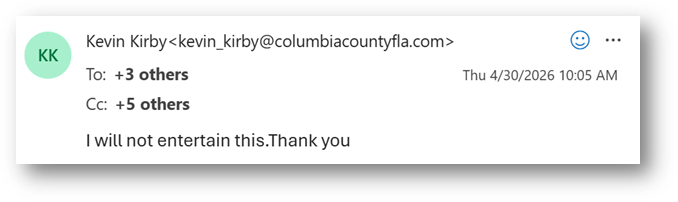
At one point, the contractor’s representative put it directly to the county: if you’re not performing the inspections, you shouldn’t be charging for them.
The county’s response was brief.
“I will not entertain this.”
What followed was not resolution, but fallout.
According to those involved, the prolonged dispute and uncertainty over the permitting process ultimately led to the private provider being removed from the project.
That outcome is hard to ignore.
Because it raises a broader question — not just about this permit, but about the system behind it.
If engaging a private provider leads to higher costs, less clarity, and extended delays, what signal does that send to applicants?
And more importantly: what choice does it leave them with?
To be clear, Columbia County officials have suggested that some of the inconsistencies stem from system limitations and the need to align local ordinances with evolving state law. That may explain part of what happened here.
But it does not explain the pattern.
A capped fee that exceeds the cap — in a system that demonstrably applies that cap elsewhere.
A reduced invoice that cannot be explained.
A revised invoice that climbs back toward the original number.
All in the context of a statute designed to push costs in the opposite direction.
At a minimum, it creates the appearance of a system where the numbers are not fixed — they are negotiated.
And where the path of least resistance may be the one that keeps the process inside government.
For a project like Busy Bee — a recognizable, high-profile investment — that kind of uncertainty carries weight.
Developers can plan for high costs. They can plan for low costs.
What they cannot plan for is a system where the cost depends on how long they are willing to push back.
That’s when the process stops being a calculation.
And starts becoming a decision point.
Not about what the permit should cost.
But about whether it’s worth the fight.
That’s the question Columbia County’s process now puts in front of anyone looking to build.
May 11, 2026By Skip Foster, Red Tape Florida
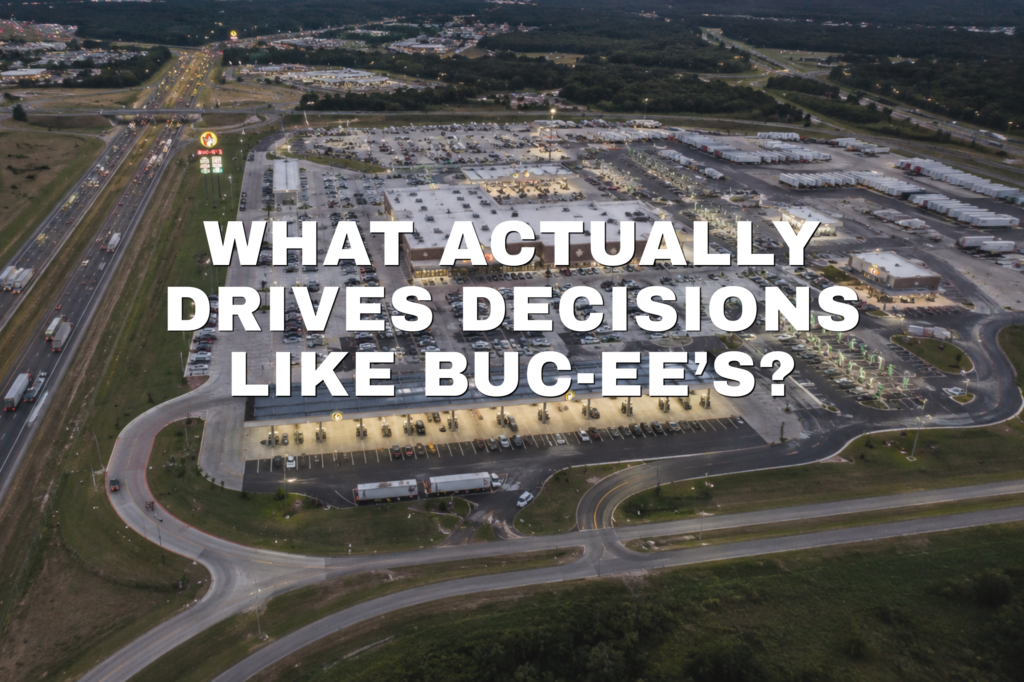
What actually drives decisions like Buc-ee’s
By Skip Foster, Red Tape Florida
Pam McVety’s recent column raises a thoughtful question: in a world transitioning toward cleaner energy, does a large travel center built around gasoline make sense?
It’s a fair question — and one informed by her background as a scientist and longtime advocate on environmental and public health issues. The concerns she outlines are real, and the broader direction she describes is one most people would agree with: lower emissions, cleaner energy, and more efficient transportation.
But it’s also a question that operates at a level of abstraction that doesn’t reflect how communities — or markets — actually function.
There are at least three different conversations happening here.
- The first is what we would like the world to look like.
- The second is what we believe people should do.
- And the third — the one that ultimately determines whether projects like this get built — is what people are actually doing.
Right now, people are still overwhelmingly driving gasoline-powered vehicles. That is not a political position. It is a market reality.
As long as that remains true, the question is not whether fueling infrastructure exists. It must. The question is what form it takes.
Facilities like this are typically located along major interstate corridors, where demand is already concentrated. That often means fewer detours and more direct trips. The result can be greater efficiency, not less.
Modern travel centers are also not static. Many now include electric vehicle charging alongside traditional fueling. Buc-ee’s locations in multiple states have begun incorporating EV infrastructure, reflecting the same transition Ms. McVety describes.
The broader issue is one of scale.
The energy transition Ms. McVety is advocating for is a macro challenge. It will be driven by technology, policy, pricing, and consumer behavior over time — not by the approval or rejection of individual projects.
That doesn’t make local decisions irrelevant. But it does mean that treating a single project as a proxy for global outcomes can lead to conclusions that don’t hold up.
There is also a more basic question at play — one that sits at the core of how communities should make decisions.
Projects like this are not approved because they align with a particular worldview. They are approved — or rejected — based on whether they meet established rules: zoning, traffic, environmental standards, and applicable state law.
What Ms. McVety is effectively arguing is that even if a project meets those standards, it should be denied because it does not align with a broader policy preference about energy use.
That is a different kind of decision.
And it is one that puts government in the position of picking winners and losers based not on compliance, but on ideology.
And that logic doesn’t stop with gasoline.
If we shouldn’t build infrastructure tied to current consumer behavior because we want that behavior to change, then we wouldn’t build fast-food restaurants because of public health concerns. We wouldn’t build water parks because of water consumption. We wouldn’t build bookstores because of paper use.
That is not how communities function.
We do not prohibit entire categories of activity because they are imperfect. We regulate them, improve them, and over time — as behavior changes — the market shifts with it.
And there are real downstream consequences to getting this wrong.
Leon County Schools is preparing to ask voters to renew a half-penny sales tax for capital needs. Blueprint projects rely on similar revenue streams. When growth is stifled, those funding sources are affected — and so are the roads, schools, and infrastructure they support.
The transition Ms. McVety describes is real. But it is not instantaneous. It is measured in decades, not news cycles. And during that transition, communities still need to function.
That includes providing the infrastructure that supports how people actually live and travel today.
The risk in this debate is not that we will build one too many gas stations.
It is that we will confuse long-term goals with near-term decision-making — and lose sight of the difference between aspiration and reality.
Both matter.
But they are not the same thing.
May 8, 2026By Skip Foster, Red Tape Florida
The Chamber steps up, breaking deafening silence from Tallahassee-Leon leaders

Commentary by Skip Foster, Red Tape Florida
Something important just happened in Tallahassee — and it didn’t come from City Hall or the County administration building.
It came from the private sector.
Greater Tallahassee Chamber of Commerce Chairman Eddie Gonzalez Loumiet made it clear Tuesday that the Chamber intends to step forward and take a more active role in recruiting companies and jobs to this community.
His reasoning, in a piece in The Tallahassee Democrat, was simple: Tallahassee needs a quarterback.
He’s right.
And the fact that he had to say it out loud tells you everything you need to know about where things stand.
Because for nearly a decade, the Tallahassee-Leon County Office of Economic Vitality — OEV — has been positioned as that quarterback. It was created to lead, coordinate, and deliver results.
Readers of Red Tape Florida know how that has worked out: Only one major success. A pipeline that rarely materializes into announcements. A local economy still heavily dependent on government and public-sector spending.
That’s not a talking point. That’s a pattern — one that Red Tape Florida has been documenting in detail, including a deeper look at OEV’s project pipeline and the gap between activity and actual outcomes.
And now, the private sector is responding accordingly.
Eddie Gonzalez Loumiet didn’t hedge around that reality. He stepped into it and said what others have been unwilling to say plainly: the current structure is not producing what this community needs.
That’s leadership.
What we’re seeing from local government, by contrast, is something else entirely.
Take City Manager Reese Goad’s response.
According to reporting, Goad suggested that OEV remains “perfectly situated” to lead recruitment efforts and emphasized that the existing structure is essentially the right one.
That’s beyond tone deaf – it’s hallucinatory. As Red Tape Florida has documented, Leon County has one – ONE — out-of-market win in OEV’s entire existence. That was an Amazon distribution center that multiple people close to the project said had absolutely nothing to do with OEV efforts.
If the system were working, the Chamber wouldn’t feel compelled to step in and “run point.” If the system were working, we wouldn’t be having this conversation at all.
A broader issue
Tallahassee leaders don’t like to talk about problems.
OEV’s incredibly poor track record ought to be a major topic of conversation at city and county commission meetings.
Instead, crickets.
Tallahassee-Leon leaders are so busy giving themselves awards, touting obscure rankings and starting Facebook posts with “I’m honored to have been named ….” that nobody seems to make time to acknowledge clearly failing vital institutions.
And it doesn’t stop at economic development.
Silence as far as the ear can hear
We’ve seen the same pattern play out in smaller, more contained situations — where the stakes are lower, but the signals are just as clear.
Take Midtown Reader.
A small business was pushed through a costly and time-consuming process that resulted in the loss of usable parking and the installation of infrastructure with little practical value. The story reached tens of thousands of readers. The public outcry was overwhelming.
And the City of Tallahassee’s response?
Nothing.
No engagement. No correction. No acknowledgment.
Nothing from the city commission dais.
A functional city government would have read the series and immediately taken steps to make things right – to convert the grassy plot into badly-needed parking.
Not here. We don’t do that.
Red Tape Florida and other residents have suggested improvement to the Tallahassee airport. They may not have all been good ideas, but they were all met with stony silence. Meanwhile, TLH has fewer air travelers today than in 1988.
Then there is the CEO who told Red Tape Florida about how he eventually gave up on locating in Tallahassee, even though it was his first choice, because of a lack of responsiveness by OEV.
The ultimate irony is that the City also goes silent when contacted by email by builders and tradespeople, knowing that their often-outrageous demands will be subject to public records law. That clear evasion of the spirit of the state public records law should have drawn the immediate attention of city commissioners.
That silence matters.
Because if the system cannot respond to a clear, visible, fixable problem affecting a single small business, it raises serious questions about its ability to respond to larger, more complex challenges.
That’s the through line.
Whether it’s OEV’s underwhelming track record on major recruitment, permitting friction that slows down investment, or small-business impacts like Midtown Reader, the pattern is consistent: problems surface, evidence builds, and the response from those in charge is delayed, diluted — or nonexistent.
The Chamber’s move cuts directly against that pattern.
It says: stop waiting, start acting.
It says: results matter more than structure.
And it says, implicitly but unmistakably, that the current approach isn’t getting it done.
That’s why Eddie Gonzalez Loumiet’s comments matter. Not just because of what he said — but because of what they reveal.
Leadership isn’t maintaining a structure that isn’t producing results. Leadership is recognizing that reality and stepping forward anyway.
Tallahassee doesn’t just need a quarterback for recruiting companies.
It needs a system — across the board — that is responsive, accountable, and willing to engage when something clearly isn’t working.
Right now, the private sector is showing what that looks like.
The question is whether anyone else is willing to follow.
May 5, 2026What does the crystal ball say on the Tallahassee City Manager search?

Madam Sunshine already knows how it ends
By Skip Foster, Red Tape Florida
Madam Sunshine — RTF’s Notary of Inevitable Outcomes — doesn’t predict the future. She reads the pattern. And in Tallahassee’s city manager search, the pattern is already complete.
She has lit her candle. Her notepad is open. Three items are already checked: Divided Board. Lame Duck Timing. Predictable Outcome. She peers into her crystal ball — which, it should be noted, is fully subject to Florida’s public records law — and sees the Tallahassee Capitol dome staring back at her.
“I see a press release,” she says, not looking up. “It uses the words ‘rigorous,’ ‘transparent,’ and ‘the best candidate for Tallahassee’s future.’ I have read this press release before.”
She seems unsurprised. She is always unsurprised.
The setup
City Manager Reese Goad is leaving on September 30. A new commission takes office in November. Rather than pass this decision to the incoming body — the one voters are about to elect in a change election — outgoing Mayor John Dailey has announced that the current commission will conduct a nationwide search and hire before the new commission is seated. His justification: “Collectively, that’s over 65 years of public service.” He did not mention that virtually every significant decision this commission has confronted ended in a 3-2 vote, or that his math includes the two commissioners whose opinions his majority has routinely ignored.
He also left out that those years of experience have presided over the nation’s most expensive airport, a giant tax increase, a high crime rate and stagnant population growth.
Let’s be clear: What Mayor Dailey is proposing is not a national search. It is the performance of one.
Madam Sunshine checks her notepad. All three boxes were already checked. She takes a sip from her mug.
The precedents
History, it turns out, has opinions about what happens next.
Palm Bay, Florida — 2018. The city conducted a genuine national search — 79 applicants, seven finalists, outside candidate hired. His name was Gregg Lynk. In November 2018, a newly elected council member was sworn in and promptly cast the deciding vote to fire him. The vote was 3-2. Lynk’s offense: being hired by the wrong commission.
Portsmouth, Virginia — 2023. City Manager Tonya Chapman was fired by a new council after six months on the job. Six months. A national search. A new council. A firing. The headline wrote itself.
Spokane Valley, Washington — 2016. A new council majority ousted City Manager Mike Jackson despite the mayor acknowledging there was “no malfeasance or incompetence or wrongdoing.” A new majority wanted its own direction. Jackson’s qualifications were never the issue. His hiring commission was.
But wait, there is a different way!
Palm Coast, Florida — the city that said no. Facing the identical situation, Palm Coast looked at the risk and chose to wait. New commission seated. Search conducted. Hire made. No drama. No 3-2 firing on night one.
This is what the search firm said about Palm Coast waiting: “Realistically, most qualified city managers are not going to want to step into that uncertain landscape of who their direct reports are going to be, the five that are going to be sitting at this dais.”
Tallahassee is choosing to be Palm Bay. It has the option to be Palm Coast.
“I see city managers in Ohio and Oregon and places that end in -ville,” Madam Sunshine continues, peering deeper into the glass. “Impressive people. Impressive resumes. I see them reading about Tallahassee. I see Google search results like ‘divided Tallahassee commission’ and ‘Palm Bay city manager fired.’ I see them quietly closing their browsers. I see them returning to their current jobs, where nobody is about to fire them.”
She watches the inbox. It is not filling up the way one might hope.
She does not appear surprised.
Why qualified candidates will pass
Any city manager worth recruiting has a career to protect. They have a family. They have a mortgage. They are not going to relocate to Tallahassee — or even submit an application — knowing that a new commission takes office sixty days after they’re hired, that the hiring body has a 3-2 dysfunction record, and that the precedent in cities exactly like this one is termination with prejudice.
What is left when serious external candidates self-select out? Internal candidates. People who are already here. People who have nothing to lose by applying because their current job exists regardless of the outcome. People, in other words, who were always going to get this job.
What Madam Sunshine sees next is not just a hiring decision. It is a protection mechanism. The bureaucracy protecting itself. The status quo preserving continuity — not because it is working, but because it is comfortable. Red Tape Florida has documented that record: weak job growth, underwhelming economic developmentand mind-boggling permitting policies and practices. This process does not challenge that record. It guarantees it.
“Now the crystal ball gets interesting,” Madam Sunshine says, leaning forward. “I see a search firm. I see marginally qualified external finalists. I see community forums where residents ask thoughtful questions and nothing is decided. And then — oh, here it is — the commission reaches a stunning conclusion.”
She pauses for effect. She doesn’t need to. She has known this part since the beginning.
“The best candidate was here all along!”
Madam Sunshine sets down her mug. She affixes her notarial seal. She blows out the candle.
What should happen instead
There is no emergency here. Goad leaves September 30. The new commission arrives in November. A senior staff member serves in an interim capacity for sixty days. It has been done in cities far larger than Tallahassee. It is not complicated.
The new commission — with a voter mandate and at least the possibility of a more collegial majority — deserves to choose the person who will report to them. That is not a radical idea. It is what Palm Coast did. It is what good governance looks like.
If Madam Sunshine is indeed clairvoyant. If a “national search” doesn’t find out-of-market candidates worthy of leading the capital city of the nation’s third largest state. If the disingenuous fallback is an internal candidate …
… then you won’t need a crystal ball to know what has happened:
Tallahassee’s insiders are protecting an embarrassing status quo by stacking the Tarot card deck.
May 5, 2026
On the brink of a win against Florida red tape
Florida does not need another speech about housing affordability. It needs fewer obstacles to building housing.
That is what HB 803 addresses.[…]
April 28, 2026By Skip Foster, Red Tape Florida
On the brink of a win against Florida red tape
Governor DeSantis should sign HB 803 – and we believe he will
By Skip Foster, Red Tape Florida
Florida does not need another speech about housing affordability. It needs fewer obstacles to building housing.
That is what HB 803 addresses.
The bill, now awaiting the governor’s signature, goes directly at the layer of local permitting that quietly drives up costs — duplicative reviews, inflated fees, shifting requirements, and timelines that stretch for reasons that have little to do with safety or code compliance.
This is not abstract. Red Tape Florida has documented it.
In Gulf County, the county imposed a $500 “planning review fee” on applicants who used a private provider — the very tool state law created to speed up permitting. Builders were effectively told: use the private-sector fast lane and pay a toll for the privilege. In some cases, they were also routed through additional internal steps before permits could move forward.
HB 803 shuts that down.
The bill requires local governments to reduce permit fees when private providers are used — at least 25 percent in some cases, and at least 50 percent when private providers handle both plan review and inspections. It also prohibits additional administrative or inspection fees tied to the use of a private provider.
That is a straightforward fix. If government is doing less work, it should not charge the same — and it certainly should not charge more.
Alachua County offers another example of how the system has drifted.
RTF reported that the county created a “Private Provider Inspection Confirmation” process that does not exist in state law. Contractors described county inspectors redoing inspections already completed by private providers, issuing correction notices without coordinating with them, and requiring additional approvals before work could proceed.
The county also required scheduling through a portal that limited flexibility, rejected documentation for technical reasons, and added layers of process that had the effect of slowing projects even after private-provider approval.
That is not oversight. That is duplication.
HB 803 addresses that by limiting how far local governments can go once a qualified private provider is engaged. It restricts local review largely to true local issues — site conditions, floodplain management, administrative completeness — rather than allowing a second round of building-code review under a different name.
It also requires local governments to maintain registration systems for private providers and bars them from charging administrative fees just to participate in the process.
The point is simple: if the state authorizes private providers, local governments cannot quietly recreate the same process and call it something else.
Tallahassee provides a third, more familiar example.
RTF reported on a property owner attempting to renovate a small maintenance shed at an apartment complex. What should have been routine turned into a multi-year process involving dozens of plan-review comments, additional surveys, stormwater requirements, tree-mitigation calculations despite no tree removal, structural questions about decades-old footers, and even a dispute over a roof overhang extending a few inches beyond a setback line.
At a certain point, it became cheaper and faster to demolish the structure than to satisfy the process.
That is the system Florida says it wants to fix.
HB 803 does not solve every one of those problems, but it targets the mechanics behind them.
It requires more uniform building permit applications statewide, reducing the need to relearn the process from one jurisdiction to another. It creates a five-business-day decision window for certain smaller residential permits once an application is complete. It prevents inspection fees from being based on total project cost rather than the actual cost of the inspection.
And it addresses a quieter constraint on supply by requiring that offsite-constructed housing — including modular and manufactured homes — be treated the same as site-built homes. Local governments can no longer impose more restrictive rules simply because of how a home is constructed.
Taken together, these changes do something important: they reduce uncertainty.
And uncertainty is expensive.
Every additional review, every extra requirement, every week a project sits waiting for a decision adds cost — financing, carrying, and risk. Those costs do not disappear. They are built into the final price of housing.
If Florida is serious about affordability, it cannot ignore that reality.
HB 803 does not rely on subsidies or new programs. It removes friction. It aligns fees with actual work. It reinforces the role of private providers. And it sets clearer expectations for how permitting should function.
It also reflects a consistent direction in state policy. Florida has spent the past several years pushing to reduce barriers to development and increase predictability. This bill fits squarely within that approach.
The Legislature’s support reflects that. HB 803 passed with overwhelming, bipartisan margins.
There is nothing controversial about requiring government fees to match government work.
There is nothing controversial about preventing duplicate inspections.
There is nothing controversial about treating different types of housing fairly.
What is controversial is the status quo — where local processes add cost without adding value, and where builders and property owners face a system that too often feels designed to slow them down rather than help them move forward.
Governor DeSantis has made cutting red tape a central theme of his administration. HB 803 is exactly that.
It reduces unnecessary costs. It limits duplication. It makes it easier to build.
Florida does not need another conversation about housing.
It needs fewer barriers to building it.
This bill removes some of them.
It should be signed and we believe it will be.
April 28, 2026By Skip Foster, Red Tape Florida

OEV marketing doesn’t add up
If you want to understand Tallahassee’s economic development problem, start here…[…]
April 22, 2026Skip Foster, Red Tape Florida
OEV marketing doesn’t add up
From contradictory records to weak results, new documents reveal a strategy that isn’t competing
By Skip Foster, Red Tape Florida
If you want to understand Tallahassee’s economic development problem, start here:
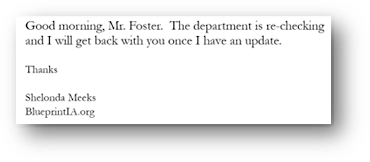
The Office of Economic Vitality was asked by Red Tape Florida to produce the last three years of marketing and promotional spending — broadly defined to include advertising, sponsorships, memberships, events, and payments to third parties.
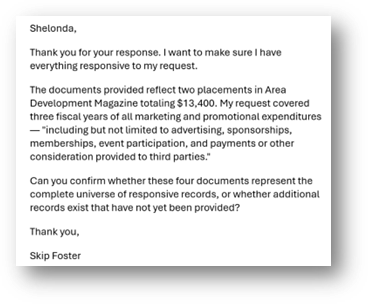
OEV’s initial response produced just two print ads totaling roughly $13,400.
After a follow-up request from Red Tape Florida, expressing skepticism that the response was complete, OEV produced a second batch of records showing approximately $132,700 in additional spending, bringing the total to about $146,000.
But even that was not the full picture. Separate internal materials reviewed by Red Tape Florida identify additional marketing channels that do not appear in either records production.
This doesn’t just raise questions about transparency.
It helps explain a broader pattern — one that shows up in limited out-of-market reach, heavy in-state image-building, inconsistent data, and a continued failure to turn Tallahassee’s most unique asset into a driver of economic growth.
And that pattern becomes clearer the deeper you go.
A trend of in-state spending
Start with where the money is actually going.

Of the roughly $146,000 in documented spending, a significant share is tied to Florida Trend — a publication with strong visibility inside Florida, but limited reach among national site selectors or companies making location decisions outside the state.
There is nothing inherently wrong with advertising in Florida Trend.
But it is not, by itself, an out-of-market recruitment strategy.
Economic development is not about being known in Florida. It is about competing outside of it.
And on that front, the numbers are striking.
Over the same three-year period, just $13,400 — less than ten percent of total documented spending — went to Area Development Magazine, one of the core national outlets used to reach site selectors and corporate decision-makers.
Those dollars bought a total of two print ads. In three years.
That imbalance is not incidental. It reflects a strategy that is far more focused on in-state visibility than on national competition.
And that’s before we consider what OEV – funded with $20 million in tax dollars over 10 years — didn’t include in either of its public records responses.
Missing marketing
A slide from an August 2025 OEV presentation to a local advisory board, obtained by Red Tape Florida, lists “Recent & Scheduled Advertising” placements that include Tallahassee Reports, Capital Outlook, airport advertising, Business in Focus, LIVE in Tallahassee, and unspecified digital buys.
If these placements are part of OEV’s marketing activity, why do they not appear in either response to a public records request that explicitly asked for all marketing and promotional expenditures? How much was spent in each area? What were the results?
Beyond the lack of transparency, who is this strategy designed to reach?
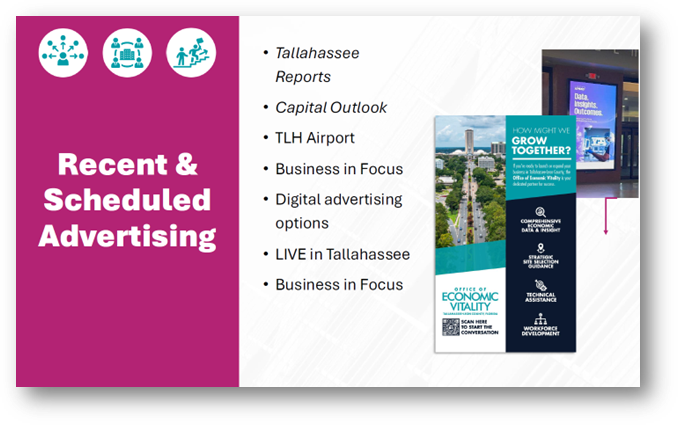
Several of these outlets are local or niche platforms with limited exposure beyond Tallahassee or North Florida. Others are general business features that do not specifically target site selectors or corporate decision-makers.
And, of course, as Red Tape Florida readers know, Tallahassee Reports dramatically changed its coverage of the City once taxpayer dollars started flowing its way. OEV fits the pattern – Red Tape Florida could not find a single story critical of OEV since 2020.
Back to marketing focus, it matters because it’s not just about visibility — it’s about visibility in the right places.
And there is little in this list that suggests a sustained effort to reach the audiences that actually drive location decisions.
But the issue is not just incomplete records or reaching the right audience. The performance data in the same presentation raises an equally important concern.
Across multiple slides, OEV reports digital and marketing engagement that can be most charitably described as modest. Limited reach, low interaction, and little evidence of sustained audience growth.
Communities that are serious about competing for visitors or investment typically measure engagement in the hundreds of thousands — or millions — of impressions across campaigns. By contrast, the activity reflected in OEV’s own materials is at a much smaller scale, with limited reach and minimal interaction. Just 89 clicks on the OEV web site in Q2 of 2025?
Not good.
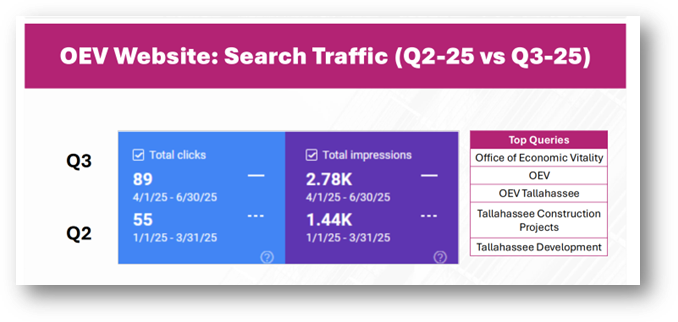
Even if the strategy were locally focused, the results would still need to justify the approach.
Instead, the data suggests a marketing effort that is not only narrowly targeted but also underperforming within that narrow scope.
The same pattern shows up in how Tallahassee treats its most distinctive economic asset.
Marketing magnetism
The National High Magnetic Field Laboratory is, by any measure, a world-class institution. It is also one of the few truly unique differentiators the community has in a competitive economic development landscape. Yet, Tallahassee’s underperformance at growing economic activity around this asset has been well-documented.
A notable and positive exception and recent big win for OEV — in collaboration with FSU — has been securing an important magnetics conference for two straight years. It’s surely a source of lead generation that is important for Tallahassee to retain.
Further, OEV has, at times, attempted to build a brand around the Mag Lab. Internal messaging refers to Tallahassee as the “Magnetic Capital of the World.” A 2023 video promotes the lab as “Florida’s Most Powerful Attraction,” highlighting its potential impact on energy, transportation, and healthcare. (Full disclosure: The video, which was nominated for a Suncoast Emmy award, was produced by Hammerhead Communications, in partnership with The Zachary Group).
But there is little evidence of a sustained effort to turn that concept into an actual recruitment strategy. Which is a fancy way of saying – that message is not being spread.
The video itself has drawn minimal viewership – 308 views on YouTube at last check. There is no visible campaign built around it. No consistent targeting of industries that would logically cluster around magnetics research, advanced materials, or high-field applications.
In other words, Tallahassee has a compelling story to tell. It just isn’t telling it where it matters.
Now, all of this could be overlooked if OEV was top notch at blocking and tackling. If the scoreboard was lighting up with wins. If the area was known for its business-friendliness and responsiveness.
But Red Tape Florida readers know that’s not the case.
From CEOs who wanted to come to Tallahassee, but eventually gave up, to the reality that there is only one out-of-market win for OEV in 10 years to the sad reality of our area’s poor job numbers, to the 0-for-2025 performance … the lack of marketing matches the results.
The bottom line
Put all of this together, and the pattern is difficult to ignore.
- An organization that struggles to produce a complete accounting of its own marketing activity.
- A spending profile that favors in-state visibility over out-of-market competition.
- A marketing footprint that is local, scattered, and not clearly aligned with decision-makers.
- Performance data that shows limited traction even within that footprint.
- And a world-class asset that remains under-leveraged as an economic driver.
These are not separate issues. They reinforce each other. And they lead to a simple conclusion:
Tallahassee’s economic development challenge is not just about the results. It is about whether the system is designed to produce them.
Of course, OEV is simply a part of a community-wide public sector pattern. Red Tape Florida has documented a similar mentality with the City of Tallahassee – ignoring non-performance and mediocrity while simultaneously pumping out feel good stories and touting obscure rankings.
Meanwhile, the economic development and business world passes Tallahassee by because companies don’t wait for follow-ups. They make decisions based on who shows up, who makes a clear case, and who competes.
Right now, Tallahassee isn’t doing enough of that.
And the records — incomplete as they may be — make that clearer than ever.
April 22, 2026Skip Foster, Red Tape Florida