
The gap between Florida’s housing policy and local reality
April 16, 2026Skip Foster, Red Tape Florida
The gap between Florida’s housing policy and local reality
Share this
Share
+1
Tweet
Share
Share
By Skip Foster, Red Tape Florida
Florida’s political leadership has been clear: the state needs more housing, and it needs it faster.
Over the past two years, lawmakers have passed a series of increasingly aggressive reforms aimed at making that happen. The Live Local Act opened the door to higher-density residential development in commercial and mixed-use areas. Follow-on legislation strengthened those provisions — clarifying height allowances, tightening approval standards, and giving developers more tools to challenge local denials.
Taken together, the direction of state policy is unmistakable.
Florida is trying to make it easier to build.
But the fact that lawmakers have had to revisit and refine the law — first through SB 328 in 2024, and later through SB 1730 in 2025 — raises a natural question:
If the policy is working cleanly, why does it keep needing to be strengthened?
One answer, reflected in legal and industry analysis, is that the original law created confusion and, in some cases, disputes between developers and local governments over how it should be interpreted and applied.
In other words, the problem was not just what the law said.
It was how it worked in practice.
That tension is now playing out most visibly in South Florida.
In Surfside, a proposed 11-story Live Local development — in a town where height is otherwise capped at four stories — triggered immediate and intense backlash from residents and local officials. The project was legally grounded in the statute, but politically controversial from the start. The result was not a clean approval process, but a high-profile local fight over what the law actually allows and how far it should go.
In Hollywood, the conflict moved even further. A Broward County judge sided with the city in a dispute over a proposed Live Local tower, prompting the developer to challenge what it described as a misinterpretation of the law. That case illustrates a different phase of the same issue: disagreements over Live Local are no longer just playing out in public meetings — they are moving into the courts.
And these are not isolated examples.
Industry reporting and legal commentary indicate that multiple South Florida communities have pushed back on Live Local projects, either through litigation, policy adjustments, or political pressure. In some cases, local governments are testing the limits of the law. In others, they are attempting to shape outcomes within it.
That helps explain why lawmakers have continued to act.
Recent legislation, including HB 399, goes even further in limiting local discretion — requiring more objective standards and narrowing the ability of local governments to deny qualifying projects. The message from the state is consistent: reduce friction, increase predictability, and move projects forward.
But the emergence of these conflicts suggests something important.
The gap between policy and execution has not closed.
It has simply shifted.
The Live Local Act largely governs what happens at the point of formal approval. But development projects are shaped long before they reach a hearing.
They move through pre-application discussions, staff review cycles, design revisions, and informal feedback processes that are not always visible to the public.
It is in those stages — before a vote is ever taken — that timelines expand, costs increase, and projects are quietly reshaped.
Local governments cite real pressures — infrastructure constraints, staffing limitations, community concerns about density. Those pressures are legitimate. But they do not change the math on Florida’s housing shortage, and they do not excuse a pattern of delay, litigation, and resistance that leaves working families without affordable options.
But the result is a system where state-level intent and local-level execution are not always aligned.
For developers, that creates a new reality.
The challenge is no longer simply understanding what the law allows. It is navigating how that law is interpreted, applied, and, in some cases, contested — both politically and legally.
And for policymakers, the implication is just as significant.
Passing legislation is only the first step.
Ensuring that it translates into actual housing production depends on what happens after the law is passed — in staff reviews, in administrative processes, and increasingly, in courtrooms.
Florida has made it clear that it wants to build more housing.
The question now is whether the system that delivers that housing can move at the same speed as the policy designed to enable it.
That is where the next phase of this story will be decided.
April 16, 2026Skip Foster, Red Tape Florida
The Red Tape Ramblers debut: “Sidewalk to Nowhere”
If you’ve been following along, you know the story.
A perfectly poured, fully compliant, taxpayer-funded sidewalk in Midtown Tallahassee — that doesn’t connect to anything.
Not a mistake. Not temporary. Required.
So we did what any reasonable person would do.
We wrote a song about it.
Introducing The Red Tape Ramblers — a new (and possibly recurring) musical experiment from Red Tape Florida, turning real-world examples of local government dysfunction into something a little more… listenable.
“Sidewalk to Nowhere” is based on a real project on Gadsden Street, where a developer was required to build a short stretch of sidewalk that leads nowhere, adding cost, delay, and exactly zero public benefit.
It’s funny. It’s absurd. And it’s also the point.
Because this is how it works — not in theory, but in practice.
Give it a listen below.
And if you’ve seen something like this in your own community, send it our way. There’s a good chance it ends up in the next track.
April 10, 2026Red Tape Florida
OEV’s 10-year scorecard: Few deals, conflicting numbers, little accountability
By Skip Foster, Red Tape Florida
The Tallahassee-Leon Office of Economic Vitality turned 10 years old at the end of February.
You probably didn’t notice any 10-year anniversary posts.
There’s a reason.
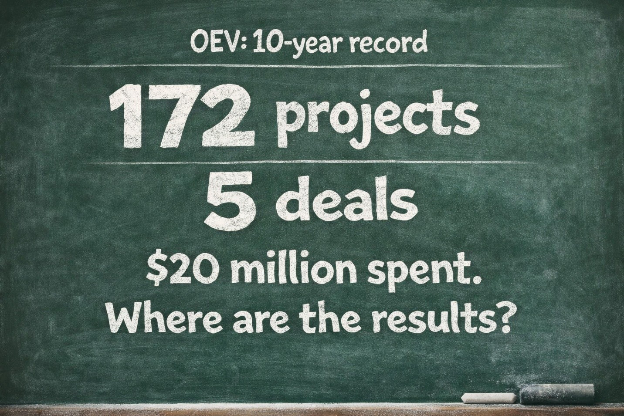
While taxpayers have funded OEV to the tune of $20 million over the last 10 years, the list of wins provided to Red Tape Florida after a public records request was alarmingly short.
First, a word about timing – Red Tape Florida made its public records request to OEV more than two weeks before Thanksgiving. The response came the Thursday before Palm Sunday. That’s a full college football season and it’s not acceptable. Transparency is one easy place for city and county commissioners to demand better performance from OEV.
But there are more.
The results
First, the headline: Since it was born 10 years ago, OEV has recruited precisely one new industry to Leon County: Amazon.
Even that single out-of-market win comes with some hard truth. Red Tape Florida talked to four people intimately familiar with the Amazon deal and all said essentially same thing: Amazon was coming here whether OEV did anything or not.
Amazon had already picked out to which market it wanted to come, the land (owned by Devoe Moore) and other particulars. OEV helped move things along, but this was less “recruitment” and more “facilitation.”
Now, let’s look at the rest of its activity.
Code name: Underachievement
According to OEV’s own data, since 2016, 172 projects have been assigned “code names,” like “Project Santa,” “Project Kong” and “Project Heavy Metal.” This indicates an opportunity is real and being pursued.
Of those 172, a total of 5 turned into deals. That’s 1 every 2 years.
Of the 5 deals, 4 were for existing businesses that were either expanding or relocating. Let’s break those down.
Proof Brewing (2018)
You might recall that Proof wanted to move from the All Saints District to the old Coca Cola Building on South Monroe – about seven tenths of a mile. It obtained the Coca Cola building in a land swap with J.T. Burnette (yes, that J.T. Burnette) and then received from OEV a 70 percent reimbursement for development fees and an additional 70 percent reimbursement of the city property tax paid on the land, improvements and tangible personal property for seven years, according to the Democrat story.
In addition, the county agreed to provide reimbursement of the property taxes equal to the amount reimbursed by the city for the Target Business Program, estimated at $97,400, according to OEV.
Danfoss expansions
Telling the recent story of Tallahassee economic development without Danfoss Turbocorp is like an episode of Seinfeld without Kramer. Danfoss is the only major addition in the 30 or so years of the National Mag Lab’s existence at FSU, and two of the 5 OEV deals are expansions of Danfoss.
There is no way to couch Danfoss’ arrival and expansion as anything other than a positive for our community.
Danfoss Executive Advisor and former CEO and President of Danfoss Turbocor Ricardo Schneider says the Tallahassee facility is nearing 500 employees. He says the while OEV incentives are appreciated, it was proximity to the MagLab that drove Danfoss expansion.
“We are here because of the MagLab and the ecosystem around it,” Schneider said, in an interview with Red Tape Florida. Schneider added that state incentives are actually the most valuable to his company.
Expansions are great and the new jobs created are just as important as jobs that come from out of market. But when expansions are essentially all an economic development organization is creating, something is wrong.
No sunshine on Sunrise
The last is “Project Sunrise,” a $373,000 incentive program for … well, we can’t be sure. While the incentive was approved more than four years ago, OEV has never made public the actual recipient. It is widely believed, however, that the recipient was Golden Lighting, owned by Yuh-Mei Hutt, who chaired Domi Station, an economic incubator and OEV ecosystem partner.
The lack of public disclosure — for a taxpayer-funded incentive — is itself a problem.
Jobs numbers: Who’s on first?
OEV touts jobs that are promised as a part of its incentives, but what exactly is being guaranteed?
As one dives in, the math becomes muddled, to say the least.
Let’s start with Proof.
In its response to the Red Tape Florida public records request, OEV claimed that the “total economic impact” of the project would “total 102 jobs.”
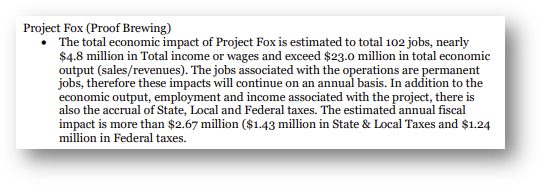
But in a 2018 quarterly report to the combined city and county commissioner board (the IA board), the story was different.
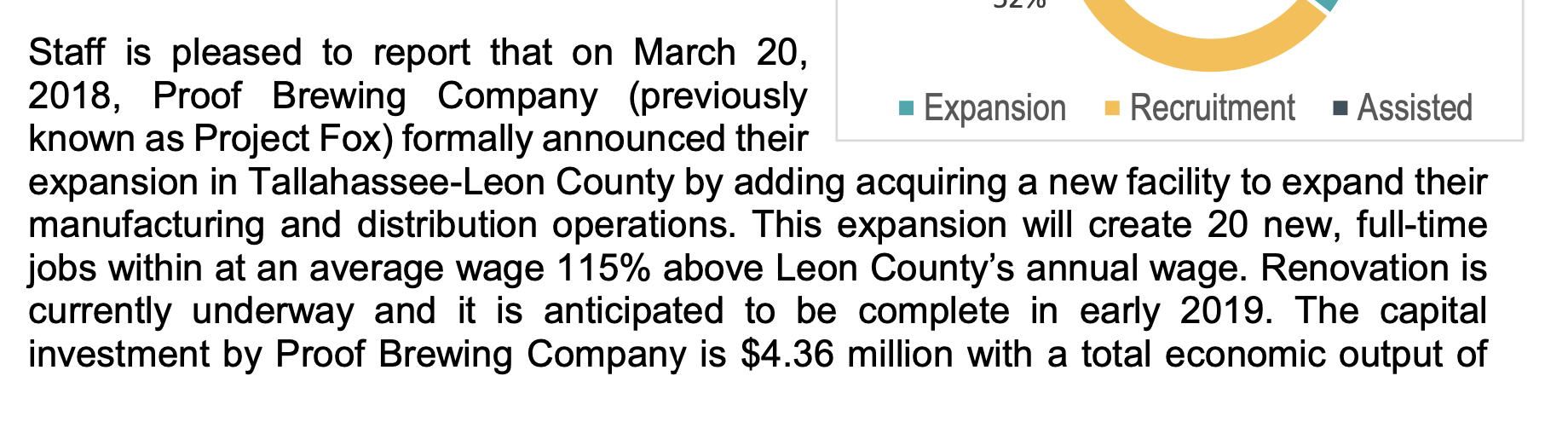
So, was it 20 jobs or 102 jobs?
Or maybe it was 50 jobs? Here is a February 2024 OEV summary of projects in a Blueprint agenda:
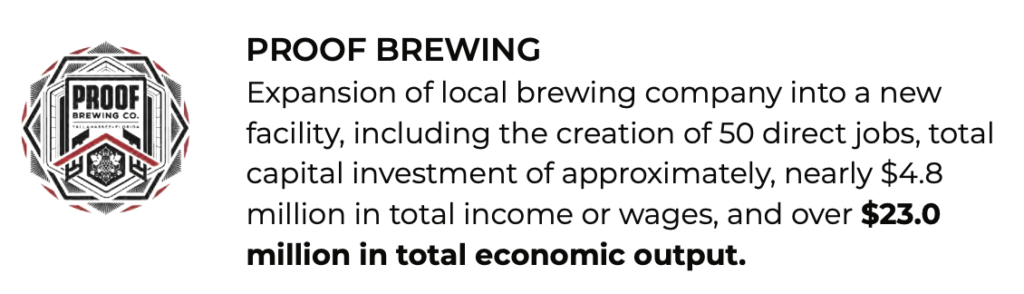
A possible explanation is that Proof added 20 actual jobs, then OEV was attempting to estimate additional jobs created as a part related businesses (“direct jobs” or “total economic impact … jobs”). Even that explanation, however, comes with an unexplained range of jobs — 50 to 100. And remember, the public records request calls these jobs “permanent,” so they can’t just be chalked up to construction jobs as a part of the relocation.
The next question is: where are these additional jobs and who measures them? It’s one thing if Boeing relocates a production facility to a market. One can then expect engine makers, airplane painters and others to follow.
But a relocation of a brewery by seven tenths of a mile?
Has there been some sort of influx of plastic cup makers, barley farmers or coozie manufacturers to Tallahassee – with a bunch of new jobs — that Red Tape Florida has missed?
Meanwhile, the Project Sunrise job numbers are equally confusing. In the same 2022 report that mentioned Proof, OEV claims that the Sunrise incentives kept 49 jobs from leaving, added 10 new jobs (that’s a 59) but then somehow came up with 73 “direct” jobs.
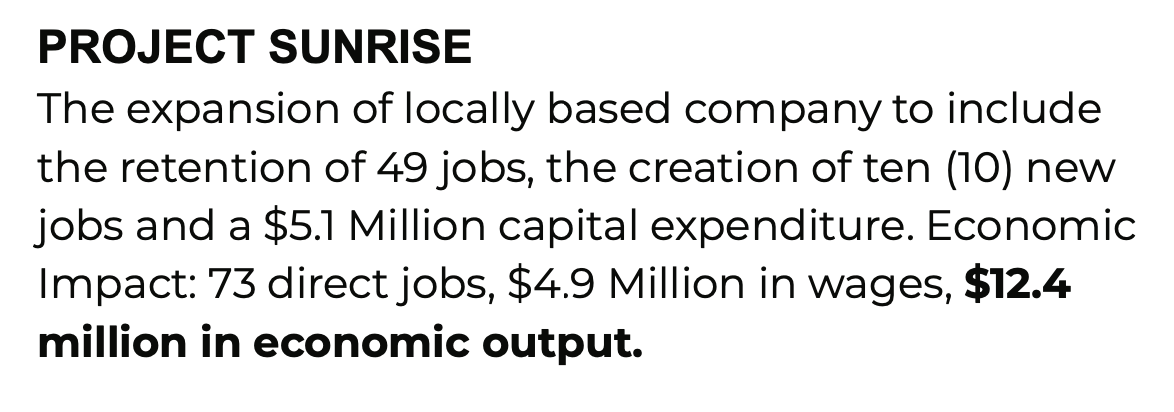
But in the public records request recently fulfilled by OEV, the numbers are completely different.
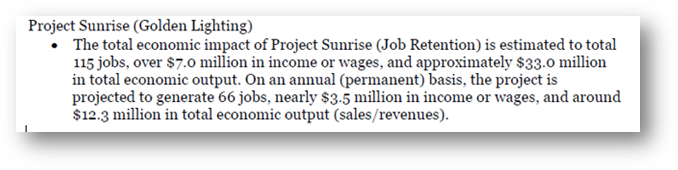
So, 115 jobs? 66 permanent? What’s right?
Red Tape Florida emailed Hutt and Proof owner Bryan Burroughs but neither responded.
Finally, Danfoss
There is no company that engenders more community pride than Danfoss Turbocor. Outgoing CEO Ricardo Schneider has become a Tallahassee icon, deeply invested in Tallahassee’s success, even though he is a relatively recent transplant.
Schneider said that while he definitely knows of national suppliers whose Tallahassee-area operations have benefitted from Danfoss’ expansion, he does not know how many. He added that no one from OEV has ever gotten his input on jobs created in the market outside of those hired by Danfoss directly.
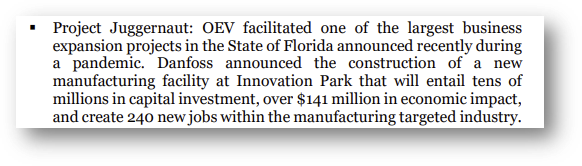
In its recently fulfilled public records request, this is how OEV characterized Danfoss jobs as a part of its second expansion:
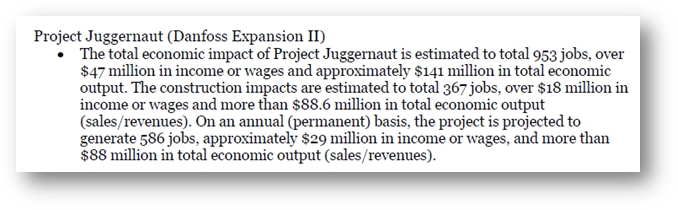
The 2022 quarterly report had completely different numbers:
Trust, but verify
Here’s the real problem, though. Red Tape Florida spent a considerable amount of time and effort trying to find any sort of after-the-fact validation of all these job projections. We scoured OEV reporting, minutes, agendas and supporting documents.
None could be found.
OEV has been very effective at publicizing projections for major projects like Danfoss, Sunrise, Proof, and Amazon. What is much harder to identify in public records is a consistent, project-by-project accounting of whether those projections were met — or independently verified after the fact.
For an organization funded by taxpayers and tasked with delivering measurable economic outcomes, this lack of publicly accessible verification is not a minor oversight — it is a fundamental accountability gap
Here is yet another place for city and county commissioners to demand better performance.
Conclusion
The fulfilled OEV public records request to Red Tape Florida is a double whammy: It reveals anemic performance and contradictory data.
It is part of a mounting case that the structure of OEV is hopelessly broken and chronically ineffective.
It also helps explain Tallahassee’s poor standing in key metrics – job and population growth.
According to OEV’s own data, Tallahassee’s population grew just 1 percent from 2020 to 2025, next to last among the metro areas measured.
And Red Tape Florida has already reported on Leon County’s loss of jobs from 2022 to 2025.
In Florida, this is stagnation. And it raises a basic question: if OEV’s incentives and projects are delivering the kind of economic results being promoted, why isn’t that showing up in the most visible measure of all — whether more people are choosing to live here?
An even more important question: When are local elected leaders, candidates, the business community and citizens at large going to start publicly demanding a discussion about a major change in how our community handles economic development?
April 10, 2026Skip Foster, Red Tape Florida
Sidewalk of Doom, meet the Sidewalk to Nowhere
Just a couple of hundred yards north of Midtown Reader — where a recent Red Tape Florida series told the story of a sad plot of grass which serves as a burial ground to common sense — you’ll find a different monument to bureaucratic ineptitude. […]
April 8, 2026Skip Foster, Red Tape Florida
Sidewalk of Doom, meet the Sidewalk to Nowhere
By Skip Foster, Red Tape Florida
Just a couple of hundred yards north of Midtown Reader — where a recent Red Tape Florida series told the story of a sad plot of grass which serves as a burial ground to common sense — you’ll find a different monument to bureaucratic ineptitude.
It’s the Sidewalk to Nowhere.
Tallahassee readers have probably seen it many times, but never really noticed it.
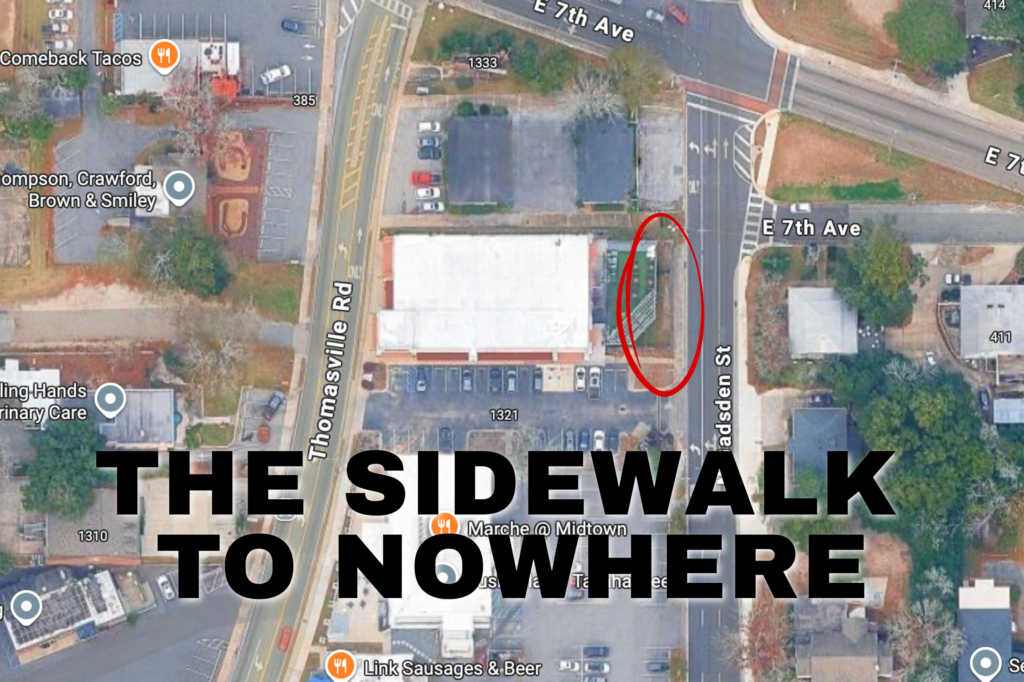
It’s near the southwest corner of Gadsden Street and 7th Avenue, adjacent to the building that holds Brass Tap and Orange Theory.
The sidewalk is incredibly short … just 50 feet. It’s the kind of feature that just becomes a part of a driver’s peripheral vision.
And yet, as you are about to find out, it’s another one of the hidden monuments in Tallahassee. Markers to incompetence, business-unfriendliness and, of course, red tape.
A sidewalk on the wild side
Here is a link to the exact stretch of sidewalk we are talking about.
You’ll notice a few things:
1) Other than this 50-foot stretch, there is no sidewalk anywhere in the vicinity on the west side of Gadsden. If you head south, you’ll see this sidewalk-free zone continues all the way to Johnson Street – about a half mile away.
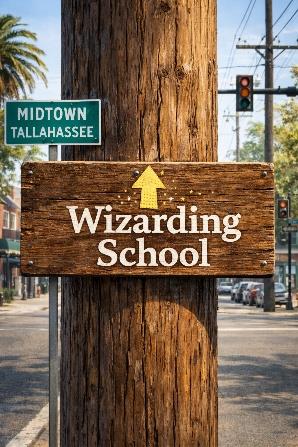
2) To the north, the sidewalk dead ends into a power pole (a little hard to see since the satellite is shooting straight down on it, but if you drive by, you’ll see). If Harry Potter had a Tallahassee portal to Hogwarts, this might be it.
3) There is no crossing lane or any other reason for this sidewalk to be here.
So, why is it here?
Because 10 years ago, the City’s director of public works told Roger Osborne, the landowner, that it had to be included or he couldn’t build on his land.
The lot in question
Roger Osborne’s adult life started Tallahassee in the 1970s and he returned here a couple decades later and has never left. He is a C.P.A. by trade, who got his Master’s in accounting from Georgia State after getting his M.B.A from FSU in the 1970s.
Most recently he has worked in commercial real estate, perhaps most significantly as the developer of the VA outpatient clinic in Tallahassee.
Around 2003, he and partners wanted to build townhomes on the property in Midtown, but that fell through and the partnership dissolved leaving him the sole owner. About 10 years later, he decided it was time to develop the lot, but shifted to a retail plan.
He went through the always-arduous permitting process and was on the verge of getting his development permit issued when the City public works director intervened. “I want a sidewalk on Gadsden Street,” the official demanded.
Initially, Osborne reminded the City that they had proposed a “fee in lieu of” for the sidewalk. That essentially meant Osborne would pay a fee since a sidewalk wasn’t required. It was an offer which Osborne accepted.
But, even though all the engineering plans were complete, the then-director of public works insisted that a sidewalk be added. He argued that the City was moving toward a more walkable planning model and, even if this was the only small stretch of sidewalk in the area, there could be more connected to it … “some day.”
The City director made it clear – the project wouldn’t start until Osborne agreed to build a sidewalk.
In other words, the City withdrew its offer at the last minute.
And, “some day” still hasn’t come.
Much more (expense) to the story
Unlike the Midtown Reader Sidewalk of Doom, the Sidewalk to Nowhere didn’t actually cost Osborne more to build than the fee he was going to pay anyway.
But that doesn’t mean it wasn’t expensive in other ways.
The expense in this matter was this: Building the sidewalk shifted the entire project – from Gadsden to Thomasville Road by — 10 feet.
Do you know what it costs to redesign and reengineer a project of this magnitude by 10 feet?
Osborne does. He calculates the shift cost him around $90,000 — in additional fees to engineers and architects to reposition the building and added interest. That also includes the added time – months and months when he could have been receiving lease revenue (and when tenants could have been hiring employees and growing their own businesses).
In the business world, time is money. In the bureaucracy, time is someone else’s problem.
An even uglier reality
Then, the most painful irony.
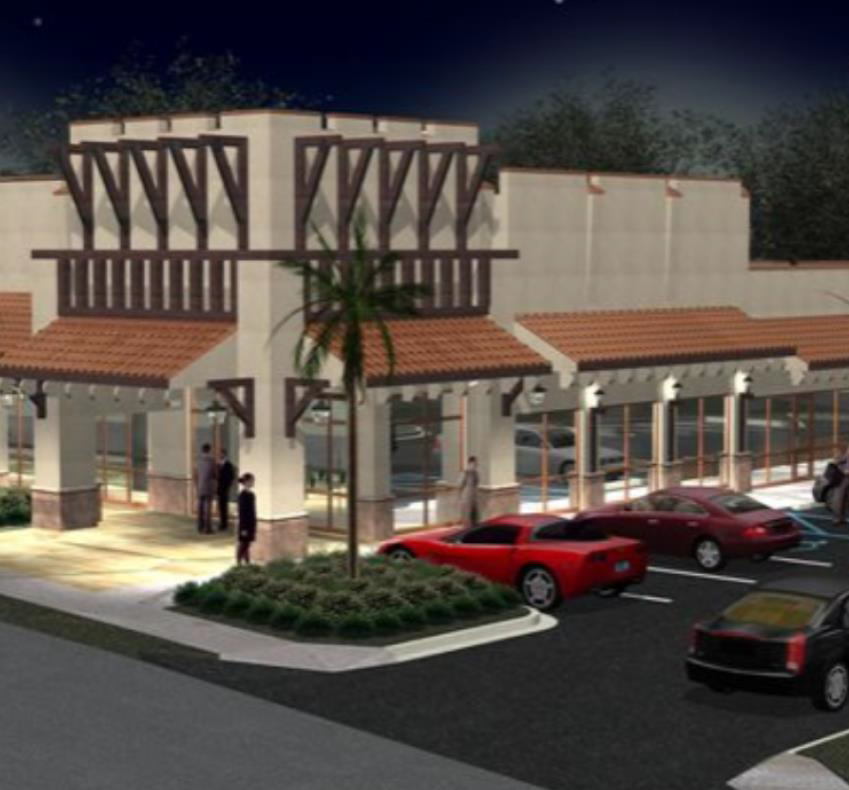
That 10 feet brought the building – and specifically, a beautiful design element of the edifice – too close to overhanging powerlines. Osborne had to scrap the artistic façade, and go with a much plainer design.
In other words, as it turned out, the “placemaking” mentality that led to a Sidewalk To Nowhere actually made the area less visually appealing than it would have been.
Of course, Osborne encountered the other usual array of City silliness. Because the lost feature had a somewhat Mediterranean feel to it, he wanted to plant expensive Italian Cypress trees to line the property.
The City said no – they aren’t on our approved tree list.
Later they came back and said he could pay $2,500 for a special variance.
Chew on that logic a second: You can pay us money for the right to pay more money to have something nicer on land … that you own.
Osborne was also required to do an archeological dig, for reasons never fully explained to him. The firm hired to do it was so embarrassed it was being required that they barely charged him anything.
Why is a 10-year-old story important?
Two reasons:
1) It shows that the culture of Tallahassee permitting dysfunction has been around a long, long time and will take a major effort to fix.
2) The same logic being used today to drive decision making – “placemaking,” pedestrian-friendly, sidewalks over parking – was being used 10 years ago.

Guess what? People are still choosing to, almost always, drive cars.
You may not like that, you may not want that. But it’s the reality of the world and pushing policies misaligned with how people actually travel ultimately costs money for businesses and that ultimately costs jobs.
And Red Tape Florida readers are well aware that this isn’t a community that can afford to lose jobs.
After all, more economic stagnation in this market and we will be a Community to Nowhere.
April 8, 2026Skip Foster, Red Tape Florida
Midtown Reader’s nightmare proves Tallahassee’s permitting system is broken
Here are 7 solutions to the City’s 5 biggest bureaucratic problems
Opinion by Skip Foster, Red Tape Florida
Sally Bradshaw just wanted to add 700 square feet to her bookstore. And she was willing to pay $850,000 to buy the lot next door to make it happen.
But what the City of Tallahassee put her through is a story that should make every business owner in this city angry — and every elected official ashamed.
This is what Red Tape Florida was created to cover.
The Midtown Reader expansion debacle is not just a series about one business. It is a case study in how Tallahassee’s development process actually operates — and why so many in the private sector quietly say it doesn’t.
Over the course of this series, we have documented the facts.
- A modest 700-square-foot expansion required more than a year to complete.
- It triggered 997 documented emails between the architect, engineers and city staff.
- It required about $90,000 in professional and permitting fees.
- It involved unwritten rules — including a critical exemption threshold that was not documented anywhere but materially affected the outcome of the project.
- It included requests for public-facing uses on private property — from food trucks to minute garden details like a “water feature” — that were not clearly grounded in written code or allowed under property rights theory.
- And it culminated in a requirement that a single 150-foot stretch of sidewalk be doubled in width — at a cost exceeding $150,000 — while the remaining 97 percent of the corridor remained unchanged.
These are not opinions. They are facts.
And when you step back from them, a pattern emerges. This is not a system optimized for outcomes. It is optimized for process and the whims of bureaucrats.
A system where compliance is expensive, time-consuming and uncertain. A system where critical rules are not always written down.
A system cloaked in secrecy, where communication often intentionally shifts off the record. And a system where the burden of navigating it all falls squarely on the private citizen.
The result: A small businesswoman paid $850,000 for property adjacent to her business to add on a modest 700 square feet to her bookstore.
And now, she can’t use the lot for anything else.
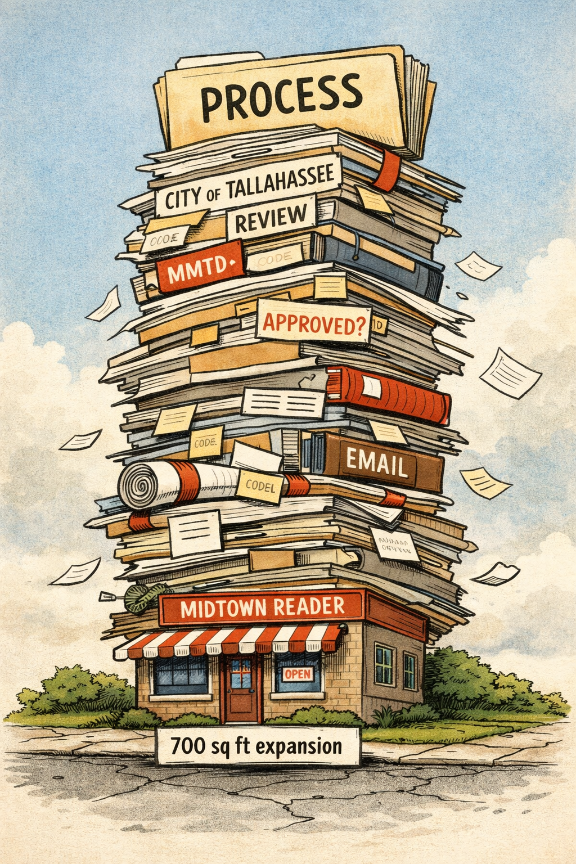
Five Huge Problems
If we take a step back, the permitting debacle experienced by Midtown Reader illuminates five major problems with Tallahassee’s approach to development:
- The building regulations are antiquated and wildly misaligned with reality. Much of Tallahassee’s regulatory framework is derived from planning principles established in the 1980s, a time when urban planners thought we all should live like European townspeople, riding our bicycles around the quaint plaza with fresh baguettes spilling out of our baskets. It’s why we see this absurd tilt toward wide sidewalks and expensive bike lockers when most of Tallahassee relies on cars for transportation.
- The permitting process itself is broken. The messages and mandates a builder receives are often conflicting between departments and individual inspectors, and one bureaucrat may demand a change after construction that directly conflicts with an earlier mandate from another bureaucrat. It’s a Kafkaesque nightmare of miscommunication and ineptitude, and one that hugely increases the cost of housing and stifles business growth.
- The culture within Tallahassee’s bureaucracy is toxic. Contractors will tell you that no local government bureaucracy – literally none— is more hostile than Tallahassee’s to development or more capricious in its demands. There is no sense of urgency, no urge to help, no nod toward private property rights, and no contrition when the goal posts constantly shift. The focus on meaningless detail is ridiculous; planners imposing their personal tastes rather than applying rational regulation.
- There is little private sector pushback. The Tallahassee Chamber is notable for its silence and reluctance to engage, and builders, architects, and engineers in the City are intimidated by the threat of quiet retribution from city staff. It is a conspiracy of silence that predictably results in a bureaucracy run amok with no real scrutiny or accountability.
- There is no leadership at the top of the city government addressing the problem. The never-ending food fight between our 3-2 vote split seems to consume all the available attention, and the very practical problem of running the permitting arm of city government seems to fall by default to the people in the cubicles. This last decade was an opportunity for Mayor John Dailey and City Manager Reese Goad to make meaningful progress in this area. Instead, they paid to win some awards.
But, there is hope. Here are seven solutions to all of these problems if leaders emerge who are interested in growing jobs and helping small businesses:
First, modernize the code
Tallahassee needs a full, line-by-line audit of its land development code, with one simple test: does this reflect how people actually live, build and move in this city today?
If the answer is no, it goes.
Sidewalk standards, bike infrastructure requirements, aesthetic mandates — all of them should be evaluated against actual usage and cost impact. If 95 percent of residents are driving, then forcing expensive pedestrian-oriented infrastructure onto every small project is not planning — it’sfantasy.
This is not a tweak. It is a reset.
And it should be led by the private sector as much as planners, not the other way around.
Second, create a true “single point of accountability” for permitting
Right now, applicants are navigating a maze of departments, each with the power to delay, contradict, or reinterpret.
That has to end.
Every project should have one designated project manager inside city government with actual authority — not just coordination responsibility — to resolve conflicts, enforce timelines, and provide binding answers.
If two departments disagree, the applicant should not be the one stuck in the middle.
The city should be.
Third, require everything to be written down — and enforce it
No more unwritten rules. No more “this is how we usually do it.” No more verbal only communications to avoid a public record trail of accountability.
If a requirement affects cost, design, or approval, it must exist in the written code or in a formally adopted policy.
If it’s not written down, it cannot be enforced. Period.
And if staff applies a requirement that is not in code, there should be a clear, fast appeal process with real consequences. Sunlight alone would eliminate half the problems described in this series.
Fourth, measure the system like a business — and publish the results
Right now, no one is being held accountable for outcomes. That’s fixable.
The city should publicly track:
- Average permitting time by project type
- Number of review cycles per project
- Number of post-approval changes required
- Total fees and compliance costs for representative projects
- How much time deviations are adding to projects.
On the last bullet, we learned from Midtown Reader that a fast permit doesn’t always mean anything – there are other ways a bureaucracy can throw sand into the gears.
All of those metrics should be published quarterly.
If it takes 12 months to approve a 700-square-foot expansion, that should not be anecdotal. It should be visible — and unacceptable. What gets measured gets fixed.
Fifth, create safe, structured private-sector feedback — and actually listen
Right now, contractors, architects, and business owners stay quiet for a reason. They fear retribution.
That has to change.
The city should establish a formal, anonymized feedback system for applicants and industry professionals, paired with quarterly roundtables where concerns can be raised without fear of retaliation.
Sixth, leadership needs to own this publicly
This is not a staff-level issue. It is a leadership failure.
The Mayor, City Manager, and Commission should set clear, public goals for permitting reform:
- Reduce approval times by a certain percent
- Eliminate conflicting directives
- Codify all requirements
And then report progress — or lack thereof — to the public.
If this is not a priority at the top, it will not change at the bottom.
Seventh, the Chamber needs to get in the game
As the business community’s leading advocate, the Chamber needs to ramp up accountability and find the right people to work on this issue. “Behind the scenes” efforts have not produced results. It’s time for strong, visible leadership. Political support should come with the expectation of progress on this (and other) issues. This will almost certainly require different Chamber voices being heard.
The bottom line
Is it so unreasonable to expect a local government, when approached about a small business expansion like Midtown Reader, to say: “Great! How can we help?”
Instead, the City creates some sort of American Ninja obstacle course.
Make no mistake, the Midtown Reader story isn’t about the system failing, it’s about the system operating exactly as it is designed – making it as hard as possible for a business to succeed.
It’s unacceptable and Red Tape Florida won’t stop until it’s fixed.
April 1, 2026Skip Foster, Red Tape Florida
The Amazing Adventures of Midtown Reader and the Sidewalk of Doom: Full series
This is a three-part story about a bookstore, a city, and a process that few people ever see until they are in it. It includes hundreds of emails, unwritten rules, unexpected requirements, and a $150,000 sidewalk that raises larger questions about how decisions get made.[…]
March 31, 2026Special Report by Skip Foster, Red Tape Florida
The Amazing Adventures of Midtown Reader and the Sidewalk of Doom: Full series
Special Report by Skip Foster, Red Tape Florida
This is a three-part story about a bookstore, a city, and a process that few people ever see until they are in it. It includes hundreds of emails, unwritten rules, unexpected requirements, and a $150,000 sidewalk that raises larger questions about how decisions get made.
PART ONE
This is a story about 997 emails, a $150,000 sidewalk, an 8-eye-bolt bike rack and a parking lot that never got built.
The story includes specific instructions on a pollinator “water feature,” an order to build bookshelves into windows and a very, very expensive patch of grass.
But ultimately, it’s a story about what happens when a city government mistakes a beloved small business for a regulatory obstacle course.
This is The Amazing Adventure of Midtown Reader (and the Sidewalk of Doom).
· · ·
The City of Tallahassee almost broke Sally Bradshaw. Almost.
The founder and owner of Tallahassee bookstore Midtown Reader has turned it into a beloved Tallahassee institution.
But as the store bustled, it also busted at the seams. She needed additional inventory space and parking — the latter a chronic issue for Midtown merchants.
So, after Don Quarello decided to close the adjacent Waterworks after a long and iconic run and after no successor emerged to run the bar, she purchased the property
By August of 2024, Waterworks had been demolished and Sally was ready to go.
Then, the real adventure began. It was time to deal with the City of Tallahassee.
It took more than a year before the small expansion opened.
And the cost? Well, read on …
The city had some ideas
There were two main phases to the attempt to get the renovation complete.
As it turned out, the building permit was the easy part. It was the process of getting approval for what are called “deviations” that turned a modest 700-foot expansion into a novel more at home in the sci fi section of the bookstore than home improvement.
A deviation is a formal city approval allowing a property owner to deviate from a specific development standard — a waiver, essentially, from what the code requires.
There are plenty of rules in the City’s voluminous book of codes. But it was the ones NOT listed that city officials started dropping on Midtown Reader. At one point, city officials suggested the bookstore set aside space on its private property for food trucks.

Food trucks. For a bookstore.
Now, a pause.
One thing Red Tape Florida has discovered in its first year is that local government planning departments are all quite familiar with the state’s public records laws. It’s for that reason that most “suggestions” are delivered, you guessed it, verbally.
While email traffic can still be voluminous (more on that later) there are other things local government officials wouldn’t be caught dead putting in a public record.
Red Tape Florida has found that builders and contractors will often send an email with a question, but the reply will come by phone. Emails asking to confirm what was discussed go unanswered.
With that backdrop, let’s return to Midtown Reader.
The biggest city demand wasn’t about food trucks. It was about a sidewalk.
Remember the left turn lane controversy?
To understand this story, one has to remember what was happening in the news in Tallahassee. In early 2025, as the Midtown Reader project was gaining steam, opposition began to form over proposed changes to Thomasville Road in Midtown.
A Blueprint 2000 “placemaking” project would result in the road becoming one way for at least 2 years while the left turn lane was eliminated and utilities were upgraded. Among many Midtown merchants, Sally Bradshaw spoke publicly against the plan and its devastating impact on her business.
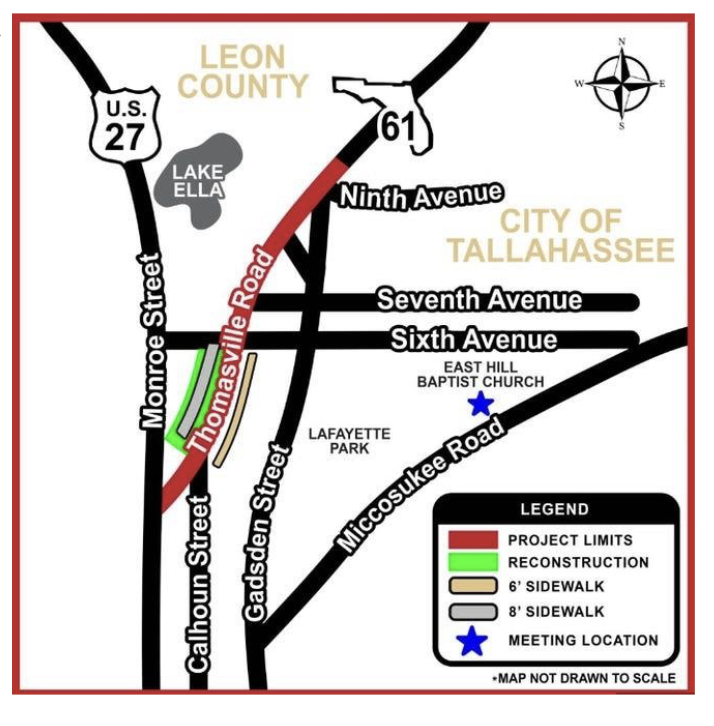
Oh, and one more change was a part of the Blueprint plan: The Thomasville Road sidewalks would be expanded from 5 feet wide to 6 feet wide on the east side of the street and 7 feet on the west side.
When sidewalks go sideways
In Midtown, about 3,000 feet of sidewalk line Thomasville Road on each side, from the intersection of 7th Avenue, south to Monroe Street. The 5-foot-wide stretch of sidewalk in front of Midtown Reader and the old Waterworks lot is only 150 feet long.
But for the City of Tallahassee to issue a building permit to Midtown Reader, it had some demands.
Namely this: Midtown Reader would be required to double the width of the sidewalks in front of its half block — from 5 feet to 10 feet wide.
AND it would be required to do all the accompanying utility work – gas and electric.
The result would be a 150-foot stretch of 10-foot-wide sidewalk, while the other 97 percent of the sidewalk on either side of Thomasville Road in Midtown remained 5 feet wide.
Oh, you might be thinking … how much does that cost?
The initial estimate obtained by Bradshaw was a whopping $150,000-plus and included grading, earthwork, curbing, demolition and much more. And that was before any utility work.
But things get even stranger.
You might be asking, where did 10 feet come from?
Good question. The ill-fated Midtown Placemaking project — eventually scuttled by FDOT after concerns about the devastating impact on affected businesses — only called for sidewalks to be widened to 6 feet on the east side of Thomasville Road (the Midtown Reader side) and 8 feet on the west side.
Why was 6 feet good enough for Blueprint, FDOT and the City of Tallahassee but now 10 feet was the new rule for Midtown Reader?
Bradshaw never got a clear answer to that question.
For Sally, the sidewalk demand was a non-starter given the cost, and the fact that walking traffic in midtown is extremely low — most customers come from other areas of the city, they drive, they need parking.
But the City had a counteroffer.
The sidewalk was the final indignity. But it wasn’t the first.
PART TWO
· · ·
When we left our story in Part 1, it was late 2024 and the City of Tallahassee had just dropped a $150,000-plus sidewalk demand on a bookstore owner who just wanted to add 700 square feet. But that wasn’t where the adventure began. To understand the Sidewalk of Doom, we need to go back to the beginning.
· · ·
Before the Sidewalk of Doom, there was the deviations gauntlet.
A deviation, as noted in Part 1, is a formal city approval allowing a property owner to depart from a specific development standard. Think of it as asking permission to not follow a rule.
What Sally Bradshaw discovered is that some of the most consequential rules aren’t written down anywhere.
The accidental discovery
When Bradshaw first planned the expansion, she envisioned developing the full Waterworks lot. That meant full compliance with something called the MMTD — a layer of design requirements that governs everything from sidewalk widths to window placement to where you can put your parking.
Full MMTD compliance is expensive, time-consuming and, as it turns out, sometimes unnecessary.
It turns out City Hall has a secret menu. You just have to know to ask.
Here’s how Bradshaw found out.
The project’s civil engineer was simultaneously working on a small addition for a church on Pasco Street. The engineer had done everything right: she went through the full MMTD compliance process, dotting every “i.”Then, after all that work, the City informed her that a project adding less than 33 percent of new building area to an existing structure didn’t have to comply with the strict MMTD standards.
Nobody had written this policy down. It lived, apparently, in the institutional memory of city planning staff. It is not known how many times it has been applied to those who discovered it – or not applied to those who were unaware.
The engineer on the church job applied that hard-won knowledge to Midtown Reader. She made sure their plans kept the new addition under the 33 percent threshold — ending up at 29.88 percent — and suddenly a significant portion of the regulatory burden evaporated.
The unwritten rule had saved Bradshaw. But the fact that it was unwritten had nearly cost her the entire project.
Food trucks, gardens and eye bolts
Even with the 33 percent workaround, the deviations process ground on.
City planning officials informed Bradshaw she needed to provide what staff called an “active use” area — a minimum 1,200-square-foot paved space, open to the public, on her private property. Part 1 referred to a food truck, which was a non-starter.
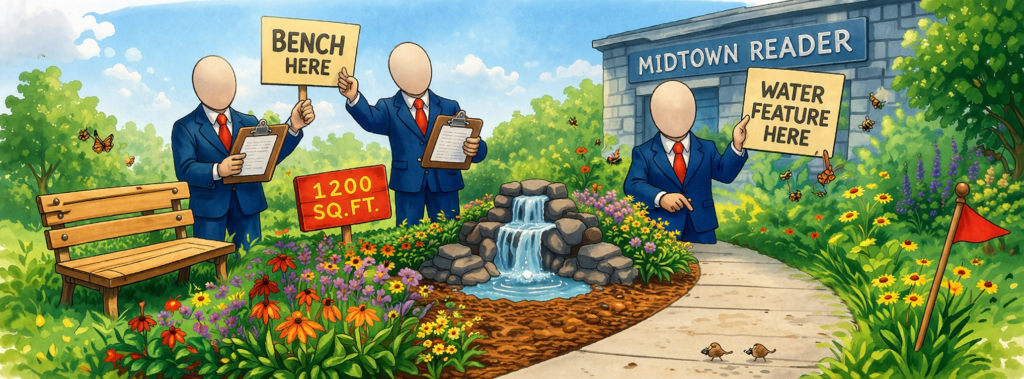
Bradshaw proposed a pollinator garden instead. The City agreed — then proceeded to weigh in on the exact configuration of the sidewalks running through it, the precise design of the garden itself, the requirement of a water feature, and the mandatory placement of a bench. All of it open to public access, on private property.
It was, as one participant in the process later described it, the “least-worst” solution.
Then there was the bike rack.
All properties within the MMTD overlay are required to provide secure bicycle parking. The City’s preferred solution has historically been large, box-style bike lockers. Bradshaw pushed back because the large bike area was inconsistent with the building’s design and was far too large for a modest expansion. After negotiation, the requirement was whittled down to its code minimum: a covered structure with hardware sufficient to lock a bicycle.
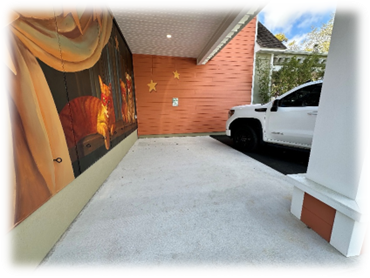
The final result was a shed roof and 8 eye bolts for bike spaces.
Of note, since the grand opening, the bike rack has held either one or zero bikes every time Sally has seen it. And she recently discovered that the one bike that has been using the rack is from someone who walks across the street to do work at another business.
The window that wasn’t
City planning staff informed Bradshaw she was required to install an 8-by-8-foot window on the west wall of the addition for what the MMTD calls transparency — the idea that buildings should have visible, active frontages.
The problem: it’s a bookstore. The west wall needed to hold bookshelves.
Bradshaw’s team argued the point. The City rejected the reasoning. So, the architect did the math — calculating all existing glazing on the building and determining, by what one participant described as “the smallest ofmargins,” that the existing windows already met the MMTD transparency standard.
The 8-by-8 window requirement disappeared. But not after weeks of back and forth.
The cost of time … and email.
Consider what it took just to communicate with the City.

The project’s architect logged 997 emails on the Midtown Reader project alone — to the owner, the engineers, and a cast of city staff spanning multiple departments. Many of those emails required hours of research.
And this for a modest 700-square-foot bookstore expansion.
Bradshaw was fortunate enough to know how to persevere in a war of attrition.
But most small businesspeople never find out the unwritten rules and pay even more.
Or just give up.
PART THREE
· · ·
When we last saw Sally Bradshaw, she had survived months of deviations, secret menus of unwritten City rules and a mandatory bench in a pollinator garden. But the City still had one more move to make. The $150,000 Sidewalk of Doom was waiting. And so was a deal nobody could believe.
· · ·
Independent bookstores aren’t exactly cash cows. Online giants cast a long shadow. The war is won with relationships and by creating an experience. Oh, and also by forming deep personal connections to community.
Midtown Reader’s “Let’s Read” program is a great example. While owner Sally is trying to turn a profit (while not even taking a salary for herself), she’s also seeking grants and pleading for contributions to hold book fairs in Leon County Title I schools, so that all children can experience the thrill of “shopping” for a shiny, colorful, brand-new book.

So far, Midtown Reader and its customers have donated over 5,000 books that have been gobbled up by children hungry to read.
The City had already put Bradshaw through months of deviations, unwritten rules and negotiated compromises. Now, even after Sally told the City the $150,000-plus sidewalk cost was a non-starter, the bureaucracy was less than empathetic.
City officials questioned the sidewalk bid provided to Bradshaw, believing it to be inflated. But building a sidewalk is not just pouring concrete. The city was requiring that Bradshaw incur the cost of relocating electrical and gas utilities, adding substantial cost to the project. Bradshaw’s estimate was on paper and real.
Still, the City was clear: No sidewalk improvements, no building permit.
Sally considered abandoning the renovation and told the City there was no way she could spend that type of money, having purchased the Waterworks building for over $850,000 and then planning to spend over $400,000 on a building addition plus parking. And that doesn’t include any additional book inventory, the entire purpose of the expansion.
Have we got a deal for you!
Then, the City came up with another path forward: Kill your parking lot and we will drop the sidewalk requirement.
It was, of course, both patently ridiculous and an offer Sally couldn’t refuse.
Just to put it in proper perspective, the options presented by the city were:
OPTION 1
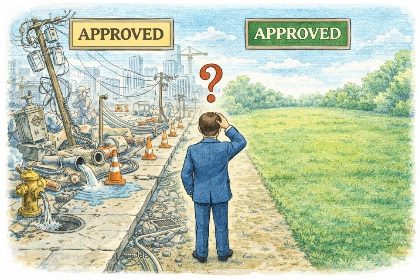
Add desperately needed parking (not just for Midtown Reader but other nearby businesses) but to earn that right, pay $150,000-plus for sidewalk and additional money for utility improvements – all to impact less than 3 percent of the total sidewalk on that stretch of Thomasville Road.
OPTION 2
Keep the sidewalk as is, but only be allowed to keep the same number of parking places as existed for Waterworks, prior to Bradshaw purchasing it.
Of course, the coup de grâce is that Waterworks went out of business, with a lack of parking a possible contributing factor.
So, Option 2 it was.
And what about the property that could have been used for parking? Well, we’ll save that for the end.
Meanwhile, let’s talk finances for a second.
When private property rights vanish
Bradshaw paid $850,000 for the Waterworks building and lot.
For that money, she gets a small expansion of Midtown Reader and … nothing else.
She can’t build on the rest of the lot.
She can’t add more parking than was already there.
She can’t do anything except … pay more property taxes!
That’s right sports fans, for some reason, Sally’s property taxes more than tripled, from $6,019 to $22,018. How could an empty, essentially unusable lot add $15,999 to a property tax bill? Nobody at the City has offered a satisfying answer.
So, let’s get out the adding machine.
The cost to ACTUALLY build the addition (new square footage added, shelves, paint, etc.) was $450,000.
Then there’s the architect and engineering fees.
Industry standards peg architectural and engineering fees for a renovation project at roughly 10 to 15 percent of construction costs. On a $450,000 project, that should be $45,000 to $67,500.
Midtown Reader’s architectural and engineering fees came to around $90,000.
The $400,000 in construction costs built the bookstore’s expansion. The additional $90,000 built nothing — no square footage, no jobs, no customers served. It was simply the price of permission..
Now, take a moment and think about all the other commercial and even residential projects that are ongoing at any one time in Tallahassee and then extrapolate that math.
And it’s not like Midtown Reader wasn’t willing to pay to improve the property — the mural on the Thomasville Road side of the building was paid for by Bradshaw, without requesting any local grant money to fund it.
What makes this even worse
As you think about this happening to hundreds of businesses across town, also consider this.
Sally knows how to get things done.
Think about all the small business owners who aren’t as well-connected. How could they possibly have prevailed against the might of the bureaucracy?
Then this: Midtown Reader added two employees, even with an expansion that lacks proper parking support and includes hundreds of thousands of dollars flowing to the government in regulatory fees and taxes. How many more jobs would our community have if the bureaucracy wasn’t so good at its job?
Finally, if Bradshaw hadn’t shipped that $90,000 to the bureaucracy, guess how many books it would have bought for Title 1 students?
18,000.
The final chapter
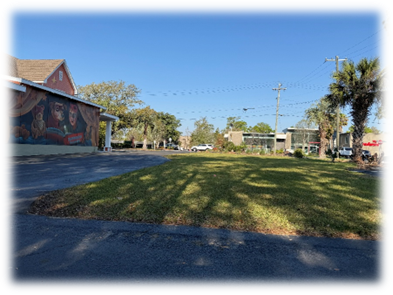
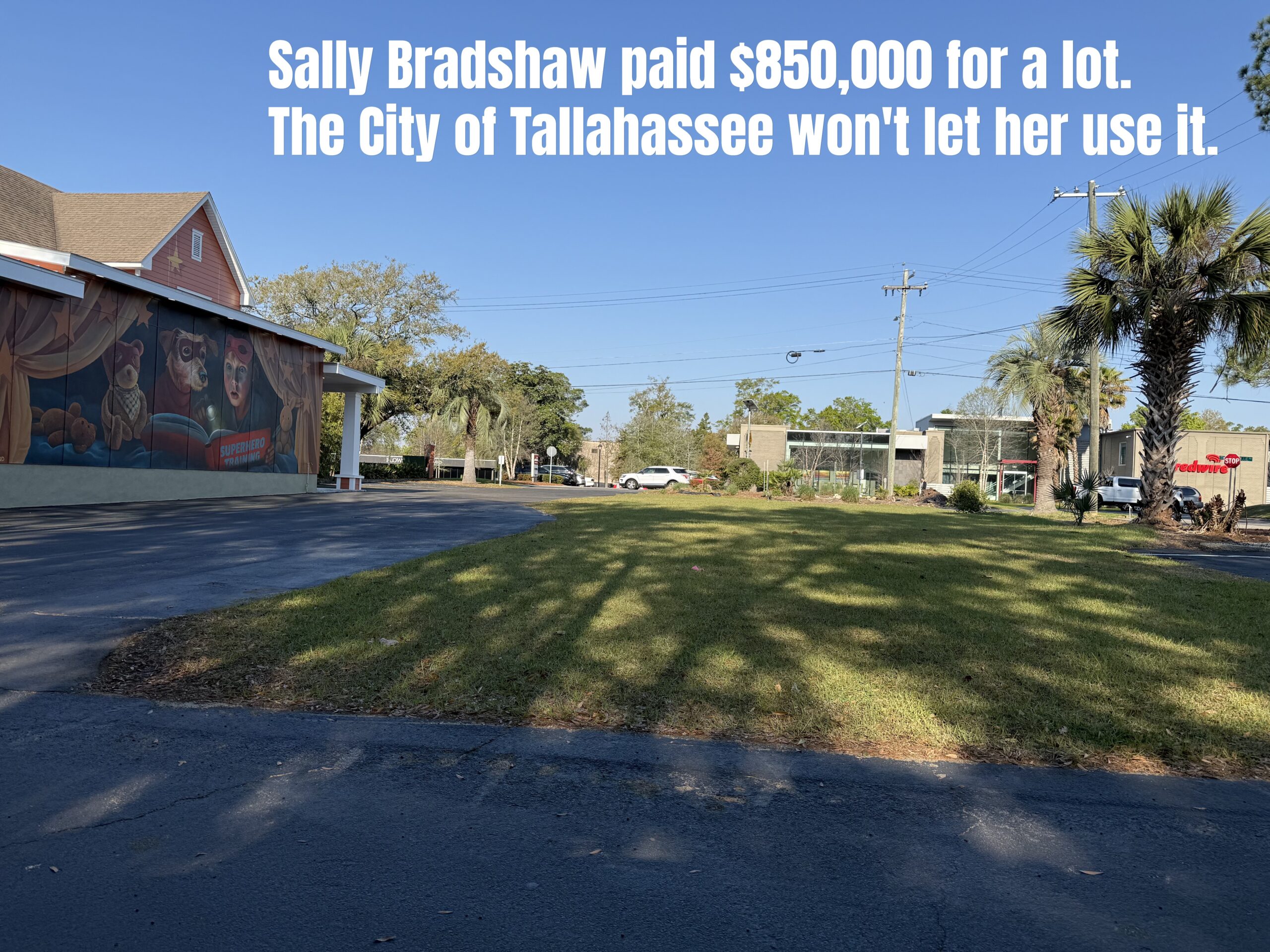
Illustrating this story, you see a picture of what has become of the vast majority of the old Waterworks lot. Instead of valuable parking that could have helped Midtown Reader grow and add even more jobs, it’s just a simple grass plot.
It’s there because that’s the way the City of Tallahassee wanted it.
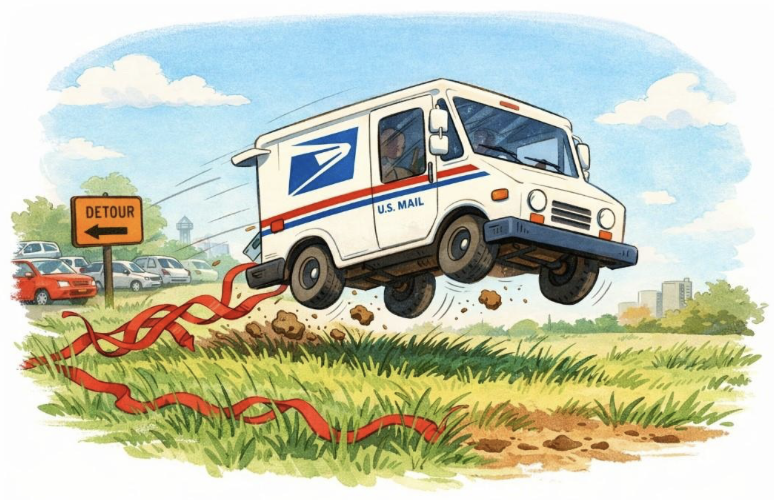
Sometimes people park on the grass anyway – that won’t work when it rains. Recently a USPS truck, hemmed in by traffic seeking a parking spot, just cut across the grass to escape.
That lot has become a symbol – a patch of grass where the entrepreneurial spirit has been buried under a thick mat of red tape.
Yet, at the same time, it’s a monument to the perseverance of a small businesswoman, determined to expand her business to create jobs, bring more books to customers and eager school children, provide a third space where a diverse group of Tallahassee residents can read and who did all that while finding a way to do it all while surviving a bureaucracy that seemed hellbent on killing her dream.
The End.
March 31, 2026Special Report by Skip Foster, Red Tape Florida
City of Tallahassee: We will trade you Park Place for Free Parking
When we last saw Sally Bradshaw, she had survived months of deviations, secret menus of unwritten City rules and a mandatory bench in a pollinator garden. But the City still had one more move to make. The $150,000 Sidewalk of Doom was waiting. And so was a deal nobody could believe. […]
March 30, 2026Special Report by Skip Foster, Red Tape Florida
City of Tallahassee: We will trade you Park Place for Free Parking
PART 3 in a series
(Click here for Parts 1 and 2)
Special Report by Skip Foster, Red Tape Florida
· · ·
When we last saw Sally Bradshaw, she had survived months of deviations, secret menus of unwritten City rules and a mandatory bench in a pollinator garden. But the City still had one more move to make. The $150,000 Sidewalk of Doom was waiting. And so was a deal nobody could believe.
· · ·
Independent bookstores aren’t exactly cash cows. Online giants cast a long shadow. The war is won with relationships and by creating an experience. Oh, and also by forming deep personal connections to community.
Midtown Reader’s “Let’s Read” program is a great example. While owner Sally is trying to turn a profit (while not even taking a salary for herself), she’s also seeking grants and pleading for contributions to hold book fairs in Leon County Title I schools, so that all children can experience the thrill of “shopping” for a shiny, colorful, brand-new book.
So far, Midtown Reader and its customers have donated over 5,000 books that have been gobbled up by children hungry to read.
The City had already put Bradshaw through months of deviations, unwritten rules and negotiated compromises. Now, even after Sally told the City the $150,000-plus sidewalk cost was a non-starter, the bureaucracy was less than empathetic.
City officials questioned the sidewalk bid provided to Bradshaw, believing it to be inflated. But building a sidewalk is not just pouring concrete. The city was requiring that Bradshaw incur the cost of relocating electrical and gas utilities, adding substantial cost to the project. Bradshaw’s estimate was on paper and real.
Still, the City was clear: No sidewalk improvements, no building permit.
Sally considered abandoning the renovation and told the City there was no way she could spend that type of money, having purchased the Waterworks building for over $850,000 and then planning to spend over $400,000 on a building addition plus parking. And that doesn’t include any additional book inventory, the entire purpose of the expansion.
Have we got a deal for you!
Then, the City came up with another path forward: Kill your parking lot and we will drop the sidewalk requirement.
It was, of course, both patently ridiculous and an offer Sally couldn’t refuse.
Just to put it in proper perspective, the options presented by the city were:
OPTION 1
Add desperately needed parking (not just for Midtown Reader but other nearby businesses) but to earn that right, pay $150,000-plus for sidewalk and additional money for utility improvements – all to impact less than 3 percent of the total sidewalk on that stretch of Thomasville Road.
OPTION 2
Keep the sidewalk as is, but only be allowed to keep the same number of parking places as existed for Waterworks, prior to Bradshaw purchasing it.
Of course, the coup de grâce is that Waterworks went out of business, with a lack of parking a possible contributing factor.
So, Option 2 it was.
And what about the property that could have been used for parking? Well, we’ll save that for the end.
Meanwhile, let’s talk finances for a second.
When private property rights vanish
Bradshaw paid $850,000 for the Waterworks building and lot.
For that money, she gets a small expansion of Midtown Reader and … nothing else.
She can’t build on the rest of the lot.
She can’t add more parking than was already there.
She can’t do anything except … pay more property taxes!
That’s right sports fans, for some reason, Sally’s property taxes more than tripled, from $6,019 to $22,018. How could an empty, essentially unusable lot add $15,999 to a property tax bill? Nobody at the City has offered a satisfying answer.
So, let’s get out the adding machine.
The cost to ACTUALLY build the addition (new square footage added, shelves, paint, etc.) was $450,000.
Then there’s the architect and engineering fees.
Industry standards peg architectural and engineering fees for a renovation project at roughly 10 to 15 percent of construction costs. On a $450,000 project, that should be $45,000 to $67,500.
Midtown Reader’s architectural and engineering fees came to around $90,000.
The $400,000 in construction costs built the bookstore’s expansion. The additional $90,000 built nothing — no square footage, no jobs, no customers served. It was simply the price of permission..
Now, take a moment and think about all the other commercial and even residential projects that are ongoing at any one time in Tallahassee and then extrapolate that math.
And it’s not like Midtown Reader wasn’t willing to pay to improve the property — the mural on the Thomasville Road side of the building was paid for by Bradshaw, without requesting any local grant money to fund it.
What makes this even worse
As you think about this happening to hundreds of businesses across town, also consider this.
Sally knows how to get things done.
Think about all the small business owners who aren’t as well-connected. How could they possibly have prevailed against the might of the bureaucracy?
Then this: Midtown Reader added two employees, even with an expansion that lacks proper parking support and includes hundreds of thousands of dollars flowing to the government in regulatory fees and taxes. How many more jobs would our community have if the bureaucracy wasn’t so good at its job?
Finally, if Bradshaw hadn’t shipped that $90,000 to the bureaucracy, guess how many books it would have bought for Title 1 students?
18,000.
The final chapter
Illustrating this story, you see a picture of what has become of the vast majority of the old Waterworks lot. Instead of valuable parking that could have helped Midtown Reader grow and add even more jobs, it’s just a simple grass plot.
It’s there because that’s the way the City of Tallahassee wanted it.
Sometimes people park on the grass anyway – that won’t work when it rains. Recently a USPS truck, hemmed in by traffic seeking a parking spot, just cut across the grass to escape.
That lot has become a symbol – a patch of grass where the entrepreneurial spirit has been buried under a thick mat of red tape.
Yet, at the same time, it’s a monument to the perseverance of a small businesswoman, determined to expand her business to create jobs, bring more books to customers and eager school children, provide a third space where a diverse group of Tallahassee residents can read and who did all that while finding a way to do it all while surviving a bureaucracy that seemed hellbent on killing her dream.
The End.
Coming Next: Red Tape Florida’s Skip Foster opines on the Sidewalk of Doom
March 30, 2026Special Report by Skip Foster, Red Tape Florida
997 emails and a pollinator garden (with a mandatory water feature)
When we left our story in Part 1, it was late 2024 and the City of Tallahassee had just dropped a $150,000-plus sidewalk demand on a bookstore owner who just wanted to add 700 square feet. But that wasn’t where the adventure began. To understand the Sidewalk of Doom, we need to go back to the beginning. […]
March 27, 2026Special Report by Skip Foster, Red Tape Florida
997 emails and a pollinator garden (with a mandatory water feature)
Part 2 of a series (read Part 1 here)
Special Report by Skip Foster, Red Tape Florida
· · ·
When we left our story in Part 1, it was late 2024 and the City of Tallahassee had just dropped a $150,000-plus sidewalk demand on a bookstore owner who just wanted to add 700 square feet. But that wasn’t where the adventure began. To understand the Sidewalk of Doom, we need to go back to the beginning.
· · ·
Before the Sidewalk of Doom, there was the deviations gauntlet.
A deviation, as noted in Part 1, is a formal city approval allowing a property owner to depart from a specific development standard. Think of it as asking permission to not follow a rule.
What Sally Bradshaw discovered is that some of the most consequential rules aren’t written down anywhere.
The accidental discovery
When Bradshaw first planned the expansion, she envisioned developing the full Waterworks lot. That meant full compliance with something called the MMTD — a layer of design requirements that governs everything from sidewalk widths to window placement to where you can put your parking.
Full MMTD compliance is expensive, time-consuming and, as it turns out, sometimes unnecessary.
It turns out City Hall has a secret menu. You just have to know to ask.
Here’s how Bradshaw found out.
The project’s civil engineer was simultaneously working on a small addition for a church on Pasco Street. The engineer had done everything right: she went through the full MMTD compliance process, dotting every “i.”Then, after all that work, the City informed her that a project adding less than 33 percent of new building area to an existing structure didn’t have to comply with the strict MMTD standards.
Nobody had written this policy down. It lived, apparently, in the institutional memory of city planning staff. It is not known how many times it has been applied to those who discovered it – or not applied to those who were unaware.
The engineer on the church job applied that hard-won knowledge to Midtown Reader. She made sure their plans kept the new addition under the 33 percent threshold — ending up at 29.88 percent — and suddenly a significant portion of the regulatory burden evaporated.
The unwritten rule had saved Bradshaw. But the fact that it was unwritten had nearly cost her the entire project.
Food trucks, gardens and eye bolts
Even with the 33 percent workaround, the deviations process ground on.
City planning officials informed Bradshaw she needed to provide what staff called an “active use” area — a minimum 1,200-square-foot paved space, open to the public, on her private property. Part 1 referred to a food truck, which was a non-starter.
Bradshaw proposed a pollinator garden instead. The City agreed — then proceeded to weigh in on the exact configuration of the sidewalks running through it, the precise design of the garden itself, the requirement of a water feature, and the mandatory placement of a bench. All of it open to public access, on private property.
It was, as one participant in the process later described it, the “least-worst” solution.
Then there was the bike rack.
All properties within the MMTD overlay are required to provide secure bicycle parking. The City’s preferred solution has historically been large, box-style bike lockers. Bradshaw pushed back because the large bike area was inconsistent with the building’s design and was far too large for a modest expansion. After negotiation, the requirement was whittled down to its code minimum: a covered structure with hardware sufficient to lock a bicycle.
The final result was a shed roof and 8 eye bolts for bike spaces.
Of note, since the grand opening, the bike rack has held either one or zero bikes every time Sally has seen it. And she recently discovered that the one bike that has been using the rack is from someone who walks across the street to do work at another business.
The window that wasn’t
City planning staff informed Bradshaw she was required to install an 8-by-8-foot window on the west wall of the addition for what the MMTD calls transparency — the idea that buildings should have visible, active frontages.
The problem: it’s a bookstore. The west wall needed to hold bookshelves.
Bradshaw’s team argued the point. The City rejected the reasoning. So, the architect did the math — calculating all existing glazing on the building and determining, by what one participant described as “the smallest ofmargins,” that the existing windows already met the MMTD transparency standard.
The 8-by-8 window requirement disappeared. But not after weeks of back and forth.
The cost of time … and email.
Consider what it took just to communicate with the City.
The project’s architect logged 997 emails on the Midtown Reader project alone — to the owner, the engineers, and a cast of city staff spanning multiple departments. Many of those emails required hours of research.
And this for a modest 700-square-foot bookstore expansion.
Bradshaw was fortunate enough to know how to persevere in a war of attrition.
But most small businesspeople never find out the unwritten rules and pay even more.
Or just give up.
COMING NEXT: PART 3
What will the City accept in place of the Sidewalk of Doom? The city makes an offer Midtown Reader can’t believe … or refuse
March 27, 2026Special Report by Skip Foster, Red Tape Florida
How the City of Tallahassee threw the book at Midtown Reader
This is a story about 997 emails, a $150,000 sidewalk, an 8-eye-bolt bike rack and a parking lot that never got built.[…]
March 25, 2026Skip Foster, Red Tape Florida
How the City of Tallahassee threw the book at Midtown Reader
PART ONE
Special Report by Skip Foster, Red Tape Florida
This is a story about 997 emails, a $150,000 sidewalk, an 8-eye-bolt bike rack and a parking lot that never got built.
The story includes specific instructions on a pollinator “water feature,” an order to build bookshelves into windows and a very, very expensive patch of grass.
But ultimately, it’s a story about what happens when a city government mistakes a beloved small business for a regulatory obstacle course.
This is The Amazing Adventure of Midtown Reader (and the Sidewalk of Doom).
· · ·
The City of Tallahassee almost broke Sally Bradshaw. Almost.
The founder and owner of Tallahassee bookstore Midtown Reader has turned it into a beloved Tallahassee institution.
But as the store bustled, it also busted at the seams. She needed additional inventory space and parking — the latter a chronic issue for Midtown merchants.
So, after Don Quarello decided to close the adjacent Waterworks after a long and iconic run and after no successor emerged to run the bar, she purchased the property
By August of 2024, Waterworks had been demolished and Sally was ready to go.
Then, the real adventure began. It was time to deal with the City of Tallahassee.
It took more than a year before the small expansion opened.
And the cost? Well, read on …
The city had some ideas
There were two main phases to the attempt to get the renovation complete.
As it turned out, the building permit was the easy part. It was the process of getting approval for what are called “deviations” that turned a modest 700-foot expansion into a novel more at home in the sci fi section of the bookstore than home improvement.
A deviation is a formal city approval allowing a property owner to deviate from a specific development standard — a waiver, essentially, from what the code requires.
There are plenty of rules in the City’s voluminous book of codes. But it was the ones NOT listed that city officials started dropping on Midtown Reader. At one point, city officials suggested the bookstore set aside space on its private property for food trucks.
Food trucks. For a bookstore.
Now, a pause.
One thing Red Tape Florida has discovered in its first year is that local government planning departments are all quite familiar with the state’s public records laws. It’s for that reason that most “suggestions” are delivered, you guessed it, verbally.
While email traffic can still be voluminous (more on that later) there are other things local government officials wouldn’t be caught dead putting in a public record.
Red Tape Florida has found that builders and contractors will often send an email with a question, but the reply will come by phone. Emails asking to confirm what was discussed go unanswered.
With that backdrop, let’s return to Midtown Reader.
The biggest city demand wasn’t about food trucks. It was about a sidewalk.
Remember the left turn lane controversy?
To understand this story, one has to remember what was happening in the news in Tallahassee. In early 2025, as the Midtown Reader project was gaining steam, opposition began to form over proposed changes to Thomasville Road in Midtown.
A Blueprint 2000 “placemaking” project would result in the road becoming one way for at least 2 years while the left turn lane was eliminated and utilities were upgraded. Among many Midtown merchants, Sally Bradshaw spoke publicly against the plan and its devastating impact on her business.
Oh, and one more change was a part of the Blueprint plan: The Thomasville Road sidewalks would be expanded from 5 feet wide to 6 feet wide on the east side of the street and 7 feet on the west side.
When sidewalks go sideways
In Midtown, about 3,000 feet of sidewalk line Thomasville Road on each side, from the intersection of 7th Avenue, south to Monroe Street. The 5-foot-wide stretch of sidewalk in front of Midtown Reader and the old Waterworks lot is only 150 feet long.
But for the City of Tallahassee to issue a building permit to Midtown Reader, it had some demands.
Namely this: Midtown Reader would be required to double the width of the sidewalks in front of its half block — from 5 feet to 10 feet wide.
AND it would be required to do all the accompanying utility work – gas and electric.
The result would be a 150-foot stretch of 10-foot-wide sidewalk, while the other 97 percent of the sidewalk on either side of Thomasville Road in Midtown remained 5 feet wide.
Oh, you might be thinking … how much does that cost?
The initial estimate obtained by Bradshaw was a whopping $150,000-plus and included grading, earthwork, curbing, demolition and much more. And that was before any utility work.
But things get even stranger.
You might be asking, where did 10 feet come from?
Good question. The ill-fated Midtown Placemaking project — eventually scuttled by FDOT after concerns about the devastating impact on affected businesses — only called for sidewalks to be widened to 6 feet on the east side of Thomasville Road (the Midtown Reader side) and 8 feet on the west side.
Why was 6 feet good enough for Blueprint, FDOT and the City of Tallahassee but now 10 feet was the new rule for Midtown Reader?
Bradshaw never got a clear answer to that question.
For Sally, the sidewalk demand was a non-starter given the cost, and the fact that walking traffic in midtown is extremely low — most customers come from other areas of the city, they drive, they need parking.
But the City had a counteroffer.
The sidewalk was the final indignity. But it wasn’t the first.
COMING NEXT: PART 2
The Rules Nobody Wrote Down: How being unaware of the City’s unwritten rulebook almost buried Midtown Reader before the sidewalk fight even began.
March 25, 2026Skip Foster, Red Tape Florida
Your rent is high because your city commissioner wants it that way
Here is a number worth sitting with: 18.3 percent.
That is the share of income the typical Austin, Texas, renter now spends on rent — the lowest on record going back at least 20 years, according to housing analyst Nick Gerli of Reventure App. The typical Austin rent has dropped to $1,565 a month while the median income has climbed to $100,000. Apartment rents are down roughly 22 percent from their 2022 peak.[…]
March 20, 2026Skip Foster, Red Tape Florida
Your rent is high because your city commissioner wants it that way
In Austin, rents are at their cheapest in 20 years. In Florida, local governments are the reason yours aren’t.
By Skip Foster, Red Tape Florida
Here is a number worth sitting with: 18.3 percent.
That is the share of income the typical Austin, Texas, renter now spends on rent — the lowest on record going back at least 20 years, according to housing analyst Nick Gerli of Reventure App. The typical Austin rent has dropped to $1,565 a month while the median income has climbed to $100,000. Apartment rents are down roughly 22 percent from their 2022 peak.
The reason is simple: Austin built its way out of the problem. Building permits spiked to more than 50,000 units in 2022. That supply has been hitting the market ever since. Developers built. The market responded. Renters won.
Now compare that to Florida, where the median renter spends more than 30 percent of income on housing, and where economists at FSU’s DeVoe L. Moore Center and the Reason Foundation found the state is missing roughly 120,000 rental units. Miami-Dade alone is short more than 7,000 rentals. Hillsborough County, which includes Tampa, is missing more than 8,000 units. Broward is short more than 10,000.
The difference between Austin and Florida is not geography or demand. It is local government.
Say it again louder for those in the back: If you are about affordable housing you, by definition, can’t be anti-growth.
The Data Is Unambiguous
Gerli’s analysis of major U.S. metros finds that inventory surplus is the single strongest predictor of where rents are heading. Cities with the biggest supply surpluses — Austin, Tampa, Dallas — are seeing prices fall. Cities with deficits are seeing prices rise. The correlation is -0.80. This is not a complicated relationship.
Florida had the same pandemic-era demand surge Austin did. What Florida does not have is a political culture at the local level willing to let the market build.
What Florida’s Local Governments Actually Did
In December 2023, Pasco County commissioners voted unanimously to sue any developer who tried to build apartments on commercial land under Florida’s Live Local Act — a state law designed specifically to fast-track affordable housing. The county’s concern about losing industrial land to housing has some merit. Threatening builders with litigation does not.
In South Florida, roughly two dozen cities and counties filed lawsuits to block a state law that temporarily froze local restrictions on development. Miami Beach officials warned the Live Local Act would destroy the city’s architectural character. The city’s median home value exceeds $700,000. Workers who serve that community cannot afford to live there.
These are not isolated examples. They reflect a political economy baked into Florida’s local governments: single-family homeowners who dominate local politics have a direct financial interest in housing scarcity. Scarce housing means higher property values. Those homeowners vote. They show up to commission meetings. And local officials, who answer to them, have spent years converting the government’s power over land use into a mechanism for making existing homeowners wealthier at the expense of everyone else.
The Honest Question
If you are a Florida renter wondering why your rent is not falling the way Austin’s is, the answer is not corporate landlords, not inflation, not the insurance market — though all of those make a bad situation worse. The fundamental constraint is the political decision, made in city halls and county commission chambers across this state, to make it difficult, slow, and expensive to build housing near where people want to live.
And those decisions are often enforced by bureaucrats who act as the foot soldiers of anti-growth radicals who would rather see “placemaking” than lower rents for working people.
Austin got out of the way. Its renters are paying 18.3 cents on the dollar. Florida’s local governments have spent years making sure that doesn’t happen here. The question is whether the voters being priced out of their own communities will eventually hold them accountable for it.
March 20, 2026Skip Foster, Red Tape Florida