By Skip Foster, Red Tape Florida
Here’s an interesting approach to government spending: Pay the contractor first. Get permission later.
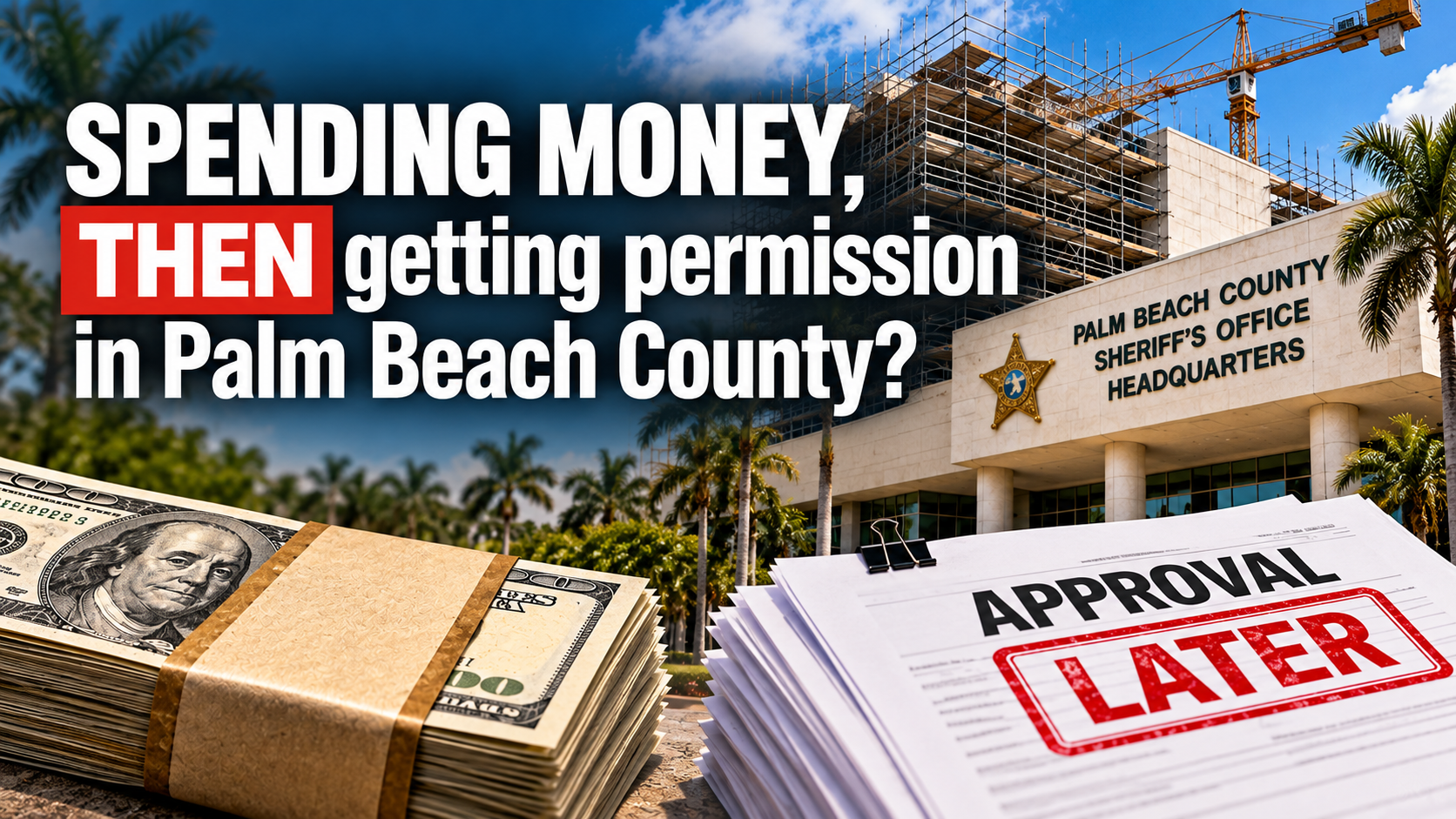
That appears to have been the procedure for portions of a $54 million renovation of the Palm Beach County Sheriff’s Office headquarters, according to a new inspector general audit.
Auditors found that county employees paid construction manager Kast Construction more than $903,000 for work that had not yet received the required approval from county commissioners.
How early were those payments?
In some cases, as much as 355 business days before the commission formally approved the change orders. That’s roughly 16 months between spending taxpayer money and obtaining the authorization that was supposed to come first.
And that wasn’t the only problem.
Auditors identified another $223,243 in payments they said exceeded contract terms or lacked sufficient supporting documentation. Of that amount, approximately $220,716 involved insurance, bonding and risk-related charges. Another $2,528 involved construction costs without adequate documentation.
County officials disputed the inspector general’s interpretation of certain contract provisions and argued that some charges were legitimate. The county’s own review nevertheless identified a preliminary net overpayment of approximately $124,478, which officials said could be deducted from the contractor’s final payment.
A $54 million renovation
The headquarters building on Gun Club Road in West Palm Beach dates to 1983. The renovation includes hurricane protection, roof replacement, mechanical upgrades and interior improvements.
Approximately $47.7 million of the project’s cost came from the county’s voter-approved infrastructure sales tax. Taxpayers presumably expected the county to follow its own purchasing rules when spending that money.
The inspector general found that the county’s construction oversight controls were generally adequate, but identified significant weaknesses in how change orders were managed. The county acknowledged that payments had been made prematurely, while arguing that the $903,000 should not be classified as questioned costs because commissioners eventually approved the work.
The inspector general disagreed.
After-the-fact approval doesn’t change the fact that required oversight was missing when the money went out.
And to be clear, the audit did not conclude that the $903,000 was stolen or that the work wasn’t performed. The issue was authorization, not necessarily the legitimacy of the construction itself.
The rules are changing
The inspector general issued seven recommendations to improve documentation, payment approvals and construction oversight. The county accepted six and rejected one.
Officials have also outlined procedural changes intended to prevent similar problems on future projects. The findings have already attracted local media coverage, including questions about how the county managed a renovation funded largely by sales-tax revenue.
But the larger question applies to local governments across Florida.If a purchasing rule requires approval before payment, what good is that rule when employees can simply obtain permission months afterward?
Government spending procedures aren’t supposed to be ceremonial paperwork completed after the money is gone.
They’re supposed to protect taxpayers before the checks go out.
In Palm Beach County, at least on this project, the paperwork sometimes arrived considerably later than the payment.
Apparently, permission could wait.