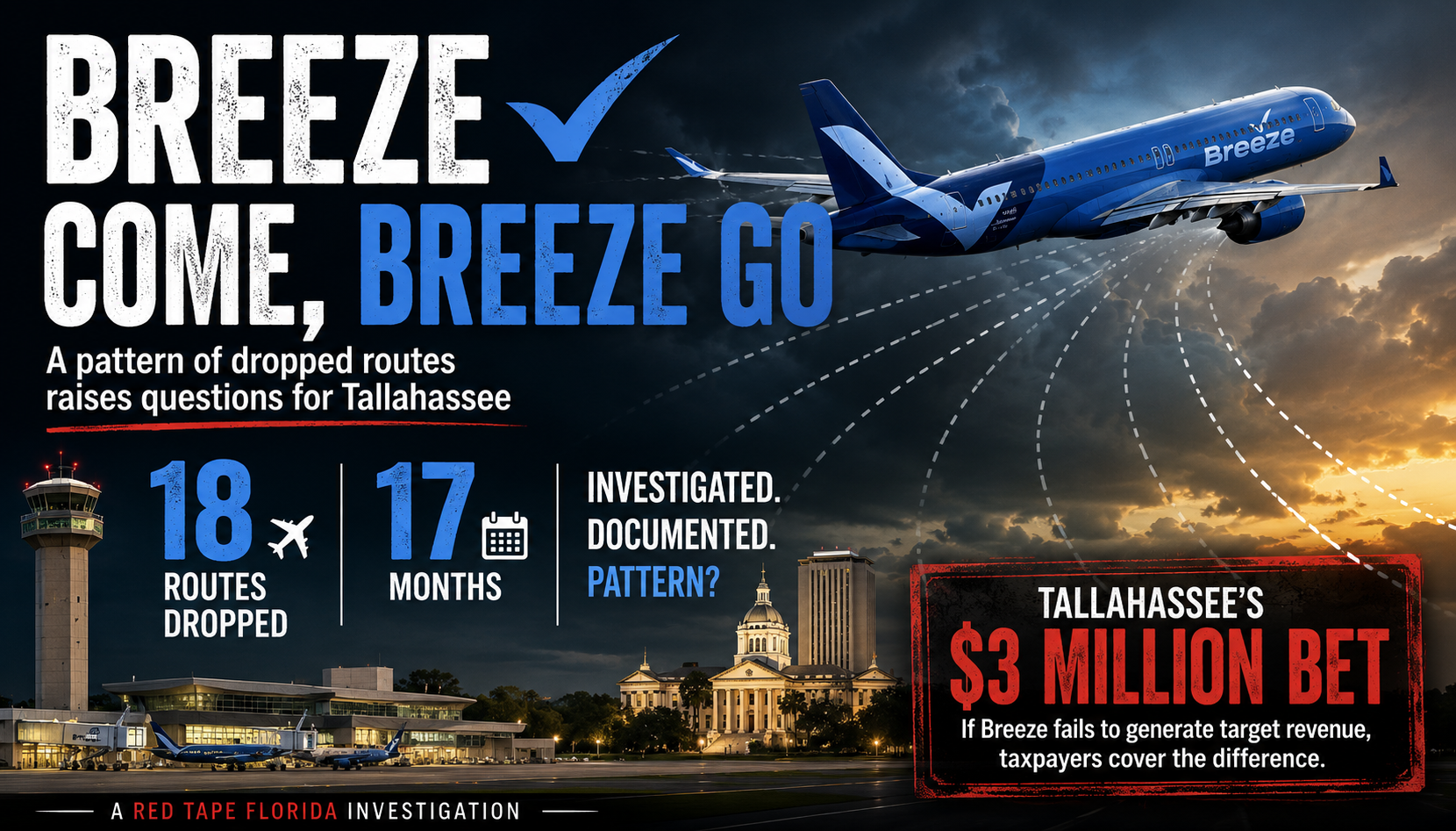
Breeze Airways dropped 18 routes in 17 months. In about half (or more) of them, public money was involved. Now it’s coming to TLH. Buckle up.
Special Investigation by Skip Foster, Red Tape Florida
The Tallahassee City Commission was practically giddy.
A shiny new airline named Breeze. Nonstop flights to Fort Lauderdale and Raleigh-Durham. Affordable fares. A 137-seat Airbus A220-300 — described, without apparent irony, as a “Goldilocks-size” plane for Tallahassee’s market.
What could go wrong?
Quite a bit, as it turns out. Red Tape Florida has meticulously researched every route Breeze Airways has dropped since January 2025 — 18 in total — and what we found should give Tallahassee taxpayers serious pause before the confetti hits the floor on July 2.
The deal the city struck is structured as a minimum revenue guarantee: if Breeze’s Fort Lauderdale and Raleigh-Durham routes don’t generate $3 million over two years, Tallahassee taxpayers pay the difference. Half comes from airport funds. Half from community incentives. It’s the aviation equivalent of a co-signer — and Breeze has left a lot of co-signers holding the bag.
Breeze’s Business Model, Decoded
Breeze Airways was founded in 2021 by David Neeleman, the airline entrepreneur behind JetBlue, WestJet, and Azul. The pitch is elegant: connect underserved secondary airports with nonstop service, bypass the hubs, keep costs lean. Five years in, Breeze has carried 16 million passengers and calls itself the fastest-growing airline in America.
It is also, Red Tape Florida has found, extraordinarily good at landing in communities carrying public incentive money. What is harder to prove is precisely how much those incentives influence Breeze’s decisions. What is clear is that public dollars appear repeatedly in the story of Breeze’s expansion — and in many of the routes it later abandoned.
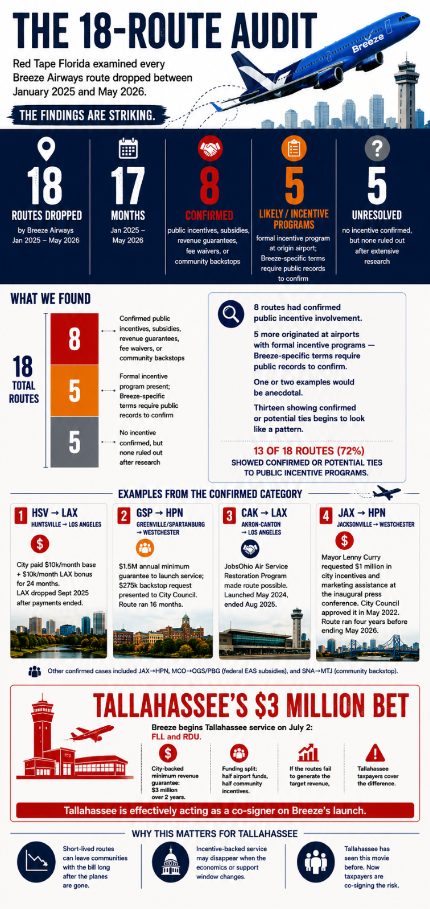
In the 17 months between January 2025 and May 2026, Breeze dropped 18 domestic routes. RTF examined every one of them.
The findings were striking:
- 8 routes involved confirmed public incentives, subsidies, revenue guarantees, fee waivers, or community backstops.
- 5 more originated at airports with formal airline incentive programs, though Breeze-specific participation requires public records confirmation.
- 5 could not be confirmed or ruled out after extensive research.
One or two examples would be anecdotal. Eight confirmed examples and five more under investigation begin to look like a pattern.
The Strongest Examples
The clearest case came from Huntsville, Alabama. The City of Huntsville signed a Memorandum of Understanding with Breeze paying $10,000 per month in base incentive payments, with an additional $10,000 per month bonus specifically designated for flying to Los Angeles. The MOU ran 24 months. The LAX route dropped in September 2025. The city then renewed its MOU with Breeze — this time without LAX as a destination. The city paid Breeze to fly to Los Angeles. When the check stopped, so did the flight.
In Greenville-Spartanburg, the airport CEO appeared before Spartanburg City Council in September 2024 specifically requesting $275,000 to fulfill a backstop agreement with Breeze Airways. He told the council the total minimum annual guarantee required to get Breeze to launch was $1.5 million. The route launched May 2024. It ended September 2025. Sixteen months.
Ohio’s economic development agency, JobsOhio, operates a $10 million annual Air Service Restoration Program providing short-term revenue guarantee incentives to airlines. JobsOhio’s own press release for the Breeze inaugural LAX flight names the program as the vehicle that made the route possible. The Akron-Canton airport CEO said at launch: “It’s our commitment, with partners like Breeze and JobsOhio — who offer the air services incentive program that brought Breeze here.” The route launched May 2024 and ended August 2025. It has not returned.
At the inaugural press conference announcing Breeze service to Jacksonville in 2022, Mayor Lenny Curry announced he was asking City Council for $1 million in incentives and marketing assistance. The council approved it in May 2022. The Jacksonville-Westchester route ran four years before ending in May 2026.
RTF’s complete route-by-route analysis, including source documents and links, is available here.
What the Counterexamples Tell Us
Not every route fit the theory.
Raleigh-Durham to Los Angeles ended in January 2026 despite an 82.1% load factor and no confirmed incentive involvement. That appears to have been a straightforward competitive decision: Breeze held just 7.8% of the RDU-LAX market against Delta’s 50.6% and American’s 41.4%. Breeze subsequently named RDU as an operating base and launched new California service to Orange County — a far less competitive market than LAX.
But exceptions do not erase the broader pattern. Public incentives appeared repeatedly in markets Breeze entered and repeatedly in routes Breeze later abandoned.
Tallahassee’s Turn
Tallahassee has seen this movie before.
JetBlue arrived with fanfare in 2022 and left in October 2024, citing underperformance. Silver Airways filed for bankruptcy and stopped all operations in June 2025. The city is now down to four American Airlines routes and a single Delta route — a skeleton crew for the capital of the third most populous state in America.
Into this void flies Breeze, which described Tallahassee as a market that has “really struggled for kind of low-cost or value service” — and which said it thinks it is “the perfect carrier for that.”
The city has committed $3 million in minimum revenue guarantees to make Breeze feel welcome. Tallahassee taxpayers are effectively co-signing Breeze’s launch. If the routes underperform, the city covers the difference. Half comes from airport funds. Half from community incentives.
The routes begin July 2.
The incentive window is two years.
Red Tape Florida will be watching the calendar.