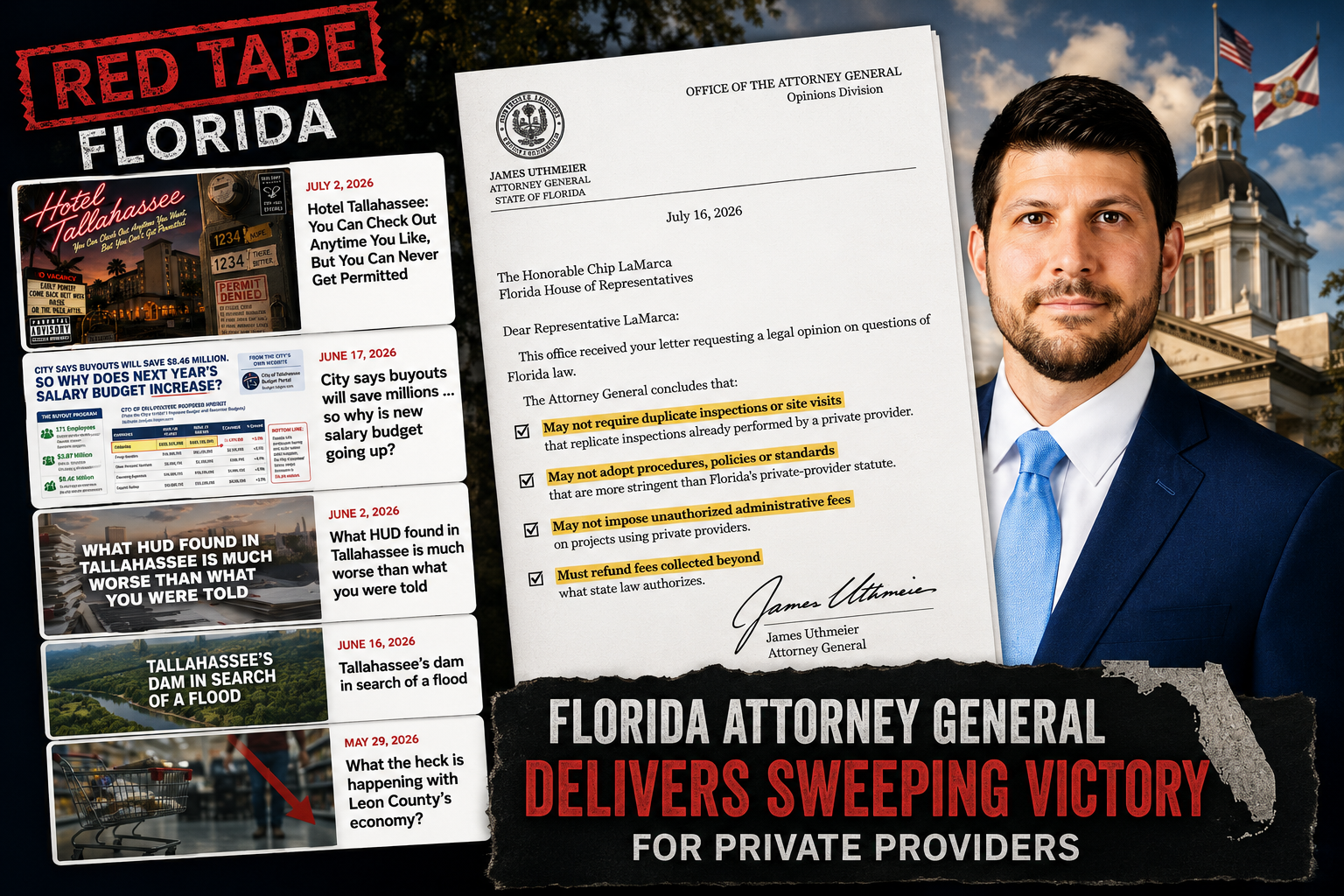
Decision validates series of stories by Red Tape Florida
By Skip Foster, Red Tape Florida
For more than a year, Red Tape Florida has documented a pattern playing out across the state.
The Legislature passes laws to reduce bureaucracy.
Some local governments respond by creating new bureaucracy.
On Thursday, Florida Attorney General James Uthmeier drew a bright legal line that should put many of those practices in jeopardy.
In a formal legal opinion requested by Rep. Chip LaMarca (R-Lighthouse Point), the Attorney General concluded that local governments:
- May not require duplicate inspections or site visits that replicate inspections already performed by a private provider.
- May not adopt procedures, policies or standards that are more stringent than Florida’s private-provider statute.
- May not impose unauthorized administrative fees on projects using private providers.
- Must refund fees collected beyond what state law authorizes.
That’s not merely another interpretation of Florida’s private-provider law.
It’s a sweeping affirmation of exactly what builders, engineers and private providers have been arguing for years — and what Red Tape Florida has repeatedly documented.
The Attorney General wrote that Section 553.791 “explicitly prohibits” local governments from requiring additional inspections that duplicate work already performed by private providers. He further concluded that local governments “may not adopt or enforce any laws, rules, procedures, policies, qualifications, or standards more stringent” than those authorized by the statute. Finally, he concluded that fees collected beyond what the law allows are unauthorized and must be refunded.
For Red Tape Florida readers, those conclusions will sound remarkably familiar.
Over the past year, we’ve reported on example after example of local governments appearing to do exactly what the Attorney General now says they cannot.
Among them:
- Alachua County. RTF documented county policies that private providers argued amounted to duplicate inspections and locally created procedures beyond those contemplated by state law. The Attorney General’s opinion squarely states that local governments may not require inspections or site visits that replicate work already performed by a private provider and may not impose more stringent procedures than Section 553.791 allows.
- Hotel Tallahassee. RTF reported on repeated city site visits after a private provider had already performed inspections, raising questions about whether local governments were effectively recreating inspections under different labels. While the Attorney General did not address that project specifically, his opinion makes clear that local governments cannot require duplicate inspections or site visits that replicate work already completed by private providers.
- Gulf County’s $500 private-provider fee. RTF questioned whether the county could charge a flat fee to applicants simply because they chose a private provider. The Attorney General now concludes that local governments may charge only those fees authorized by statute, must reduce permit fees to reflect services they no longer perform, and must refund unauthorized excess fees.
- Busy Bee in Columbia County. RTF documented wildly different permit costs on the same project and raised questions about governments charging for work they would never perform because a private provider had been retained. The Attorney General’s opinion reinforces that permit fees must reflect actual governmental costs and services, not become an additional barrier to using private providers.
- Tallahassee’s private-provider discount. RTF previously questioned why Tallahassee retained such a large portion of permit fees compared with neighboring Leon County when private providers handled much of the work. The Attorney General did not evaluate Tallahassee’s calculations, but his opinion makes clear that permit fees must be tied to the government’s actual costs and savings — not arbitrary percentages.
Each of those stories involved different facts.
Each involved different local governments.
But they all pointed to the same underlying issue: Was Florida’s private-provider law actually being followed?
Now the state’s chief legal officer has answered. This opinion leaves little doubt about legislative intent.
The Legislature didn’t spend years expanding Florida’s private-provider law only to allow local governments to recreate the same bureaucracy through extra paperwork, duplicate inspections, local policies or unauthorized fees.
That’s exactly what the Attorney General said.
For months, Red Tape Florida has chronicled the growing gap between what the Legislature said it wanted and what many local governments were actually doing.
Today’s opinion narrows that gap considerably.
The law says what it says.
The Legislature meant what it said.
Now the question is whether local governments — and the state agencies charged with overseeing them — will finally start acting like it.