
By Skip Foster, Red Tape Florida
In the waning days of his tenure as Tallahassee city manager, Reese Goad moved one of Mayor John Dailey’s top aides, Dionte Gavin, into a vacant leadership job at the jointly operated city-county Office of Economic Vitality. He did it without consulting Leon County Administrator Vince Long, and with no written authority to do so, according to the agency’s own attorney.
And Long wasn’t happy about it.
Gavin’s transfer into the job of OEV deputy director of Business Vitality and Intelligence set off a remarkable series of emails between Long, city officials and attorneys, obtained by Red Tape Florida through a public records request. In them, the county administrator demands to know who authorized the appointment and why the position was filled without an open, competitive hiring process.
Long believed Goad had disregarded an earlier decision by the Interlocal Management Committee (IMC) to leave the position vacant.
What is the IMC? It has exactly two members: the Tallahassee city manager and the Leon County administrator.
Goad and Long.
In other words, when Long complained that the IMC’s direction had been ignored, he was talking about a decision made by himself and Goad, the very person who subsequently authorized the move.
Long also wanted to know something that should be fairly easy to answer: Who gave Goad the authority to make that decision on his own?
The answer, it turns out, is nobody. At least not in writing.
A pattern of parting gifts?
The Gavin situation is the second example of controversial, end-of-tenure Goad action to surface this week. Based on public records requested and shared by the website Florida Capital Tea and confirmed by Red Tape Florida, City of Tallahassee Communications Director Allison Farris received a whopping 24 percent raise sometime between June 4 and the end of Goad’s tenure, taking her salary to $260,283. It was the second consecutive 24-percent raise for Farris, who saw her pay increase about $92,000 in two years.
Blindsided
Meanwhile, back to the Gavin hiring, the first sign of trouble came on Sept. 30, and it didn’t come from the county.
That evening, Artie White, director of PLACE, the umbrella department that oversees OEV, Blueprint and joint city-county planning, emailed the city’s human resources director. He had been “made aware this morning,” he wrote, of “the transfer of an employee” into the deputy director position.

While the records do not indicate who made White aware, Sept. 30 happened to be Goad’s last day before retirement.
“When hiring staff, the general preference is to elevate the preferred candidate to the City and County for consideration before making an offer,” White wrote. Because it was a transfer of staff, he wanted to verify that it was done “in accordance with” proper HR processes and procedures.
White forwarded his email to county staff, and it reached Long the next morning.
So, the director of the department learned about the move the day it happened. The county learned about it from a forwarded email.
Long starts asking questions
On Oct. 5, Long emailed White and OEV Director Keith Bowers to “clearly communicate my expectations” for what he called the “vacant” position.
“Should this position be filled, I will be holding you directly accountable to ensure that there is a formal competitive selection process conducted to identify the most qualified candidate for the job,” Long wrote.
He outlined the qualifications he believed the job required, including a track record in business recruitment, experience managing state and local incentive programs and the ability to supervise data-driven teams.
He also emphasized “transparency, public trust, and professionalism,” and drew a line: “Regardless of any apparent prior misinterpretation or misapplication of City policy, let me assure you that no decision to fill a position at Blueprint will be made unilaterally.”
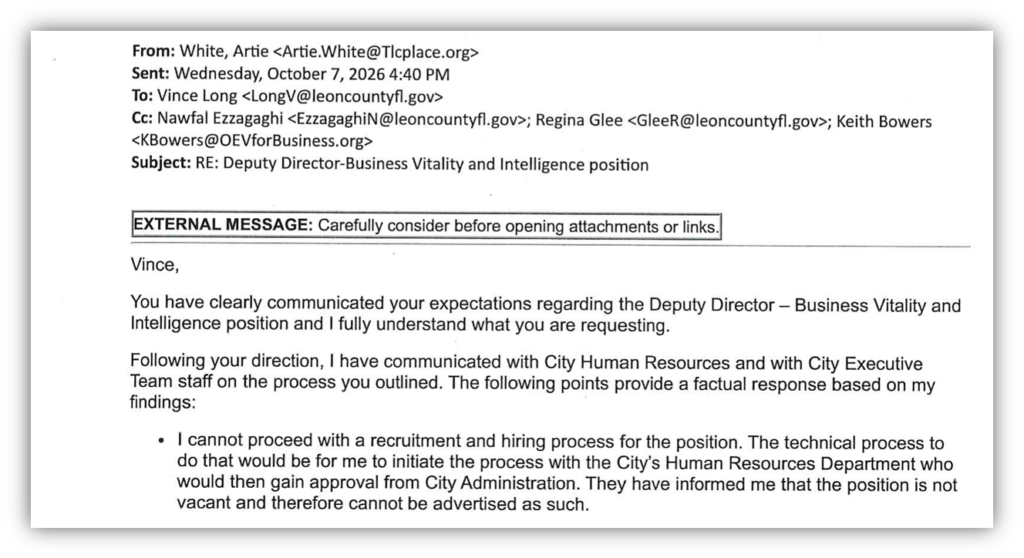
White’s answer, two days later: He couldn’t do it.
City Human Resources, he wrote, had informed him “that the position is not vacant and therefore cannot be advertised as such.” The city’s HR director had confirmed that “City Policies and Procedures were properly followed.”
The position Long wanted filled through an open search had already been filled without one.

Gavin, for his part, had already announced it. At 4:39 p.m. on Oct. 7, one minute before White’s email telling Long the job was “not vacant,” Gavin posted on Facebook that he was “excited to begin a new chapter” at OEV and had been “overwhelmed by the incredibly warm welcome.”
Not from everyone.
Long followed up the same day with two pointed questions. First, he asked White to confirm that neither White nor Bowers “conducted a process or made the hiring recommendation/decision.”
Second: “My clear recollection is that both members of the IMC agreed and provided the explicit standing direction to Keith not to fill the position (the reason the position has remained vacant and the process to fill was suspended). Please confirm.”
The city’s explanation
Assistant City Manager Wayne Tedder responded on Oct. 8.
“There was no direction from the City to freeze the position,” Tedder wrote. “The City, however, agreed to not fill the position at the time it was last advertised.”
Tedder said Blueprint and OEV have followed the city’s HR policies since Blueprint’s inception, and he pointed the finger back at the county. “There were earlier attempts to create a separate Blueprint/OEV HR policy, but the County declined to make any changes,” he wrote.
Then he described how the job was filled.
Tedder wrote that he had asked White and Bowers “to identify vacant positions within OEV,” and then “to convey information describing the Deputy Director position to Dionte and answer any questions regarding the roles of the position.”
“The next step,” he wrote, “was initiated by the City Manager through the City’s HR process and concluded with final approval by the City Manager.”
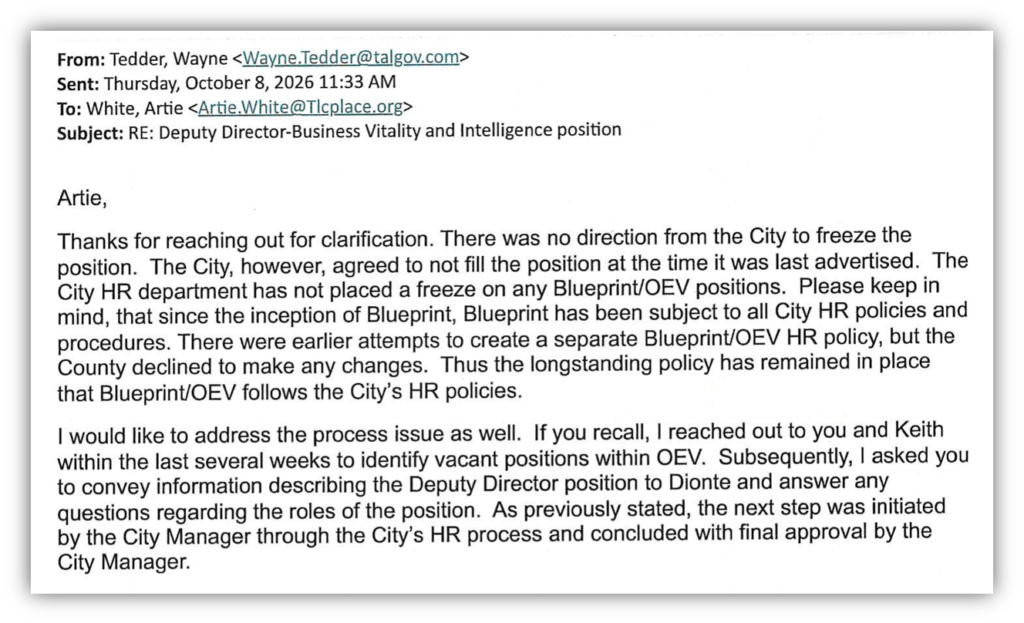
That explanation confirmed the city’s role in making the appointment. It also made clear that the job was pitched to one person.
It did not settle Long’s central question: Did the city’s responsibility for administering personnel procedures give its manager the authority to make hiring decisions for a jointly governed agency without the county’s involvement?
Long wasn’t buying it.
A question for the lawyers
On Oct. 9, Long took his concerns directly to Blueprint attorney Susan Dawson.
He wrote that the appointment “was unexpected in the unilateral and uncoordinated manner in which it was made and entirely inconsistent with the established framework and intent of this jointly managed function,” and that it “contradicted the previous explicit and standing direction of the IMC not to fill the position.”
He asked Dawson a broader question: What authority does either the county administrator or the city manager have to act unilaterally on Planning, OEV or Blueprint? He asked her to cite the interlocal agreement or any other governing document that supports it.
Dawson said she would respond in writing by early the following week.
Long had his own lawyer in the loop, too. He blind-copied County Attorney Chasity O’Steen on nearly every email in the exchange, and on Oct. 9 she sent him a document titled “Summary of Provisions and Outstanding Questions.”
No express authority
By Oct. 14, the disagreement had reached Goad’s successor, City Manager Karen Jumonville.
Following up on a conversation the two had the previous week, Long wrote that the appointment was “entirely inconsistent with the established framework and intent of this jointly managed function” and “directly contradicted the explicit, standing direction” of the IMC to leave the position vacant.
He proposed having Dawson draft amendments to the interlocal agreement to clarify “the recruitment, hiring, and supervision of Blueprint employees,” so there would be “no future misinterpretations or avoidable misunderstandings.”
“This email constitutes my formal direction to Artie to proceed,” Long wrote.
Jumonville replied that afternoon. “I agree with your recommendation below and look forward to reviewing the draft language.”
Minutes earlier, Dawson had answered Long’s broader question.
She identified only two circumstances in which either member of the IMC can act alone: removing an item from the agenda, as long as a board member didn’t request it, and firing the director of PLACE.
Beyond that, she wrote, the interlocal agreement and its two addenda do “not explicitly provide for either the County Administrator or the City Manager to take unilateral action regarding the operation of Blueprint or OEV.”
Dawson also explained the arrangement at the root of the dispute. Blueprint has no HR policy of its own. In 2002, its board voted to operate under the city’s administrative code for personnel matters, and Blueprint pays the city for HR services. In fiscal year 2026, that came to $15,648 for OEV alone.
Long asked for the specific city HR policy that allowed the city manager to hire at Blueprint. When Dawson sent it, he still didn’t see it.
On Oct. 15, he pointed to the record. The 2002 board vote, which he said he recalled from his own involvement at the time, was amended to narrow the city’s role to its “administrative code to include holidays, training, travel, security etc.” And the 2017 addendum to the interlocal agreement says Blueprint employees may choose to be city or county employees “only for the purposes of employment benefits administration.”
He asked Dawson for a formal legal opinion on the city manager’s authority, “citing the specific provisions from our governing documents.”
Dawson’s reply was direct.
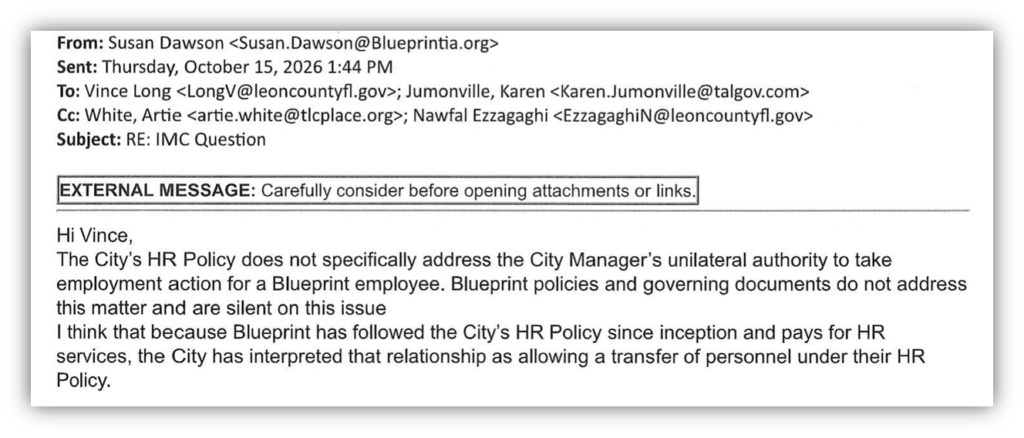
“The City’s HR Policy does not specifically address the City Manager’s unilateral authority to take employment action for a Blueprint employee,” she wrote. “Blueprint policies and governing documents do not address this matter and are silent on this issue.”
Her explanation of the city’s position: “I think that because Blueprint has followed the City’s HR Policy since inception and pays for HR services, the City has interpreted that relationship as allowing a transfer of personnel under their HR Policy.”
That was enough for Long.
“I appreciate your confirmation that there was/is currently no express authority for this employment action,” he wrote back. Based on her answers and “a plain reading of the Interlocal,” he said, he no longer needed a formal legal opinion.
Dawson asked how he wanted to fix it: a third addendum to the interlocal agreement, which would require approval from both the City and County commissions, or a Blueprint HR policy, which would need only the Blueprint board’s approval. Long suggested an HR policy approved by the board.
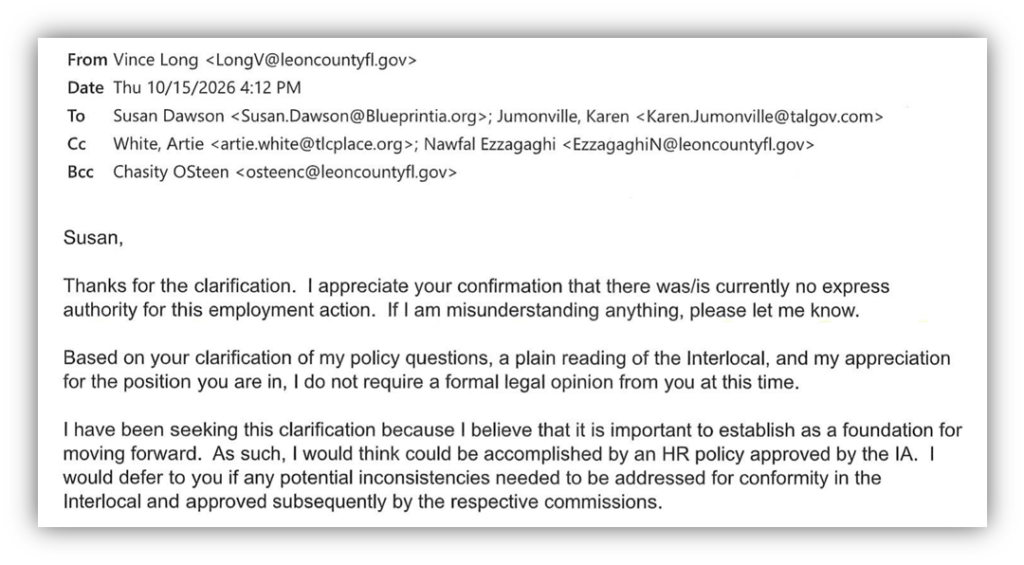
The county administrator had effectively forced a discussion about whether the city’s longstanding personnel practices had outrun the authority granted by the agencies’ governing agreements.
Who’s running OEV?
The dispute comes at an awkward time for an economic development agency already facing questions about its effectiveness in attracting businesses and creating jobs.
OEV is supposed to be a partnership between Tallahassee and Leon County, with shared oversight and accountability.
Yet the correspondence shows that the two governments could not agree on who had the authority to fill a senior management position.
The emails do not establish that the appointment was illegal or that Gavin lacks the qualifications for the job. They do establish that the county administrator objected to the process, that the agency’s own attorney found no written authority for it, and that the two governments are now rewriting the rules to prevent a repeat.
For Goad, the appointment was among the personnel decisions made near the end of his tenure as city manager.
The appointment also involves two figures with ties to Leadership Tallahassee, a program of the Greater Tallahassee Chamber of Commerce. Gavin serves on the organization’s Board of Governors, while Goad received its 2026 Servant Leadership Award on September 16 — just two weeks before his retirement and approval of Gavin’s transfer.
Gavin came to the mayor’s office in 2023 after serving as senior operations director for Visit Tallahassee, where his responsibilities included budgeting, finance, procurement and administration. Before that, he spent nearly 18 years with the Leon County Clerk of Court and Comptroller, eventually becoming financial services manager. He holds bachelor’s and master’s degrees from Florida State University. While Gavin has extensive experience in local government administration, his publicly documented work history shows no direct experience in business recruitment or economic development.
Meanwhile, for taxpayers funding the Office of Economic Vitality, the situation raises a fairly obvious question.
If the city and county can’t agree on who’s allowed to hire the people running economic development, who’s accountable for the results?