
By Skip Foster, Red Tape Florida
There is nothing quite like that new-car smell.
Former Tallahassee City Manager Reese Goad apparently got to enjoy it with remarkable frequency.
Records obtained by Red Tape Florida show the City bought or traded for five new Ford F-150 pickup trucks for Goad in just over seven years — model years 2019, 2021, 2023, 2025 and 2026.
Five trucks. Seven years. During tough budget times. Now the City’s random insistence that Red Tape Florida pay $480 for the records makes more sense.
After spending $49,701.72 on the first Goad truck in 2019, taxpayers kicked in another $60,328.48 to keep trading relatively new trucks for newer ones. Total documented cash outlay on the five transactions: $110,030.20.
The City’s detailed fleet policy required ordinary vehicle-replacement decisions to consider things like mileage, useful life, condition and maintenance history.
Goad’s vehicle was exempt.
His employment contract instead promised him “regular replacement” of a City-provided automobile. “Regular” has apparently been doing some heavy lifting.
And then there’s Truck No. 5.
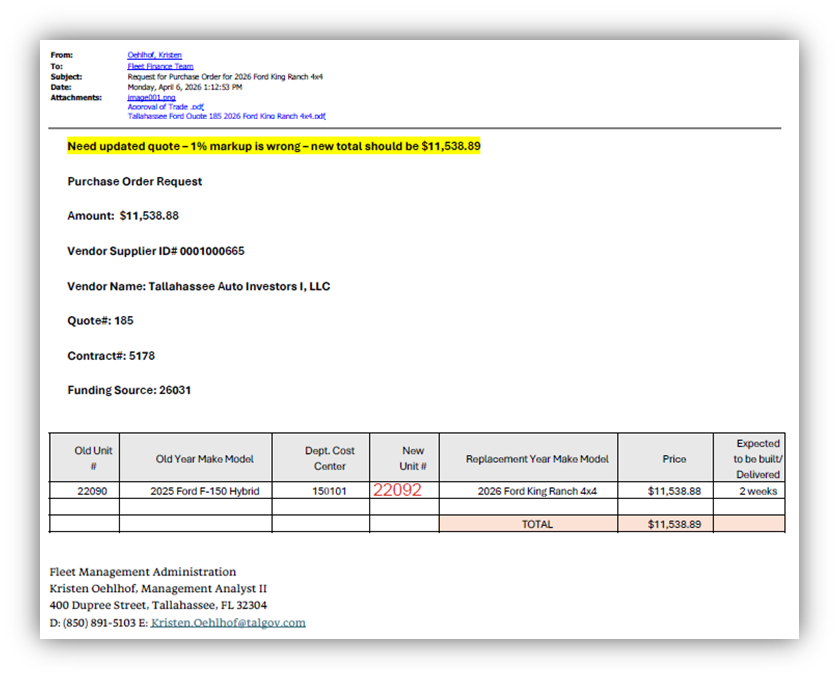
On April 6, 2026, Fleet Management requested a purchase order to trade Goad’s 2025 F-150 for a brand-new 2026 King Ranch 4×4. While it’s not as pricy as the nearly $100,000 vehicle the City purchased for Tallahassee Police Chief Lawrence Revell, the City still paid another $11,538.89, after trading in the 2025 model for $57,000. The paperwork said the new truck was expected to be built or delivered in two weeks, which would be around April 20.
Just 8 days after the estimated delivery date – on April 28 — Goad announced his retirement.
The spending is particularly striking given the financial message coming from City Hall. Tallahassee has been raising fees and searching for savings, including paying nearly $3.9 million this year to persuade 171 employees to leave — a buyout program officials claimed would save about $8.46 million annually (but haven’t been able to show their math).
The City has repeatedly described those and other measures as part of an effort to control costs and prepare for looming budget pressures. Apparently, austerity did not extend to the City Manager’s pickup trucks.
A new truck every couple of years
The cycle started in March 2019, when the City purchased a Ford F-150 for Goad’s use for $49,701.72.
In October 2021, the City traded it for another F-150. The dealer allowed $41,000 for the old truck, leaving taxpayers to kick in another $10,397.
Less than two years later, Goad did it again.
In September 2023, the City received $44,000 for Goad’s 2021 truck and paid another $15,449.84 to put him in a new one.
That one didn’t make it nearly as long.
In January 2025 – just 16 months later — the City traded it for a new F-150 King Ranch, one of Ford’s upscale trim levels. The City received $46,500 for the 2023 truck and paid another $22,942.75.
Surely that would hold him for a while, especially given what we now know … that retirement was looming.
It did not.
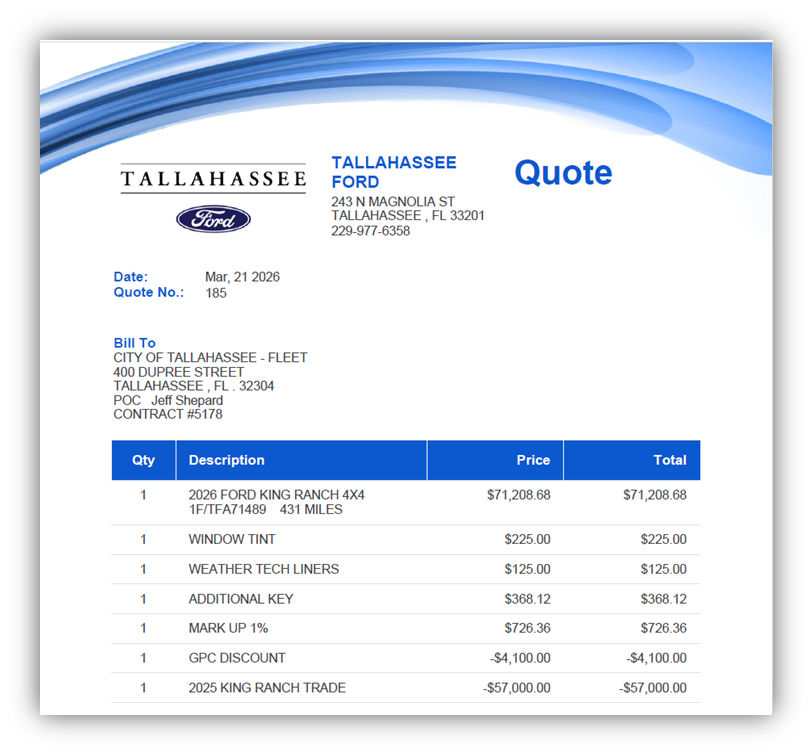
About 14 months later, the City traded the 2025 King Ranch for a 2026 King Ranch. The trade brought $57,000, and taxpayers paid another $11,538.89.
Add up those four upgrade checks and you get $60,328.48 — on top of the nearly $50,000 taxpayers spent to put Goad in the first truck.
Depreciation? Never heard of her
There is a reason financially prudent people tend not to buy a brand-new vehicle every couple years.
Depreciation.
New vehicles generally lose value fastest during their early years. There is an old saying about how a car loses thousands of dollars in value the minute it is driven off the lot.
Trading a relatively new vehicle doesn’t make that depreciation disappear. The dealer simply tells you what the used vehicle is now worth, applies that amount to the next new vehicle and somebody pays the difference.
In this case, that somebody was repeatedly the taxpayer.
To be clear, the City received substantial value for each trade-in. This isn’t $110,030 disappearing into thin air.
But the relevant comparison is between repeatedly trading Goad’s functioning, relatively new trucks and simply continuing to drive them.
Each time the City chose the former, taxpayers paid again.
$10,397.
$15,449.84.
$22,942.75.
$11,538.89.
It’s an interesting approach to vehicle depreciation: experience as much of the early part of it as possible.
For perspective, nearly two-thirds of Americans keep their vehicles at least five years, according to an April 2026 Cox Automotive study.
Apparently, they haven’t discovered Tallahassee’s vehicle replacement program.
The rules … for everybody else
And then there is Tallahassee’s Fleet Management Policy.
It is 10 pages long and contains detailed rules designed to manage City vehicles efficiently. For ordinary City vehicles, Fleet Management and the department are supposed to evaluate mileage, life expectancy, general condition and maintenance history in determining whether a vehicle should be replaced.
The City even requires a five-year vehicle replacement plan.
Sounds prudent.
Then you get to Page 10.
“Vehicles assigned to appointed officials are exempt from this policy.” Commission Policy 124
Goad was an appointed official.
So, the City had specific standards designed to determine when ordinary taxpayer-owned vehicles had reached the point where replacement made financial sense.
The City Manager’s truck wasn’t subject to them.
And remember who sat at the top of the fleet-management system. The policy gives the City Manager responsibility for approving fleet administrative guidelines and vehicle utilization rates.
Mileage, useful life, condition and maintenance history for everybody else. For the boss: “regular replacement.” Goad wasn’t operating without any rules. Appointed officials are instead subject to the City’s purchasing requirements.
Those are reassuring, too.
The City’s procurement policy says one of its objectives is obtaining acceptable-quality goods and services “at the right time and price.”
It’s difficult to argue with that.
Buying things at the wrong time and price would be a considerably less promising procurement strategy.
Where are the guardrails?
The same City purchasing policy gives the City Manager authority to approve transactions up to $250,000. Taken together, the City’s policies and Goad’s employment agreement appear to have created a remarkably closed loop.
Goad was entitled to a City-provided automobile. His contract required taxpayers to pay for its purchase, operation, maintenance, repair and “regular replacement.”
How expensive could the vehicle be?
His contract doesn’t say.
How often could it be replaced?
It doesn’t say.
How many miles did it have to accumulate first?
It doesn’t say.
Did it have to be worn out, unreliable or expensive to maintain?
It doesn’t say.
Ordinarily, those are exactly the kinds of questions Tallahassee’s Fleet Management Policy requires the City to consider before replacing a taxpayer-owned vehicle.
But vehicles assigned to appointed officials are specifically exempt from that policy.
And Goad wasn’t merely an appointed official receiving a City vehicle. He was the City Manager — the official the City’s policies put at the top of the administrative and purchasing structure.
His purchasing authority extended to $250,000.
So far, Red Tape Florida has found no separate vehicle-price limit, replacement schedule, mileage requirement or condition standard that applied to Goad’s truck.
That’s the remarkable part of this story.
The City Commission promised its City Manager a vehicle with “regular replacement,” but apparently put no definition around either the vehicle or the replacement.
Goad plainly was entitled to a City vehicle. And we have found no evidence that any of these purchases violated his employment agreement.
The question is whether the system itself contained enough guardrails to protect the people paying the bills.
Because when one city manager can go through five new trucks in seven years without apparently violating a rule, the question isn’t just why he kept getting new trucks.
It’s why the rules allowed it.
And where is Truck No. 5?
There’s one loose end.
Goad retired only months after the City paid another $11,538.89 to move him from the 2025 King Ranch into a 2026 King Ranch.
His employment agreement gave him unrestricted use of a City automobile while he was employed. It did not give him ownership of one. Unlike Tallahassee Police Chief Lawrence Revell’s contract, which includes a provision for buying back a vehicle upon leaving the City, Goad’s did not include such language.
So Red Tape Florida has asked the City what happened to the newest truck after Goad left.
Did it remain in the City fleet?
Was it reassigned?
Was it sold?
Did Goad purchase it?
And if he did, how much did he pay and how was that price determined?
After five new trucks in seven years, it seems reasonable for taxpayers to know where the last one parked.