By Skip Foster, Red Tape Florida
For years, they rolled out the red tape.
Now they’re staring at the consequences — how to fund police and fire, maintain parks, and keep local government running when nearly all your revenue comes from homeowners.
At a South Dade State of the Market event last week, the mayors of Pinecrest, Palmetto Bay and Cutler Bay did something rare for local officials — they admitted the obvious.
“We didn’t have the foresight to increase the zoning enough to bring in a commercial,” Pinecrest Mayor Joseph Corradino said, according to reporting by Chloe Gallivan in Bisnow. “Commercial wouldn’t be subject to the property tax issue, and we’re going to get crushed, probably because of short-sightedness.”
“Short-sightedness.” That’s not a blogger’s word. That’s the mayor’s.
The immediate backdrop was a state-level debate over property taxes. But the larger story has nothing to do with one bill in Tallahassee.
It’s about what happens when a town spends decades treating growth like a contagious disease.
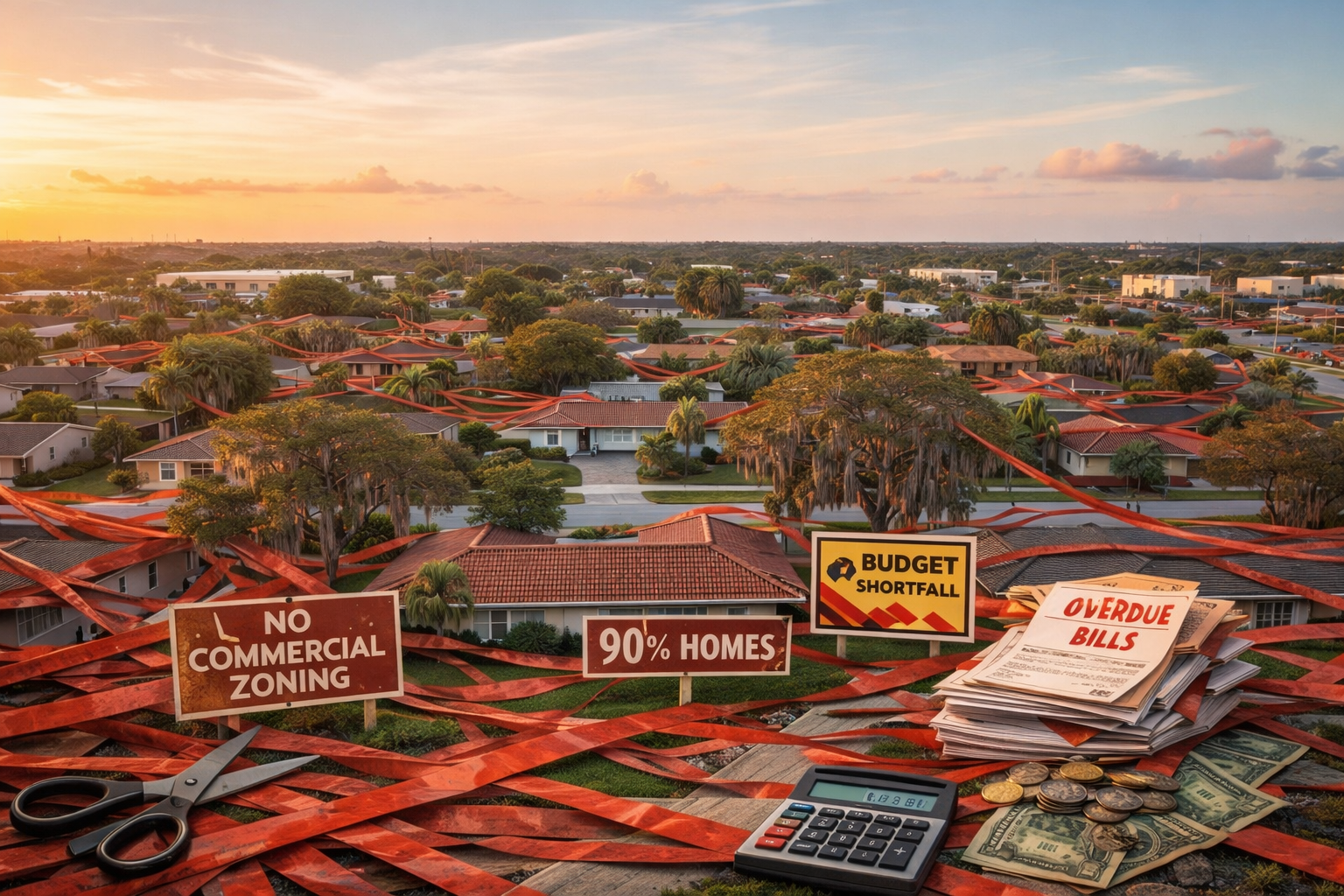
Pinecrest is more than 90 percent single-family homes. Palmetto Bay is 92 percent single-family. These are communities that carefully curated their zoning maps to limit commercial intensity, restrict multifamily, and preserve a certain aesthetic.
That wasn’t accidental. It was enforced — by planning boards, by staff reports, by zoning codes thick enough to stun a horse.
Developers were told, politely or not, that this wasn’t Miami. Go build somewhere else.
And many did.
Here’s the problem: local governments don’t run on vibes. They run on revenue.
Police. Fire rescue. Infrastructure. Parks. Schools. All funded by a tax base that, in these towns, leans overwhelmingly on homeowners.
When you deliberately wall off commercial development, you’re not just protecting neighborhood character. You’re narrowing your revenue base to one economic lane.
That works fine — until it doesn’t.
When revenue growth slows, when costs rise, when policy shifts at the state level, there’s no cushion. There’s no diversified commercial sector absorbing part of the load. There’s just homeowners and a shrinking set of options.
And suddenly, the same governments that once treated developers like intruders are wishing they’d approved more storefronts.
Palmetto Bay offers a case study in lagging realization. The village implemented a pay-to-park system meant to support a future downtown vision. The idea: people will walk. The problem, as Mayor Karyn Cunningham admitted, is that “there’s nowhere to walk right now. There’s no retail there.”
You can’t regulate your way into an ecosystem. You either allow the market to build one — or you don’t.
Cutler Bay at least has the massive Southplace City Center redevelopment in the pipeline. That project could meaningfully diversify its tax base. But even there, Mayor Tim Meerbott acknowledged that until it’s built and stabilized, the town remains heavily dependent on homesteaded property taxes.
In other words, the diversification comes after you say yes — not while you’re still saying no.
This is the recurring theme Red Tape Florida has documented across the state: anti-growth zealotry feels principled in the short term and fragile in the long term.
Communities convince themselves they are protecting residents from traffic, density or change. Bureaucrats enforce the rules with precision. Permits get slower. Zoning stays tight. Projects get watered down or walk away.
And then — years later — the same leaders discover that fiscal resilience requires exactly the kind of growth they spent decades resisting.
Government slows growth. Growth goes elsewhere. The tax base stagnates. And eventually, government itself feels the squeeze.
That’s not ideology. That’s math.
No one is arguing for reckless overdevelopment. But pretending you can fund full-service municipal government indefinitely with a nearly all-residential tax base is fantasy.
The quiet part isn’t really about one property tax proposal.
It’s this: if you block commercial growth long enough, you don’t freeze your town in amber. You weaken your own foundation.
And when the numbers stop working, there’s no planning-board motion that can undo 20 years of saying no.
For many Florida cities and counties, the time to fix that mistake is right now.