
By Skip Foster, Red Tape Florida
The Florida Legislature made a clear decision this year.
The government shouldn’t get paid for work it didn’t do.
We are talking about the years-long private provider laws in Florida which allow inspections and plan reviews to be conducted by private sector businesses.
The problem is that local government bureaucrats can’t stand private providers. They operate on government turf. And despite often having stronger credentials than their government counterparts, they’re still viewed with suspicion because they work in the private sector.
But the Legislature does trust and value private providers, and rightly so.
The private sector almost always operates more efficiently, quickly and cost-effectively than bureaucracies.
Which is why the Legislature acted on this premise: If a private provider is doing the work, taxpayers shouldn’t be paying the government as if the government did it.
That’s exactly what House Bill 803, effective July 1, requires. On commercial projects, local governments must reduce building permitfees by at least 50 percent when a private provider performs both plan review and inspections, and by at least 25 percent when the private provider performs one of those functions. On residential projects, the permit fee is supposed to reflect the work the building department actually performs. The law also prohibits local governments from tacking on administrative or punitive fees simply because an owner chooses to use a private provider.
Seems straightforward enough.
So how are local governments doing?
Not very well, at least based on an initial review of publicly available fee schedules from around Florida.
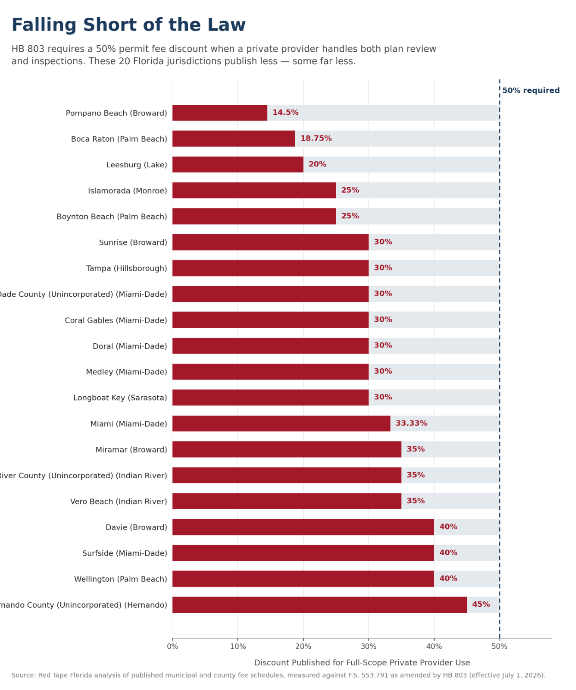
A review of more than 60 jurisdictions found dozens that appear to have fee schedules that don’t match the new law.
Some continue to offer discounts well below the statutory minimum.
Others appear to be charging separate administrative or registration fees for private provider projects. Several adopted new fee schedules after the Legislature passed HB 803 without updating the portions dealing with private providers.
If that’s correct, it raises a pretty basic question: How can local governments insist that builders follow every line of the building code while ignoring a state law that applies directly to them? The examples are hard to ignore.
Pompano Beach appears to provide a discount of about 14.5 percent in some situations where the new law requires at least 50 percent.
Boca Raton’s published schedule appears to reduce the fee from 1.60 percent of project value to 1.30 percent when a private provider performs both functions. According to the analysis, that would amount to more than a $25,000 difference on a $5 million commercial project compared with what HB 803 appears to require.
Leesburg appears to offer two separate 10 percent discounts, one for inspections and one for plan review, while also charging a $50 private provider registration fee.
Islamorada’s published procedures reference a 25 percent discount when a private provider performs both functions and 15 percent when only one function is performed.
Those aren’t isolated examples.
The review also identified published fee schedules in jurisdictions including Miami-Dade County, Coral Gables, Sunrise, Tampa and others that appear to fall below the new statutory minimum. Another group of cities and counties—Cocoa, Collier County, Palm Beach County, Dundee, Coral Springs, Polk County, Miramar, Seminole and Largo—appear to continue charging administrative fees associated with private providers, despite language in the new law intended to prohibit those charges.
Just as interesting is the timing.
Several jurisdictions updated or adopted fee schedules after the Legislature approved HB 803. Yet the published documents still appear to reflect the old approach rather than the new law.
Maybe there’s an explanation.
Maybe some jurisdictions have adopted internal procedures that simply aren’t reflected in the published fee schedule. Maybe amendments are already in the works. Every city and county deserves the chance to explain its position before anyone reaches a final conclusion.
But if the published schedules are accurate, this isn’t a technical issue.
It’s an issue of the rule of law and, ultimately, money.
Permit fees don’t disappear into thin air. They become part of the cost of building a home, an apartment complex, a medical office or a warehouse. Those costs eventually show up in home prices, rents or lease rates.
For years, local governments have defended permit fees by saying they recover the actual cost of providing the service.
HB 803 applies that same logic in reverse.
If the government isn’t doing the work, why should it collect the full fee?
That’s the question the Legislature answered.
The next question is: when are local governments going to start following the law?