From population to jobs to retail sales, the local economy is in distress
By Skip Foster, Red Tape Florida
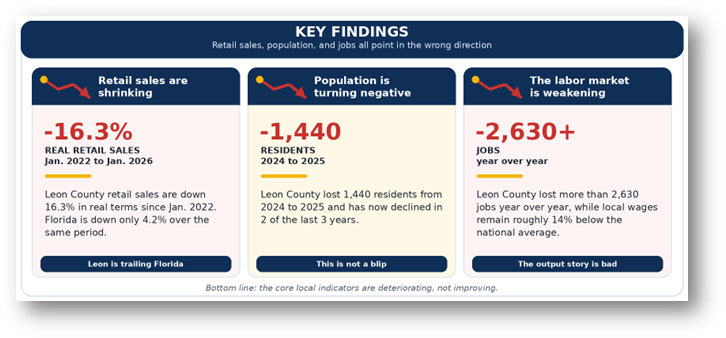
Leon County’s retail sales dropped 10% in 2025. Population actually fell while Florida grew at the second-highest rate in the nation. And the county lost jobs from 2024 to 2025, according to the Florida Chamber Foundation.
The capital county of the nation’s third-largest state has an economy in distress. The people responsible for doing something about it do not appear to be measuring the right things – or even paying attention.
Start with retail sales, the clearest measure of whether people who live here are earning money and spending it locally. According to OEV’s own dashboard, which draws on Florida Department of Revenue sales tax data, Leon County posted $391.6 million in taxable sales in January 2026. Twelve months earlier, in January 2025, the number was $437 million.
That is a $45 million decline in one year, in nominal dollars, before any inflation adjustment.
In one year, Leon County lost the equivalent of a mid-sized regional employer’s annual payroll in consumer spending. Not during a recession year. Not after a hurricane. Just a regular year in which people apparently spent significantly less money in Leon County, or spent it somewhere else.
And that single-year drop is the sharp end of a longer, uglier trend. Pull back to January 2022 and Leon County’s taxable sales were $404 million. Four years later, they were $391 million, lower in nominal dollars despite four years of inflation that should have pushed the number higher automatically.
Here is what matters about taxable sales data: it is not inflation-adjusted. It is raw dollars collected at the register. As the state’s own economists have noted, the immediate response to inflation is an increase in sales tax collections because prices are higher. In other words, if you sell the same number of goods at higher prices, taxable sales go up without any real growth at all. Leon County’s went down.
Using standard inflation adjustment based on Bureau of Labor Statistics data, Leon County’s real retail sales have declined by approximately 16.3% since January 2022. Florida statewide declined too, but only 4.2% in real terms over the same period. Leon County’s real decline was nearly four times as severe as the state average.
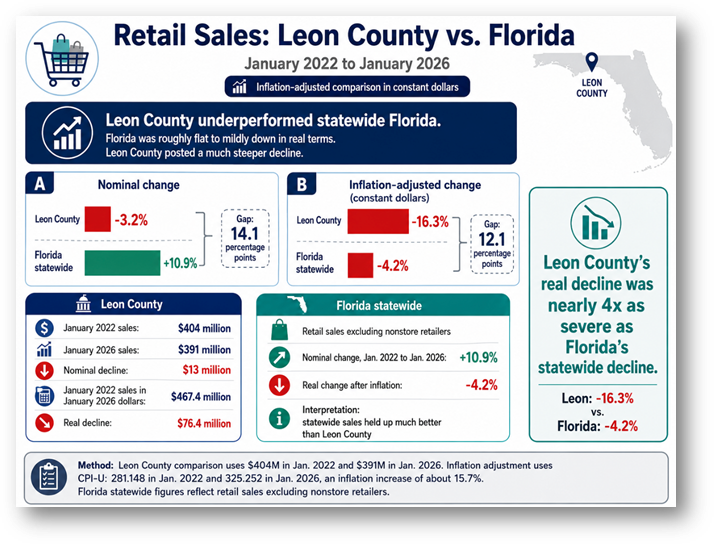
In dollar terms, Leon County would need roughly $467 million in monthly retail sales today just to keep pace with inflation. It is posting $391 million. The gap, $76 million a month, is the purchasing power that has quietly drained out of the local economy while OEV issued press releases about GDP growth and leading-metro rankings.
OEV and those trying to defend the county’s anemic economic performance will likely point to COVID-era distortions. It is a convenient argument, but it does not hold up. The baseline here, January 2022, was chosen precisely because the stimulus sugar high had largely burned off by then. Federal pandemic relief money had already cycled through the economy. Consumer spending had normalized. That makes January 2022 the honest starting point, not the artificially inflated peak months of 2021.
The problem with the COVID defense is straightforward: Florida statewide, starting from the same post-pandemic baseline, grew nominal retail sales by 10.9% through January 2026. Leon County, starting from the same baseline, fell 3.2% in nominal terms. If pandemic distortion explained the weakness, it would show up across the state. It does not.
This is not a COVID story. It is a Leon County story.
The Population Problem Nobody Wants to Talk About
You cannot separate the retail sales story from the population story, because they are the same story.
According to the U.S. Census Bureau’s most current estimates, data released this spring, Leon County’s population stood at 299,048 as of July 1, 2025. That is a decline of 1,440 residents from the 300,488 counted in July 2024.
Over the full five-year period from 2020 to 2024, Leon County grew 2.8 percent, ranking 56th out of 67 Florida counties and 29th out of the 30 largest counties in the state. Florida as a whole grew 8.5 percent over the same period. Neighboring Bay County grew 14 percent. Even Alachua County, home to a similarly government-heavy economy in Gainesville, outpaced Leon at 4.8 percent.
Harvard economist Edward Glaeser, one of the nation’s leading scholars of urban growth and decline, has shown that population loss and economic weakness are deeply connected. Cities that lose their productive edge often struggle to attract the people, talent, and investment needed to regain momentum.
The Jobs Picture
At the Tallahassee Chamber’s own Economic Forecast earlier this year, the Florida Chamber Foundation delivered a candid assessment that did not match OEV’s marketing materials: Leon County lost more than 2,630 jobs compared to the prior year, with the growth rate dipping 1.6%. The Florida Chamber Foundation said Leon County will need more than 6,630 new jobs by 2030 just to stay competitive.
“With 25% of our GDP being attributed to government,” the Florida Chamber Foundation’s keynote speaker said, “that means we need to be more active in driving private-sector growth.”
That is the business community’s own verdict, delivered at the business community’s own event.
Meanwhile, workers in the Tallahassee metro area earn an average hourly wage of $27.99, roughly 14% below the national average of $32.66, according to the Bureau of Labor Statistics.
The Inputs and the Outputs
OEV’s response to data like this is predictable: point to GDP. In February 2026, OEV Director Keith Bowers declared that Tallahassee had its best economic year in more than a decade, citing 4.3% real GDP growth. The press release went out on the city’s own email list.
What the press release did not mention is that the underlying Bureau of Economic Analysis data shows Leon County’s GDP growth was driven disproportionately by government spending and rising real estate values, not broad private-sector expansion. Manufacturing contracted sharply in real terms in 2024, even as the headline number rose. GDP counts a government payroll increase the same way it counts a new factory. In a state-capital economy, that distinction matters enormously.
OEV’s broader economic narrative is built almost entirely on input metrics: GDP figures, R&D spending, university enrollment and rankings placements purchased in Area Development magazine. These are measures of activity. They are not the same thing as outcomes.
The output metrics, the ones that tell you whether people actually want to live here, work here and spend money here, are telling a different story: retail sales down sharply, population declining, jobs lost and wages 14% below the national average.
The question worth asking, and the one that a national search for a new city manager and a county commission facing tough budget decisions should both be asking, is simple: what are we actually getting for the investment, and who is measuring the right things?
Right now, the agency tasked with answering that question is the same agency producing the marketing materials. And the dashboard they built themselves suggests the answer is not what the press releases claim.