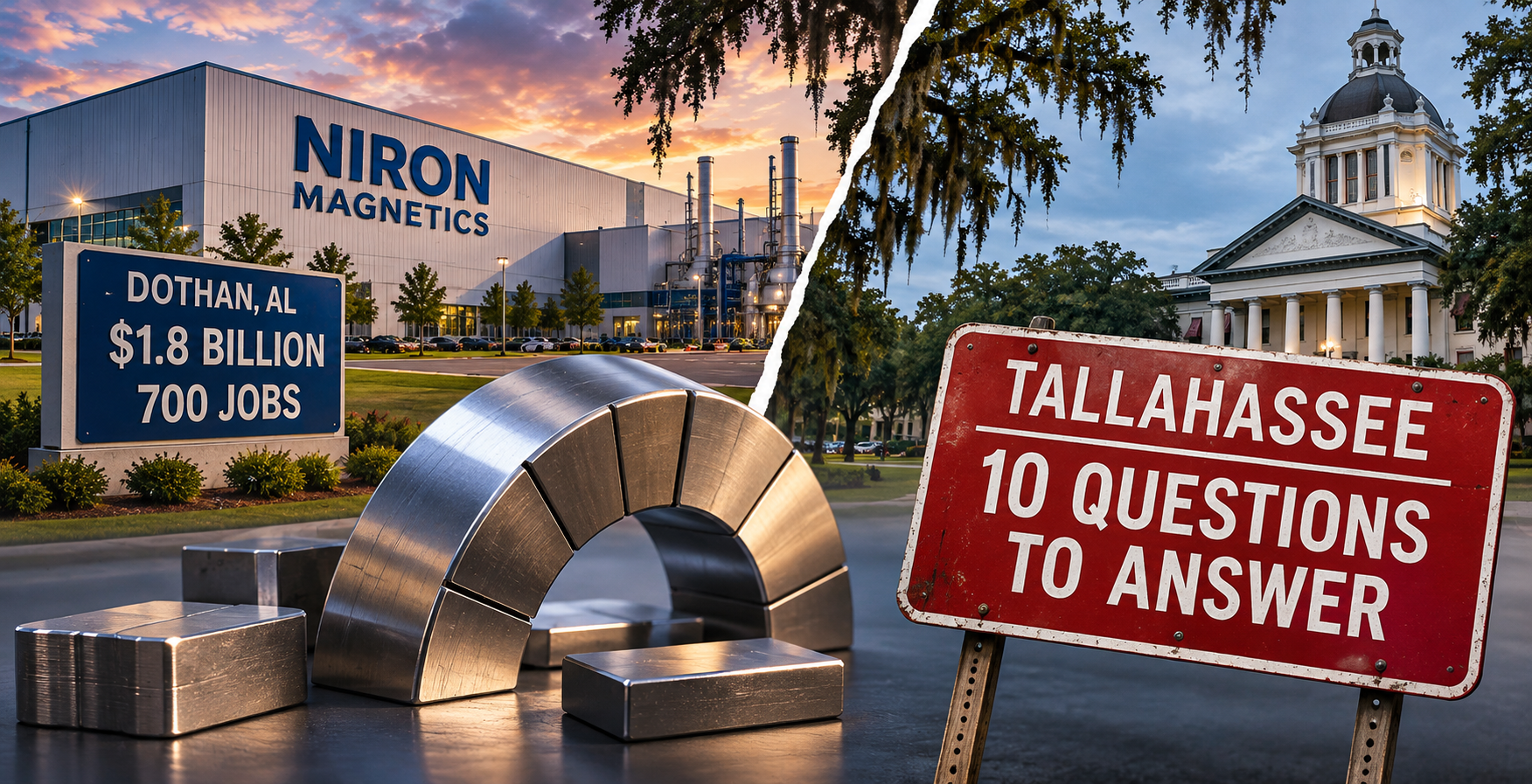
A massive investment in a neighboring state raises uncomfortable questions about Tallahassee’s economic development strategy — if there is one.
By Skip Foster, Red Tape Florida
Dothan, Alabama, just landed a $1.8 billion advanced manufacturing project expected to create 700 high-wage jobs.
Niron Magnetics, a company developing next-generation permanent magnets, reportedly considered sites in 22 states before selecting a 446-acre industrial location in Dothan.
That’s a remarkable economic development victory for a city considerably smaller than Tallahassee.
And here’s what makes the announcement particularly painful: Tallahassee is home to the National High Magnetic Field Laboratory, one of the world’s leading research institutions in magnetics.
The announcement should provoke some serious soul-searching about Tallahassee’s economic development efforts.
For decades, Tallahassee-Leon County taxpayers have invested heavily in economic development. According to Leon County’s own accounting, Blueprint had invested nearly $46 million in economic development projects through 2023. Separately, Red Tape Florida previously documented approximately $20 million in funding for the Office of Economic Vitality during its first decade. Meanwhile, Florida State University, Florida A&M University and the National MagLab provide intellectual and research assets that many communities would envy.
So why aren’t we seeing more transformative private-sector investments?
Red Tape Florida believes the community should be asking 10 questions — five looking back and five looking forward.
Five Questions Looking Back
1. Was Tallahassee ever in the running for the Niron Magnetics project? Given our connection to the National MagLab, were local economic development officials aware of the opportunity?
2. If Tallahassee wasn’t considered, why not? If we were, what happened? Were we lacking suitable land, infrastructure, incentives or something else?
3. Could Blueprint economic development dollars have been allocated more effectively? Have our investments positioned Tallahassee to compete for major industrial projects, or have other priorities taken precedence?
4. How effectively are our economic development partners working together? Are OEV, FSU, FAMU, the National MagLab, the local Chamber and FloridaCommerce coordinating their efforts to attract major private-sector employers?
5. What other major economic development opportunities has Tallahassee failed to pursue or compete for? Have companies in industries connected to our universities and research institutions established operations elsewhere without Tallahassee ever making a serious attempt to recruit them?
Five Questions Looking Forward
6. What would it take to develop genuinely shovel-ready industrial sites? Do we have locations with the land, utilities, transportation access and permitting readiness needed to compete for projects of this magnitude? Is that even on OEV’s radar?
7. What exactly is Tallahassee’s business recruitment strategy? Which industries are we targeting, what competitive advantages are we promoting? What are we doing to market ourselves? What is the current level of collaboration between key stakeholders?
8. Are there political constituencies that believe Tallahassee should NOT pursue major industrial and manufacturing employers? If so, who are they, and what alternative economic vision do they propose?
9. Who believes the current Office of Economic Vitality model is succeeding — or can succeed? What evidence supports that confidence? And if the model isn’t producing satisfactory results, why haven’t city and county commissioners taken the lead in overhauling it?
10. Who should ultimately be accountable for Tallahassee’s economic development performance? What measurable goals should our community establish for the next five years, and what happens if we fail to meet them?
A Conversation Worth Having
Dothan’s announcement should challenge Tallahassee to examine whether our economic development strategy, public investments and political leadership are producing the results our community needs.
We have the universities. We have the research institutions. We have spent the money.
Are we building the economic future those advantages should make possible?
Red Tape Florida invites residents, business leaders, elected officials and economic development professionals to join the conversation.
What are we getting right? What are we getting wrong? And what needs to change before the next $1.8 billion opportunity comes along?