By Skip Foster, Red Tape Florida
Florida cities and counties have been put on notice again: When property owners hire private building inspectors, local governments can’t pile on paperwork that state law doesn’t require.
In a Nov. 9 legal opinion, the Florida Attorney General’s Office rejected a list of administrative requirements that local building departments could place on private providers. The opinion, issued by Deputy Attorney General Greg Slemp in response to questions from state Rep. Mike Giallombardo, addressed seven questions about Florida’s private-provider law.
On all seven, the office sided against the extra local requirements.
Under Section 553.791, Florida Statutes, property owners and contractors can hire qualified private professionals to handle plan reviews and building-code inspections instead of relying solely on a government building department. Private providers still must meet licensing, insurance and building-code requirements. What local governments can’t do, the opinion says, is make that choice harder.
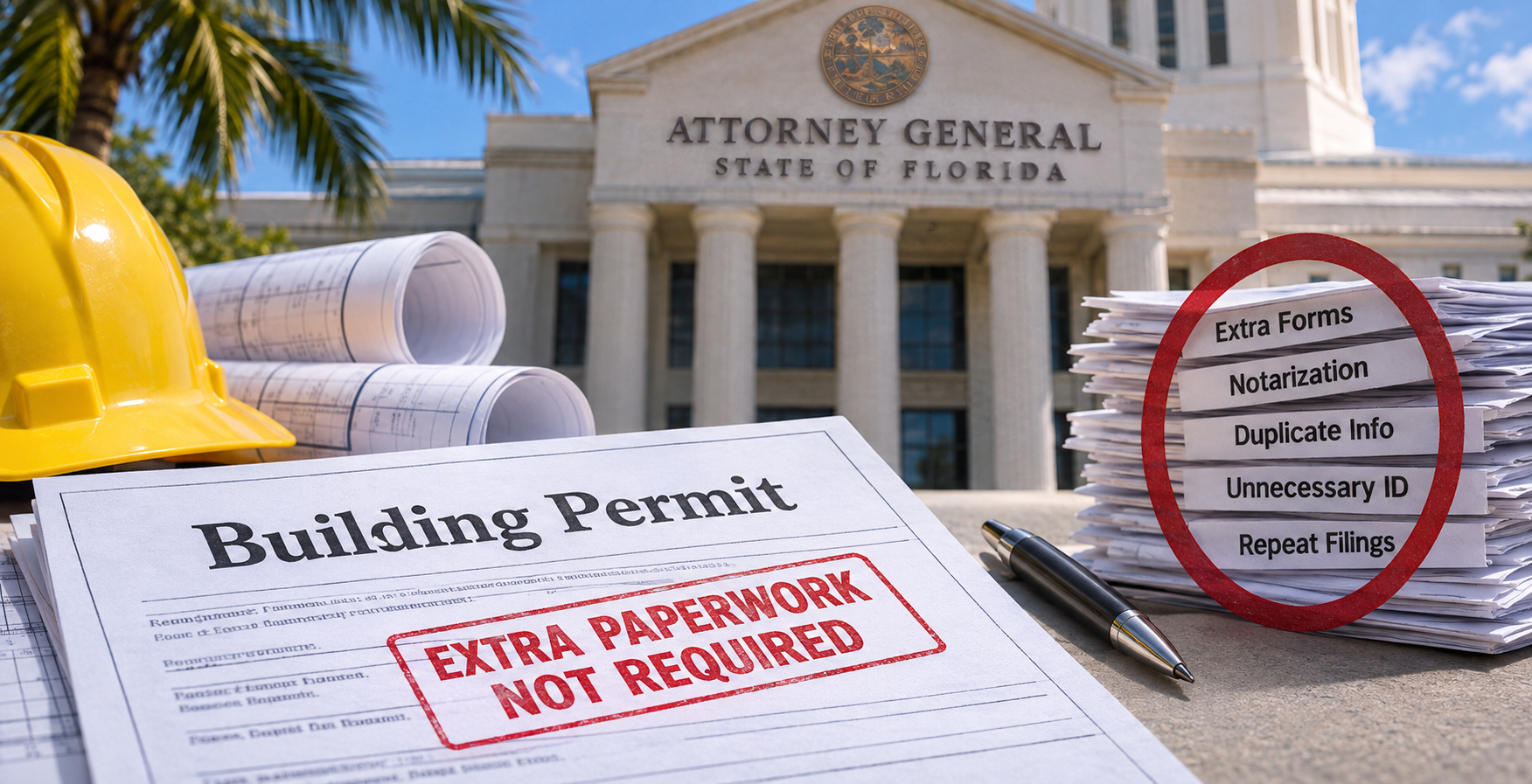
According to the opinion, local building departments cannot:
- Require their own authorization forms when the state-prescribed Notice to Building Official already satisfies the law.
- Reject a notice because it lists every qualified inspector associated with a private provider.
- Demand a full description of the contractor’s work when the statute requires only identification of the private provider’s services.
- Require notarization or original ink signatures when state law allows electronic submission.
- Demand personal identification, home addresses, birth dates or payroll information from a private provider’s authorized representative.
- Keep asking for insurance certificates and representative information already on file through the local registration process.
It’s the second time in four months the Attorney General’s Office has ruled against local restrictions on private providers. In July, as Red Tape Florida reported, Attorney General James Uthmeier issued an opinion barring duplicate inspections, unauthorized administrative fees and local requirements stricter than state law and concluded that improperly collected fees must be refunded. That opinion went after fees and duplicate work. This one goes after the forms, signatures and paperwork.
Both rest on the same provision: The private-provider statute prohibits local governments from imposing requirements more stringent than the ones it establishes.
Permitting delays don’t always come from complicated plans or short-staffed departments. Sometimes they come from extra forms, repeated information and requirements the law never called for. Each one costs contractors, property owners and government employees time, and those delays eventually show up in what homeowners, businesses and consumers pay.
The opinion doesn’t strip local building officials of their authority to enforce building codes or address legitimate safety concerns. Nor does it say every building department has been engaging in the practices it addresses. And attorney general opinions are advisory, not binding court decisions.
But the opinion gives property owners and private providers clear guidance when they run into these requirements, and it gives local governments good reason to review their procedures.
Florida lawmakers have repeatedly expanded the private-provider option to speed up permitting. The opinion makes the principle behind those changes plain: When the Legislature gives property owners an alternative to government inspections, local governments can’t undermine that choice with their own layers of bureaucracy.
For cities and counties serious about cutting permitting delays, their private-provider procedures are a good place to start.